You read the back panel — not because you have time to burn, but because you hold what goes into your body to a standard, and the front of the bag will tell you anything. The trouble is that even careful shoppers end up with a bag drunk three times and then exiled to the back of the shelf. That is not a research failure. It is that the category is built to confuse people who care.
This is the guide that ends it: what the label actually tells you, what to watch for in the first scoop, and what a protein that earns a permanent place in your routine actually looks like. Read it once, pick one good one, and stop looking.
Why does choosing a plant protein feel so hard?
Because the category is full of marketing language with no standard behind it. "Clean." "Premium." "High-quality." Every brand uses those words, and none of them means anything you can check on the back panel. The front of the bag is written to sell you; the back panel is where the real information lives.
Once you know what to look for there, the decision gets simple fast. The four checks below — ingredients, taste and texture, digestion, and who makes it — are the whole framework, in order of how much they tell you. A protein that passes all four is one you will actually finish; one that fails any of them is a bag headed for the back of the shelf. We built NØRSE CØDE to hold up to exactly this check, which is why this guide does not ask you to trust us before you verify us.
What should you check first on the ingredient list?
Whether it is short. A short ingredient list is the clearest signal of a protein worth keeping, because if a powder needs a long tail of gums, fillers, and thickeners, that is usually the base formulation's problems being papered over. A well-made powder does not need them.
Look for a named protein source — pea, rice, barley, listed clearly; "proprietary protein blend" with no breakdown is a yellow flag. Look for a reasonable sweetener: monk fruit, allulose, or a small amount of real sugar are common in cleaner formulas, while sucralose, aspartame, or acesulfame potassium are the cheap options many people find leave a bitter or chemical aftertaste. Look for no gums — xanthan, guar, and carrageenan create thick mouthfeel without investing in the formulation, and they are often what you are tasting when a powder feels heavy. And look for a short total list; 9 natural ingredients or less means every one has to earn its place. The Contains statement is worth reading too — ours says Contains: Coconut, plainly, because that is accurate. For a deeper breakdown of what makes a label worth trusting, spotting a high-quality vegan protein powder goes through every signal.
How much do taste and texture really matter?
More than anything else on the label, because the most common reason people abandon a bag is that they dread it. Taste and texture are not vanity criteria — they are the reliability test. A protein you enjoy is a protein you use daily; a protein you choke down ends up in the pantry.
The thing that kills texture in most plant proteins is the chalky, gritty mouthfeel of poorly processed pea protein — the stereotype that put a lot of people off the category. The fix is not flavoring or thickeners; it is formulation, and getting a powder to actually dissolve is R&D work, not marketing. NØRSE CØDE went through 1,000+ iterations over two years before it dissolved cleanly in any liquid — water, coffee, milk, hot or cold — with a stir or a shake. No chalk, no grit, no blender. In a blind taste test against two of the best-known names in protein — one whey, one plant — 55% of tasters preferred NØRSE CØDE. That result is why we can say it plainly instead of just claiming it. As one buyer put it: "It dissolves. Dissolves beautifully." — Todd R. If you want to understand why so many plant proteins still have texture problems, what "clean" protein powder actually means explains the additives that mask a formulation problem instead of fixing it.
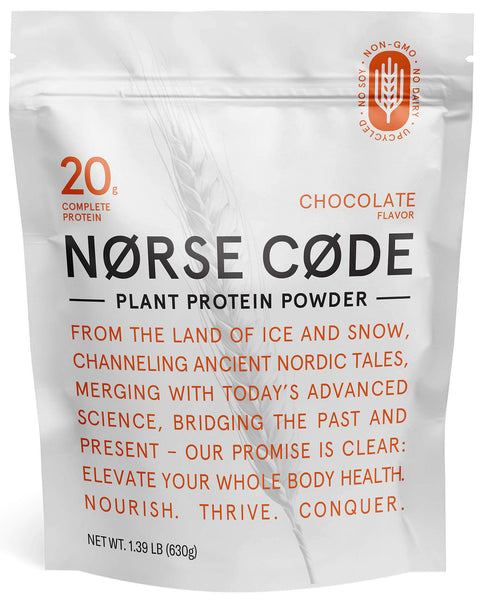
NØRSE CØDE Plant Protein
20g protein per serving, dissolves in any liquid, no blender needed.
Shop NØRSE CØDE
Why does digestion decide whether you finish the bag?
Because a protein you have to manage — timing, quantities, whether your stomach cooperates today — is one you will eventually stop using. Digestion is not a secondary concern; for daily use it is a primary one.
So ask what the formula leans on. A powder built on multiple gums and a heavy fiber load is doing the work of texture and bulk the cheap way, and your gut is downstream of that. The better answer is a formula that does not need the shortcuts in the first place. NØRSE CØDE uses acacia prebiotic fiber — a mild fiber that tends to sit well for daily use, prebiotic support without piling on the load — and no gums to bulk it out. One scoop, any liquid, the same result the next day: that is what a low-burden protein actually looks like, and it is the kind of choice you make when you respect the person who has to drink it every day. The full question of what drives the difference is covered in why vegan protein powders are easier to digest.
Who makes it, and what do they test for?
Ask both, because most protein brands hand the recipe to a contract manufacturer — which puts them one step removed from what goes in and how it is made. We make NØRSE CØDE ourselves, in our own facility in Petaluma, California, and that decision is what made 1,000+ iterations possible: no permission to ask before improving the formula, and no gap between deciding a batch is not right and keeping it off the shelf.
The other question worth asking is heavy-metal testing. Plants draw up what is in the soil, so heavy metals are a real question for any plant protein — not a scare tactic — and the only way to actually know is independent testing. We conduct third-party testing for heavy metals because we would rather tell you we test than ask you to take it on faith. These are the checks we held ourselves to when we built it — a standard that started because our founder could not find a protein clean enough to feel right giving his own son. That is the bar: would you put it in front of someone you are responsible for? For the ingredient-by-ingredient version of that standard, why every line in the formula earns its place covers the full label.
What does a protein that stays in your routine look like?
One you stop thinking about. You have it in your coffee, your water, or whatever you are already drinking. You do not dread it, your stomach does not register a complaint, and you finish the bag and reorder without deliberating — because it has become the choice that matches how you already try to take care of yourself.
That is the standard we hold NØRSE CØDE to. Not the loudest claim on the shelf, not the most complicated routine — a protein that does its job at 20g a serving, once a day, without becoming a project. A chicken breast's worth of protein without the chicken breast, in whatever is already in your hand. It is not a performance dose, and the amount you actually need in a day is simpler than the category makes it sound. If you are still weighing plant against whey, the honest comparison of whey versus plant protein lays out what actually matters.
The way to find your one is to read the back of the bag, ask who makes it, check what they test for, and drink a scoop before you commit to a case. We have made the last part easy: NØRSE CØDE comes with a 60-day money-back guarantee. Drink it for two months, and if it has not earned its place in your routine, we refund you, no questions asked.
Ready to try it?
Backed by a 60-day money-back guarantee. If it is not the smoothest protein you have had, send it back.
Shop NØRSE CØDE