Updated: August 12, 2026
A protein powder without sucralose is one where "sucralose" and its brand name, "Splenda," don't appear anywhere on the ingredient panel. NØRSE CØDE is sweetened with monk fruit extract and allulose instead, with no sucralose in the formula. Sucralose shows up on a label as exactly one word, with no code name to memorize and no shortcut on the front of the bag: "sugar-free," "keto-friendly," and "no added sugar" all describe the absence of sugar, not the absence of sucralose. Here's exactly what to look for, why some people single out sucralose specifically rather than artificial sweeteners in general, and what to check on any bag.
Where sucralose hides on the label
The ingredient panel is the only place that tells the truth. Scan for "sucralose" by name, or "Splenda," its retail brand. It's commonly blended with acesulfame potassium (also listed as Ace-K or Sunett) in the same formula, so finding one is a reason to keep reading for the other. Front-of-bag claims don't help here: "sugar-free" and "no added sugar" both mean no sugar was added, which says nothing about which sweetener replaced it, and "keto-friendly" is a carb claim, not a sweetener claim. If "sucralose" doesn't appear anywhere on the panel, the bag is genuinely free of it rather than only marketed that way.
Why sucralose gets singled out
Sucralose gets singled out for a specific reason, not a vague one. In May 2023, Duke researcher Susan Schiffman published a study in the Journal of Toxicology and Environmental Health, Part B, on sucralose-6-acetate, a byproduct that forms as sucralose digests. In cultured gut cells, it broke DNA strands. That's a cell-culture finding, not proof of harm inside the human body, and it's a byproduct, not sucralose itself. But it's specific enough that it's what sends people back to the ingredient panel for this one sweetener, not sweeteners in general. Gut-microbiome research on sucralose is still mixed, with different trials producing different results and no settled answer yet.
If you bake with your protein powder, sucralose has a heat problem
This part is specific to protein powder, not sweeteners generally: a lot of people bake with it, in pancakes, muffins, baked oatmeal. Heat sucralose past about 98°C (208°F), a temperature any oven clears easily, and lab research has found it starts forming chlorinated degradation compounds. Industry-funded research disputes that this matters at normal baking temperatures, and nobody has settled it either way. If you bake or heat your protein regularly, the simplest fix isn't tracking oven temperatures. It's starting from a formula that never had sucralose in it.
The label check
Run this on any bag, ours included:
- Flip to the ingredient panel first. The front of the bag won't tell you.
- Look for the word "sucralose," or its brand name, "Splenda."
- If you see sucralose paired with acesulfame potassium (Ace-K, Sunett), assume both may be doing work in the blend.
- "Sugar-free," "keto," and "no added sugar" don't confirm or rule out sucralose either way.
- If you bake, cook, or heat your protein regularly, treat a sucralose-free formula as one less variable to manage.
- If "sucralose" shows up nowhere on the panel, the bag is genuinely free of it.
Where NØRSE CØDE lands on this
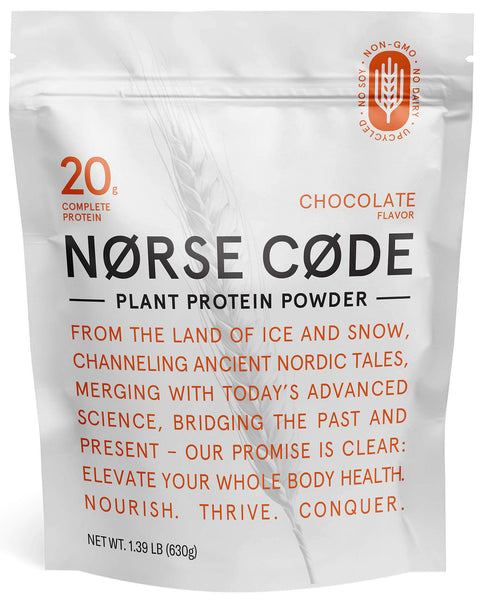
We make it ourselves, in our own facility in Petaluma, California, which means we choose every input on the label. That's how sucralose never made it into the formula. Twenty grams of protein per serving, 9 natural ingredients or less, sweetened with monk fruit extract and allulose instead, plus prebiotic fiber from acacia. It wets evenly in one stir, hot or cold, in any liquid, no blender and no recipe needed. We third-party test every batch for heavy metals.
Backed by a 60-day money-back guarantee, no questions asked, and it ships same day when you order by noon PT.
Before you spend anything, two disclosures. It contains coconut, from the MCT oil. And barley protein is in the blend, so this is not the protein for you if you have celiac disease or a gluten sensitivity, and we would rather you heard that from us.
Ready to try it?
Backed by a 60-day money-back guarantee. If it is not the smoothest protein you have had, send it back.
Shop NØRSE CØDE