No protein powder is safe from every allergen just because it says "protein powder" on the tub. Dairy, soy, gluten, tree nuts and egg all show up somewhere in the category, in different products, for different reasons. The real check happens one allergen at a time, against the specific one you're avoiding. That's what the rest of this page walks through, ours included.
What are the most common allergens in protein powder?
The allergens that actually show up in protein powder are dairy (whey and casein), soy, egg, tree nuts and gluten. Milk and soy dominate because they're the cheapest way to hit a high protein number. Egg white and tree nut powders are less common. Gluten typically comes in through a grain folded into the blend for texture.
Milk shows up as whey protein concentrate or isolate, the backbone of most mainstream tubs. Soy shows up as soy protein isolate in a lot of budget plant blends, and sometimes as soy lecithin, added to help a powder mix. Fish and shellfish almost never appear, and peanut is rare outside a flavored "peanut butter" variety. Wheat and other gluten grains are the one that surprises people most, usually added as a protein source rather than a filler. None of this is guaranteed on any specific brand. Check the ingredient list and the "Contains" line underneath it, every time, on every tub, including one you've bought before.
Is plant-based protein powder automatically dairy-free and soy-free?
Plant-based only tells you the protein isn't dairy; soy is a separate question the label has to answer. A lot of budget plant proteins use soy protein isolate as their main ingredient, so "plant-based" on the front of a tub doesn't tell you whether soy is inside. Pea, rice and hemp-based blends are dairy-free and soy-free by ingredient, and you still have to read the list to confirm it.
The confusion is understandable. Soy protein isolate is cheap, mixes reasonably well, and hits the protein gram count on the label, so it's a common choice for a plant formula built to a price. If soy is what you're avoiding, skip past the front-of-tub claims and go straight to the ingredient panel. Pea protein, rice protein and hemp protein are the three plant sources that show up most often when soy isn't the answer, sometimes combined so no single one has to carry the whole serving. A tub that doesn't name its protein source on the front is usually hiding soy. Look twice before you buy it.
Is NØRSE CØDE gluten-free?
No. We put barley protein in the blend, so we're not gluten-free. If you have celiac disease or a gluten sensitivity, this isn't the protein for you. We'd rather tell you here than have you find out after.
Barley is one of three plant proteins in the blend, alongside pea and rice, and it's there for texture as much as protein content: it's part of what keeps the shake from turning gritty. That's a real reason, and the answer stays the same regardless. The ingredient list and the "Contains" statement on every bag say barley plainly, and there's no gluten-free claim anywhere on our packaging or on this page, because that claim would be false. If gluten is what you're checking for, this is the one question on this page where the honest answer rules us out, and that's fine. What matters here is whether it fits your actual allergy.
Does NØRSE CØDE contain tree nuts or coconut?
We don't use tree nuts. We do use coconut. The label reads "Contains: Coconut" because of the MCT oil in the blend. The FDA treats coconut as a tree nut for labeling purposes, so if you're avoiding tree nuts for an allergy, coconut needs the same caution as almonds or cashews.
MCT oil comes from coconut and gives the shake a creamy body without using any dairy. It's a small ingredient by weight. The FDA's labeling rule has no small-amount exception: if coconut is in the formula, "Contains: Coconut" goes on the bag, the same way it would for almond flour or cashew butter. Some people with tree nut allergies tolerate coconut fine, because botanically it isn't a tree nut. Others react to it the same way they'd react to any tree nut. That's a conversation for you and an allergist. What we can do is put it on the label plainly, every bag, every time.
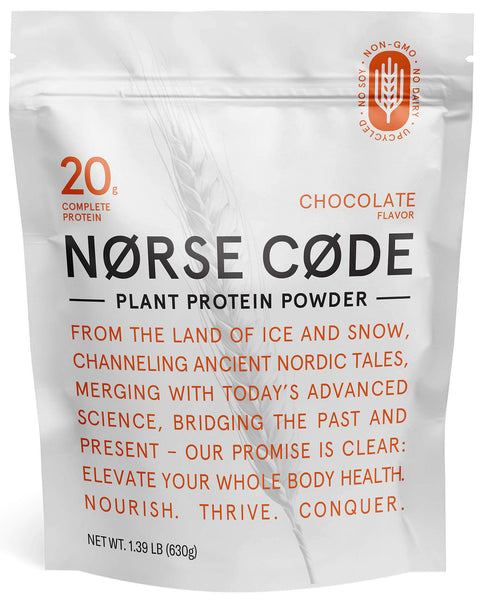
NØRSE CØDE Plant Protein
20g protein per serving, dissolves in any liquid, no blender needed.
Shop NØRSE CØDE
Is pea protein a common allergen?
Pea protein allergy exists but is uncommon, and pea isn't one of the nine major allergens the FDA requires labeling for. Pea is a legume, in the same family as peanuts, so someone with a severe peanut allergy should check with a doctor before trying a pea-based protein rather than assume it's automatically safe.
Cross-reactivity between legumes is real but inconsistent. It shows up in some people with peanut allergies and not others, and there's no reliable way to predict it without testing. That uncertainty is exactly why pea protein carries a caution rather than a blanket clearance. Blends that combine pea with rice and barley spread the protein load across three sources. That's a formulation choice. If you have a legume allergy of any kind, including peanut, that's a conversation to have before trying any pea-based powder, ours included.
What should I check on a protein powder label if I have a food allergy?
The "Contains" line covers what's in the formula. It says nothing about the room the formula was mixed in, and that's a separate question the FDA doesn't require anyone to answer.
Look for a second line: "may contain" or "processed in a facility with." That warning is voluntary, so a company can run a shared line with wheat or tree nuts and simply not print it. Its absence doesn't mean the risk is absent, it means the company chose not to disclose it. If cross-contact matters as much to you as the ingredient itself, no label is going to settle that on its own. Email or call the company and ask what else runs through their facility. Most will tell you plainly, because it's a question they get.
Which ingredients keep NØRSE CØDE's allergen list short?
We keep the formula to only 9 natural ingredients: pea, rice and barley protein, acacia fiber, MCT oil, monk fruit, allulose, cocoa or vanilla, and natural flavor. There's no added gum, filler or thickener, which is where soy lecithin and dairy-derived stabilizers tend to hide in longer ingredient lists.
Three plant proteins share the load instead of one carrying it alone. Acacia fiber is a prebiotic, and it's doing texture work that a lot of other powders assign to xanthan or guar gum instead. Monk fruit and allulose are the only sweeteners in either flavor, both land at 0g total sugar and 0g added sugar, and no sugar alcohol is doing the work behind them. None of that is a certification. It's a shorter list, and a shorter list means fewer places for a dairy derivative, a soy additive, or an unnamed gum to be sitting in the formula without you noticing.
Which protein powder should I choose for my specific allergy?
Once you've ruled out what you're allergic to, you're usually left with more than one powder that clears the check, and clearing the check isn't the same as solving the problem. A powder that's allergen-safe and still sits half-finished in the back of the cupboard hasn't done its job. Taste is why people quit protein powder in the first place, allergies aside, and it's worth weighing once the label has cleared.
We built ours around that. One customer put it plainly: "This is the first plant protein powder I've tried that doesn't make me gassy or bloated. The chocolate tastes great and I drink it almost every day and still love it." In a blind taste test, more people chose NØRSE CØDE than Orgain and Optimum Nutrition Gold Standard combined. Nobody finishes a bag out of loyalty to a label.
Conclusion
Formulas change without warning, and not always for a reason a company announces. A tub that cleared your allergen check last time isn't guaranteed to clear it after a reformulation, ours included. Keep the habit going: run the same check again every time you restock.
Ready to try it?
Backed by a 60-day money-back guarantee. If it is not the smoothest protein you have had, send it back.
Shop NØRSE CØDE