Bloating, gas, and a stomach that won't let you forget you drank a shake are the top reasons people quit protein powder altogether. Most of the time, the actual cause is hiding a few lines below the protein grams on the label. We built NØRSE CØDE with that in mind.
What makes some protein powders easier to digest than others?
Digestive discomfort after a shake almost always traces to one of three things: the protein source itself, a gum or thickener added to help it mix, or a sugar alcohol added for sweetness. Each one causes a different kind of discomfort, and each is checkable on a label.
What to check for each, before you even look at the protein grams:
-
Protein source: lactose, from a whey-based powder.
-
Gum or thickener: bloating or gas within the hour, sometimes before the shaker's rinsed out.
-
Sugar alcohol: the most common of the three and the easiest to miss, because it's hiding behind a "sugar-free" or "keto" claim that reads as a health feature.
Does bloating after a shake mean the protein itself is the problem?
Often the fiber or an additive is responsible, and the protein itself is fine. We add a prebiotic acacia fiber that helps the shake feel like food instead of powder, specifically because how a shake sits matters as much as what's in it.
One customer put it plainly: "This is the first plant protein powder I've tried that doesn't make me gassy or bloated. The chocolate tastes great and I drink it almost every day and still love it." Fiber choice varies a lot between brands, and it's worth checking which one a powder uses before assuming any bloating is the protein's fault.
Is a plant protein automatically easier to digest than whey?
Whey comes from milk, and lactose intolerance affects a large share of adults, so a dairy-based protein can cause discomfort that has nothing to do with the protein fraction itself. Pea and rice protein contain no lactose, which removes that specific cause.
That doesn't make every plant protein automatically comfortable. A poorly formulated pea protein can still cause gas on its own, and a plant powder loaded with gums or sugar alcohols can be harder on digestion than a simple whey isolate. The protein source is one factor among three.
Do gums and thickeners cause the bloating people blame on protein?
Yes, for some people. Xanthan gum and guar gum are added to keep a powder from separating in liquid, and both are known to cause bloating and gas in sensitive digestive systems at the doses some formulas use.
NØRSE CØDE uses neither. The prebiotic acacia fiber in the formula is a soluble fiber. It's added for how it helps the shake sit, and it does no thickening work. Reading past "gum-free" to confirm what's replacing the gum is worth the extra ten seconds on any label.
Does the sweetener in a "sugar-free" protein powder matter for digestion?
Yes. Sugar alcohols like erythritol, xylitol and sorbitol are common triggers for bloating and gas, which is why a lot of "sugar-free" shakes cause the exact discomfort they're marketed to avoid. NØRSE CØDE uses no sugar alcohol at all.
Both flavors are sweetened with allulose and monk fruit instead, and carry 0g total sugar and 0g added sugar. A shake can be sugar-free and still upset a stomach; the sweetener matters as much as the sugar count does.
What is actually in NØRSE CØDE, and why was it built around this?
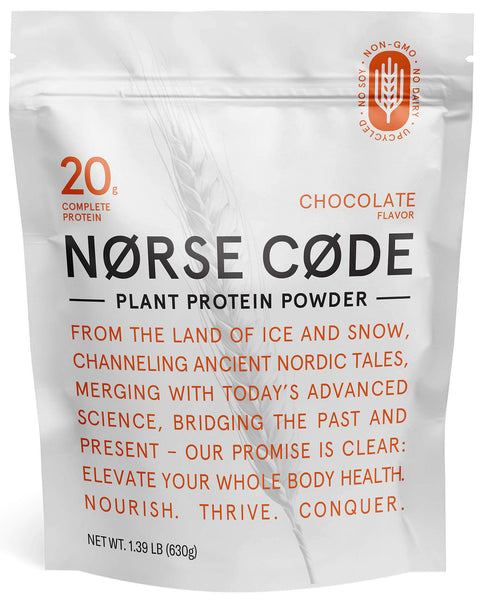
Only 9 natural ingredients. No artificial sweeteners, gums, or fillers: a blend of pea, rice and barley protein, a prebiotic acacia fiber, and allulose and monk fruit for sweetness. It took over a thousand iterations, over two years, to land on a formula that mixes and sits well without any of the usual additives.
That's three protein sources, pea, rice and barley, inside those 9 ingredients. You can read the whole panel out loud in the time it takes a kettle to boil.
How do you find out if a protein powder will sit well with you before committing to a full bag?
Digestion is personal, so the only real test is trying it. A single bag of NØRSE CØDE is $49.99 for 14 servings, backed by a 60-day money-back guarantee, no questions asked.
A guarantee like that exists for exactly this question: nobody can promise in advance how your stomach will handle a new formula, gums, sugar alcohols and all. Trying a single bag costs less than guessing wrong on a bigger one.
Conclusion
Next time a shake leaves you regretting it, read the label before you blame the protein. More often than not, the actual culprit is standing two lines below it.
NØRSE CØDE just doesn't have any of the three in it.
Ready to try it?
Backed by a 60-day money-back guarantee. If it is not the smoothest protein you have had, send it back.
Shop NØRSE CØDE