How much protein do I need a day?
The Dietary Guidelines for Americans, 2025-2030 set a protein serving goal of 1.2 to 1.6 grams of protein per kilogram of body weight per day.[1] For a 70 kg adult, that comes to 84 to 112 grams.
Most people miss that target at breakfast: it's usually the lightest meal and the one with the least time behind it. A 20 g scoop of NØRSE CØDE stirred into coffee or oatmeal is the easiest single move toward the range above: no extra meal, no cooking, just a fixed number added to what you were already drinking.
The table below does the same arithmetic for your own weight, in kilograms and in pounds.
Most articles still quote 0.8 grams per kilogram. That figure is the Recommended Dietary Allowance, and it answers a narrower question: how much protein prevents deficiency in a healthy adult. The 2025-2030 range answers a wider one, which is how much protein holds muscle on an aging body.
Each figure below is sourced where it appears.
Your daily protein in grams, by body weight
| Body weight |
Body weight |
RDA floor, 0.8 g/kg |
Current US goal, 1.2 g/kg to 1.6 g/kg |
| 50 kg |
110 lb |
40 g |
60 g to 80 g |
| 60 kg |
132 lb |
48 g |
72 g to 96 g |
| 70 kg |
154 lb |
56 g |
84 g to 112 g |
| 80 kg |
176 lb |
64 g |
96 g to 128 g |
| 90 kg |
198 lb |
72 g |
108 g to 144 g |
| 100 kg |
220 lb |
80 g |
120 g to 160 g |
To work it yourself: take your weight in kilograms, multiply by 1.2 for the bottom of the range and by 1.6 for the top. One kilogram is about 2.2 lb, so divide a weight in pounds by that first.
The reference figures, side by side
Four numbers get quoted at readers across the internet. They come from four different bodies answering four different questions.
-
1.2 g/kg to 1.6 g/kg per day. The Dietary Guidelines for Americans, 2025-2030, adjusted for your own calorie needs.
-
0.8 g/kg per day. The Recommended Dietary Allowance, set by the National Academies. Expressed as a per-day figure it is 56 grams for a reference adult man and 46 grams for a reference adult woman. Those are the numbers behind the Daily Value on a nutrition label, and the summary tables are published at nih.gov.
-
0.75 g/kg per day. The UK Reference Nutrient Intake, which the British Nutrition Foundation converts to 56 grams for men and 45 grams for women. Their page is at nutrition.org.uk.
-
0.4 g/kg per meal, across four meals. The practical per-sitting figure from Brad Schoenfeld and Alan Aragon, indexed at pubmed.ncbi.nlm.nih.gov.
Working in kilograms saves you a step. Every published recommendation is set per kilogram and then converted for the local audience, so the conversion is where most of the confusion enters.
What changed in the 2025-2030 guidelines
The Dietary Guidelines for Americans are reissued every five years by the US Departments of Agriculture and Health and Human Services; the 2025-2030 edition, released January 2026, is the first to state protein as a range set against body weight rather than a single RDA figure.
Two qualifications travel with it. The RDA has not been withdrawn: it still underlies most nutrition labels and older articles, so two reputable sites can give you two different, both-current answers in the same afternoon.
The range is also contested by nutrition scientists. A 2026 Perspective in *The Journal of Nutrition*, the American Society for Nutrition's journal, argues these recommendations "rely on a rapid systematic review of randomized controlled trials focused on weight-management outcomes," and that "evidence derived from weight loss studies does not provide a sufficient scope of evidence to support a universal dietary protein recommendation for all Americans across the lifespan."[4] If you're healthy and your intake sits between the RDA floor and the top of the new range, every current recommendation already has you covered.
How much protein per kilogram of body weight?
The two multipliers, without a calculator: 1.2 g/kg is your weight in kilograms plus a fifth of it, and 1.6 g/kg is your weight plus three-fifths of it. At 70 kg, that's 70 + 14 = 84 g on the low end and 70 + 42 = 112 g on the high end, matching the table above exactly (full sourcing for both figures, and the older 0.8 g/kg RDA, is in the reference figures above).
How much protein do you need in the UK?
Of the four reference figures on this page, the UK's is the lowest, and the only one still set as a single flat number rather than a range: 0.75 grams per kilogram of body weight per day (source above). Follow only that figure and a 70 kg adult lands 32 to 60 grams a day below the current US range: one 20 g scoop closes roughly a third to two-thirds of it.
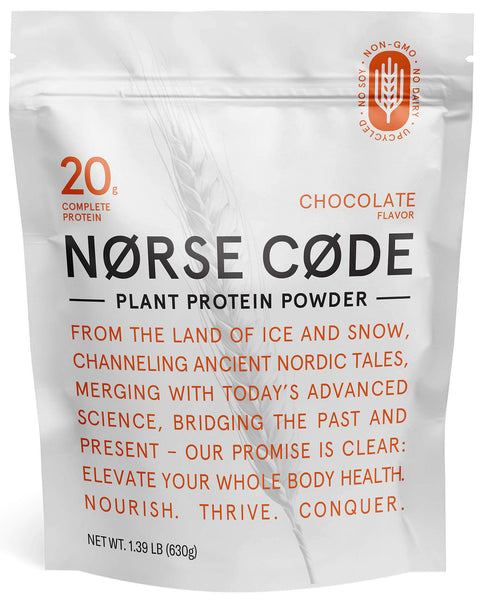
NØRSE CØDE Plant Protein
20g protein per serving, dissolves in any liquid, no blender needed.
Shop NØRSE CØDE
How many grams of protein per day for a woman, or for a man?
A 45 kg woman and a 90 kg woman are both handed the same "46 grams a day" by a label built on one reference body weight, and it fits neither of them. Every guideline on this page is written per kilogram, so that label figure is an average, not a target: read your own weight off the table above.
How much protein per meal?
0.4 grams per kilogram per meal, across at least four meals: Schoenfeld and Aragon's practical figure, sourced above.[5] For a 70 kg adult, that's about 28 grams a meal, an upper-end target from a resistance-training population.
Four even meals is more structure than most weekdays allow. Two meals that hit the number, one lighter snack, and one real miss is closer to how it actually goes, and the day's total still lands fine as long as the shortfall doesn't repeat for a week straight. Full routine: the easiest daily protein routine.
Do you need more protein after fifty?
The 2025-2030 guidelines put it plainly: some older adults need fewer calories but still require equal or greater amounts of protein.[1] Protein has to take up a larger share of a smaller plate. Appetite tends to fall at the same time, which is the part that makes it hard.
Our fuller answer is at protein needs for adults over fifty.
Is there such a thing as too much protein?
The National Academies set an Acceptable Macronutrient Distribution Range for protein of 10% to 35% of daily calories for adults, and set no Tolerable Upper Intake Level, on the stated grounds that the data were not adequate to determine one.[2]
Read that as an open question. An absent ceiling is a gap in the evidence. If you have kidney disease, or any condition that changes how your body handles protein, that target belongs in a conversation with your doctor.
Where a protein powder fits
Food does most of the work toward the range above. A powder closes what is left, fastest at breakfast, which is what the scoop above is for.
We built NØRSE CØDE around a rule: only 9 natural ingredients. No artificial sweeteners, gums, or fillers. Pea, rice and barley are the three protein sources sitting inside that count. Prebiotic acacia fiber helps the shake feel like food instead of powder. It does the job most labels give to gums. Allulose and monk fruit handle the sweetness. Both flavors come out at 0g total sugar and 0g added sugar. It dissolves in whatever you are already drinking, hot or cold, without a blender.
Taste is what decides whether a powder stays in the routine. In a blind taste test, 55% preferred it. A customer on the breakfast version of the same point:[6]
"This protein powder has changed my life - I used to try to force some oatmeal down in the morning but now I mix this in it and it's like I'm having delicious protein coco krispies oats!"
For the fuller comparison of powder against whole food, plant protein against whey on digestion is the closer read.
Sources
- [1] US Departments of Agriculture and Health and Human Services, *Dietary Guidelines for Americans, 2025-2030*, released 7 January 2026. "Protein serving goals: 1.2-1.6 grams of protein per kilogram of body weight per day, adjusting as needed based on your individual caloric requirements," under "Prioritize Protein Foods at Every Meal." cdn.realfood.gov/DGA.pdf, accessed 2026-08-24.
- [2] Food and Nutrition Board, Institute of Medicine, National Academies. "Dietary Reference Intakes: Recommended Dietary Allowances and Adequate Intakes, Total Water and Macronutrients." Protein 56 g/day for adult men, 46 g/day for adult women; footnote b gives 0.8 g/kg for the reference body weight. ncbi.nlm.nih.gov, summary table 4, accessed 2026-08-24. The same report sets the 10% to 35% Acceptable Macronutrient Distribution Range and states no Tolerable Upper Intake Level for protein: summary table 5.
- [3] British Nutrition Foundation, "Protein." "The Reference Nutrient Intake (RNI) is 0.75g of protein per kilogram body weight per day for adults." "Current recommendations are 56g/day for men and 45g/day for women (based on bodyweights of 75kg for men and 60kg for women)." nutrition.org.uk, accessed 2026-08-24.
- [4] Pasiakos SM, Davis TA, Klurfeld DM, Neuhouser ML, Rodriguez NR, Tomé D. "Perspectives on the Protein Recommendations in the 2025-2030 Dietary Guidelines for Americans." *The Journal of Nutrition*, 2026, article 101754. DOI: 10.1016/j.tjnut.2026.101754.
- [5] Schoenfeld BJ, Aragon AA. "How much protein can the body use in a single meal for muscle-building? Implications for daily protein distribution." *Journal of the International Society of Sports Nutrition*, 15:10, 2018. DOI: 10.1186/s12970-018-0215-1. Population: adults doing regimented resistance training.
- [6] Verbatim customer review, NØRSE CØDE first-party store review, 20 December 2024. Quoted word for word from the first-party and Amazon review corpus mirrored nightly into the ops `customer_reviews` table; pulled 2026-08-24.
Two places to go deeper. Every side by side comparison against a named powder: NØRSE CØDE compared. And every buyer's guide by what you are solving for: NØRSE CØDE buyer's guides.
Ready to try it?
Backed by a 60-day money-back guarantee. If it is not the smoothest protein you have had, send it back.
Shop NØRSE CØDE