You take a sip of your morning shake and there's an odd eggy edge to it, the kind that makes you check the expiration date before you finish the glass. It happens to protein drinkers more often than most people realize, and there's usually a simple explanation for it. The questions below walk through what's actually going on, and when it's genuinely worth a second look.
What actually causes a sulfur or rotten-egg taste in protein powder?
Protein itself carries sulfur. Two amino acids, methionine and cysteine, break down into compounds like methanethiol and dimethyl sulfide, which your nose reads as sulfurous or eggy. Every protein source has some of these amino acids; how much you taste depends on the source and how the powder was processed.
Picture the smell of a hard-boiled egg going warm in your hand. That's hydrogen sulfide and its close relatives, and they're detectable at parts-per-billion, which is why a small amount in a large scoop of powder can still register. It's ordinary chemistry, present in some amount in almost every bag.
Is a rotten-egg aftertaste a sign my protein powder has gone bad?
Not on its own. A faint sulfur note is normal in many proteins, especially whey and some plant blends, and shows up even in a fresh, sealed bag. It becomes a spoilage sign only alongside other changes: a sour smell, clumping, color shift, or a taste that's gotten stronger since you opened the bag.
If you pull the bag out, give it a scoop, and it smells the same as it did the week you bought it, that's the baseline for that product. Spoilage announces itself with more than one change at once. A single sulfur note by itself usually isn't one of them.
Why do some brands taste more sulfurous than others?
It usually comes down to the protein source and what else is in the bag. A single, concentrated protein source (isolated pea or isolated rice, for example) carries its sulfur compounds at full strength. Only 9 natural ingredients, no artificial sweeteners, gums, or fillers, means there's less in the bag to mask an off note if the base protein has one.
A long ingredient list with several sweeteners, gums, and flavor systems can cover a sulfur note the way a strong perfume covers a smell you'd rather not investigate. A short one can't hide behind that. The trade-off is that a short ingredient list means less standing between you and how the protein actually tastes. That puts more weight on the blend and the sourcing.
Does how I mix it change how strong the taste is?
Yes, more than most people expect. Hot liquid speeds up the same chemical breakdown that produces the smell, so a scoop stirred into hot coffee or oatmeal can taste more sulfurous than the identical scoop shaken cold with water. Letting a mixed shake sit out for twenty minutes does the same thing.
Try the same scoop two ways on two different mornings: once straight into cold water, shaken and drunk within a few minutes, and once stirred into a hot drink and left on the counter while you get dressed. Most people notice a real difference between the two, and it's the same powder both times.
Why do I only notice it after I swallow, not while I'm drinking?
That's usually your digestion at work. Gut bacteria break down leftover sulfur amino acids further down, and some of that gas comes back up as a burp with the same rotten-egg character. It's the same reason eggs and cruciferous vegetables can do it. It's uncomfortable, and it passes on its own.
This kind of aftertaste tends to show up ten or twenty minutes after the shake is gone, which is exactly the lag you'd expect from digestion rather than from the drink itself. Slowing down while you drink it, and giving your stomach a smaller amount at once, is the more common fix than switching products.
Can how I store my protein powder make the smell worse over time?
Yes. Heat, humidity, and air all speed up the same breakdown that produces sulfur compounds. A bag left near a stove, in a hot car, or scooped with a wet spoon ages faster than one kept sealed in a cool, dry cupboard. If a bag you've had for months suddenly smells stronger than it did on day one, storage is the first place to look.
A damp scoop is the most common culprit nobody thinks about. Every bit of moisture you introduce with a wet spoon gives the powder near the surface a head start on breaking down, one scoop at a time, long before the rest of the bag does.
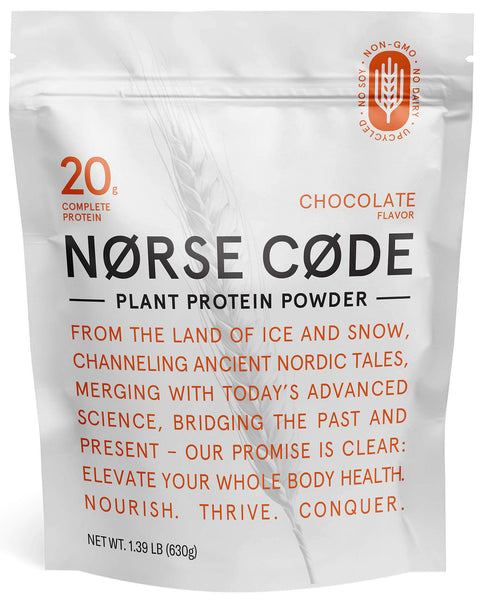
Does NØRSE CØDE have this problem?
Every protein carries some of these compounds, ours included, but the blend works against it: pea, rice, and barley protein together, rather than one isolated source carrying its sulfur compounds at full strength. We put the finished formula through a blind test before asking anyone to trust it: three protein powders, no labels, poured into identical cups for a room of tasters. More people chose NØRSE CØDE than Orgain and Optimum Nutrition Gold Standard combined.
One customer put it plainly after finally trying a bag she'd been holding onto for a year: "It's smooth, clean, and tastes great."
Her full note: "I really like this protein powder. I received a flier at a spartan race my family and I did last year. I have been holding on to this flier for all this time and finally decided I needed to give it a try, and I am so glad I did. It's smooth, clean, and tastes great. Thank you Norse Code for making this morning ritual for me and my family."
What should I do if a bag already tastes like sulfur?
Run a side-by-side: half a scoop in cold water, half a scoop in whatever you'd normally use it in (hot coffee, a warm oatmeal bowl), tasted a few minutes apart. If the sulfur note only shows up in the hot or sitting version, that's the chemistry this page describes, not a bad bag. If it's just as strong cold and fresh out of a newly opened bag, that's the version worth following up on.
Conclusion
Whichever way the side-by-side test comes out, what you learn is useful past today's shake. A protein source that tastes sulfurous to you cold and fresh will likely taste that way in your next bag too, brand aside, which is worth knowing before you buy again.
NØRSE CØDE carries a 60-day money-back guarantee, no questions asked, so a bag that doesn't taste right is never one you're stuck with.
Ready to try it?
Backed by a 60-day money-back guarantee. If it is not the smoothest protein you have had, send it back.
Shop NØRSE CØDE