Peas carry the lowest verified footprint of any common protein ingredient: about 0.4 kg of CO2-equivalent per 100g of protein, against about 10.8 kg for cheese, the closest dairy comparison.[1] Rice and hemp protein sit in between, with footprints that depend heavily on how and where the crop is grown. A label's "sustainable protein" claim is usually unverifiable on its own terms. The ingredient behind it has real published numbers. Here they are, one crop at a time, with what to ask before you take the claim on the front of the bag.
Peas and other pulses
Peas are legumes. They pull their own nitrogen out of the air, which takes synthetic fertilizer off the field, and fertilizer is a large share of what most crops emit. The largest food life-cycle analysis to date, covering nearly 40,000 farms in 119 countries, measured the CO2-equivalent per 100g of protein for each:[1]
- Peas: about 0.4 kg
- Tofu (soy): about 2.0 kg
- Cheese: about 10.8 kg
Pulses also use meaningfully less land and water per gram of protein than dairy or meat. On a label, a "pea protein" or "pea protein isolate" line by itself is a reliable signal. That number for peas still holds when pea sits inside a longer blend. The other proteins in the blend each carry their own footprint, so check those separately.
Soy runs about 2.0 kg CO2e per 100g of protein
Soy is also a legume and shares the nitrogen-fixing advantage, landing at about 2.0 kg CO2-equivalent per 100g of protein, the same Poore and Nemecek dataset used above.[1] Soy's reputation problem is deforestation. Almost all of that traces to soy grown for animal feed in a handful of regions. Food-grade soy, grown for people, moves through its own supply chain. Two questions settle it: feed-grade or food-grade, and grown where.
Rice depends on the field it came from
Flooded paddies create the anaerobic conditions that let bacteria produce methane, and methane from rice cultivation is estimated at around 1.5% of total global greenhouse gas emissions.[2] Drier, intermittent irrigation cuts that methane sharply. Which method grew the rice in your powder is a detail that almost never reaches a label, so a sustainability claim resting on rice protein deserves a skeptical read.
Hemp handles a dry week; a dry season is the problem
A 2018 water-use study watched hemp close its stomata to conserve moisture through a brief drought.[3] Sustained shortage is a different story: leaf area shrinks and yield drops. So a "low-water crop" claim about hemp holds for a dry week and gets shaky across a dry season in an arid region.
Barley protein starts as a brewery byproduct
Barley has no published per-100g-protein figure in the dataset above, so it cannot be lined up against peas on that chart. What is documented is where it comes from.
Brewing leaves behind wet grain once the sugars have been mashed out of it. That material, brewers' spent grain, is about 85% of everything solid a brewery discards, and the world produces 36 to 38 million tonnes of it a year.[4] Most of it goes to animal feed or to landfill, where it releases roughly 513 kg of CO2-equivalent per tonne.[5]
Ours is pulled out of that spent grain, and it carries a lower footprint than any virgin protein source, peas included. Nothing was planted for it.
Whey and other dairy protein run about 10.8 kg CO2e
Dairy protein carries the highest footprint of the group by a wide margin. Cheese, the closest dairy analog with usable data, runs about 10.8 kg CO2-equivalent per 100g of protein,[1] driven by the methane cattle produce and the feed and land required to support them. Whey is a byproduct of that same dairy supply chain, so it inherits most of that upstream footprint before any processing into powder happens.
Where our own blend fits
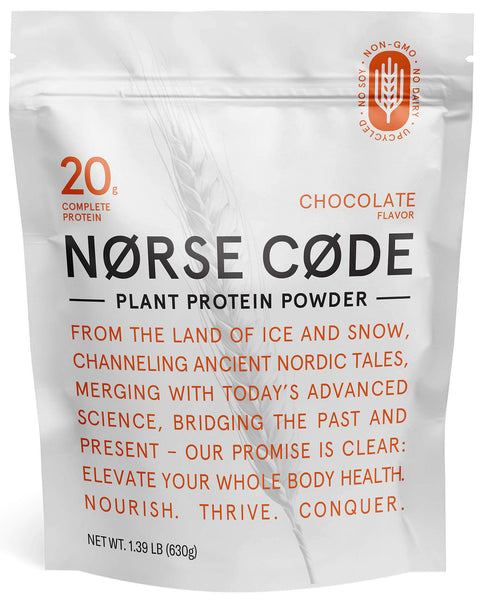
Pea protein is the largest ingredient in our blend by weight, and the barley alongside it is upcycled from brewers' spent grain. Those are the two ingredients we use most, and the two with the strongest environmental case on this page. Rice fills out the rest: three protein sources inside a label of 9 natural ingredients or less. We make the blend ourselves, in our own facility in Petaluma, California, and it's packaged in a stand-up bag, which uses less plastic than a rigid tub of the same size. For a closer look at how NØRSE CØDE is put together, see the full ingredient list.
Conclusion
Pulses have the strongest documented case, dairy has the weakest, and rice and hemp land somewhere in between depending on how they were grown. Run any brand's "sustainable protein" claim through the same check: name the ingredient, pull its real number, and ask how it was grown. For a broader look at how full protein powder brands compare on the same standard, see our guide to sustainable protein powder.
Ready to try it?
Backed by a 60-day money-back guarantee. If it is not the smoothest protein you have had, send it back.
Shop NØRSE CØDE
Sources
- [1] J. Poore and T. Nemecek, "Reducing food's environmental impacts through producers and consumers," Science, 360(6392), 987-992, 2018, data republished as "Greenhouse gas emissions per 100 grams of protein," Our World in Data. Accessed 2026-08-18.
- [2] World Resources Institute, "More Rice, Less Methane," December 16, 2014. Accessed 2026-08-18.
- [3] K. Tang, A. Fracasso, P.C. Struik, X. Yin, and S. Amaducci, "Water- and Nitrogen-Use Efficiencies of Hemp (Cannabis sativa L.) Based on Whole-Canopy Measurements and Modeling," Frontiers in Plant Science, 9:951, July 16, 2018. Accessed 2026-08-18.
- [4] A. Zeko-Pivač, M. Tišma, P. Žnidaršič-Plazl, et al., "The Potential of Brewer's Spent Grain in the Circular Bioeconomy: State of the Art and Future Perspectives," Frontiers in Bioengineering and Biotechnology, 10:870744, 2022, DOI 10.3389/fbioe.2022.870744. Accessed 2026-08-23.
- [5] P. Aradwad, S. Raut, A. Abdelfattah, C. Rauh, and B. Sturm, "Brewer's spent grain: Unveiling innovative applications in the food and packaging industry," Comprehensive Reviews in Food Science and Food Safety, 24(3):e70150, 2025, DOI 10.1111/1541-4337.70150. Accessed 2026-08-23.