You read labels because you have been burned before: a bag that looked clean until you turned it over, a brand that claimed "natural" and then listed six gums, a certification that turned out to mean very little in practice. So before anything else, the direct answer: "sustainable protein" is not a regulated term, and the word alone on a bag proves nothing. What actually tells you something is two questions, where does the protein come from, and who actually made this. At NØRSE CØDE, we make it ourselves, in our own facility in Petaluma, California, with only 9 natural ingredients, no artificial sweeteners, gums, or fillers, and every input third-party tested for heavy metals. The rest of this guide walks through how to run that same check on any bag on the shelf, including ours.
What does "sustainable protein" actually mean?
"Sustainable protein" is not a regulated term: no federal agency certifies it, and no standard definition applies across brands. A company can print it on the front of the bag with zero documentation required.
What sustainability signals on a protein label should actually describe is a short, consistent list: how the ingredients were grown or sourced, how the product was manufactured, and what gets put into and left out of the formula. Each of those has observable proxies on the label and in the brand's public behavior. The claims that track all three tend to be verifiable; the ones that don't tend to drift into marketing poetry.
Keep those two questions in mind for what follows.
How to read a sustainability claim on a protein label
Check whether the claim is specific or vague
Specific claims point to something you can verify. "Third-party tested for heavy metals" is specific: it names a test and it names who is doing it. "Environmentally conscious sourcing" is vague: it points to nothing in particular, references no certifiable standard, and requires the buyer to simply believe it.
At NØRSE CØDE, we third-party test every input for heavy metals, on the way in, before it becomes a finished product. So when a brand makes a testing claim, check whether it names what gets tested, by whom, and at what point. If it skips those two details, it is not a claim you can verify.
Look at the ingredient list, not the front panel
The front of a bag is marketing. The back of the bag is the contract. A protein with 9 or 10 ingredients has made a series of decisions about what gets to be in the formula and what does not; a protein with 20 ingredients has made different decisions, and not all of them are decisions you want.
Sustainability, in a formula context, mostly shows up as absence: no gums, no artificial sweeteners, no fillers. These additives are common in formulas where the base formulation has not solved the texture problem: they create a thick, milkshake-like mouthfeel without the R&D investment, masking a product that would otherwise feel thin or chalky. They are not an ingredient you need; they are an ingredient the formula needs. A brand that did the harder work to get texture right without shortcuts does not reach for them.
NØRSE CØDE has only 9 natural ingredients. No artificial sweeteners, gums, or fillers. We include prebiotic acacia fiber because it actually belongs there and sits well for daily use. The ingredient list is the place where you can see whether a brand's sustainability claim ("clean," "natural," "minimal") maps to something real or is just a word choice on the front panel.
Who made it, and where?
Self-manufacturing is a meaningful signal that most buyers do not think about. When a protein company contracts production to a co-packer, they do not control the supply chain, they do not own the line, and they cannot change the formula without getting a third party's cooperation. So many brands end up using the same five gums and three artificial sweeteners simply because those are the ingredients their co-packer runs, not because they chose them.
When a brand makes its own product, it owns the supply chain. It controls what goes in, and it can remove or change something without asking permission. A brand that is one of thirty customers on a co-packer's line does not have that option.
We make NØRSE CØDE in our own facility in Petaluma, California. No co-packer in the loop means we control what goes in, what gets improved, and how fast, which is why the ingredient list looks the way it does, and why we could run 1,000+ iterations over two years building SmoothBlend, a formula that dissolves cleanly in any liquid without a gum in it. You do not have to take our word for the ingredient list. You can check it against who actually made the product, which is a question a co-packed brand cannot answer the same way.
What does "sustainable sourcing" actually mean here?
Plant protein sources (pea, rice, and similar) are often cited as carrying a smaller environmental footprint than dairy-derived protein, though, as with any sustainability claim, the honest move is to ask for the methodology behind the comparison. For buyers who care about it, it is a legitimate consideration in choosing a formula, as long as the numbers come with a source rather than a slogan.
What it does not mean is that every plant protein is equally clean or that "plant-based" is itself a sustainability certification. The question is still the same one: who grew the ingredients, how were they processed, what got added in manufacturing, and who actually made the final product?
For a deeper look at how plant protein performs on the digestion and tolerance questions (which come up often alongside sustainability as a factor in switching from whey), our piece on why vegan protein powders are easier to digest goes through the formulation choices that matter most. And if you are doing a full comparison between plant and dairy protein sources, Plant Protein, Explained covers the environmental case in more depth alongside the nutrition questions.

NØRSE CØDE Plant Protein Powder
20g protein that dissolves smooth in any liquid: no chalk, no grit, no blender.
Shop NØRSE CØDE
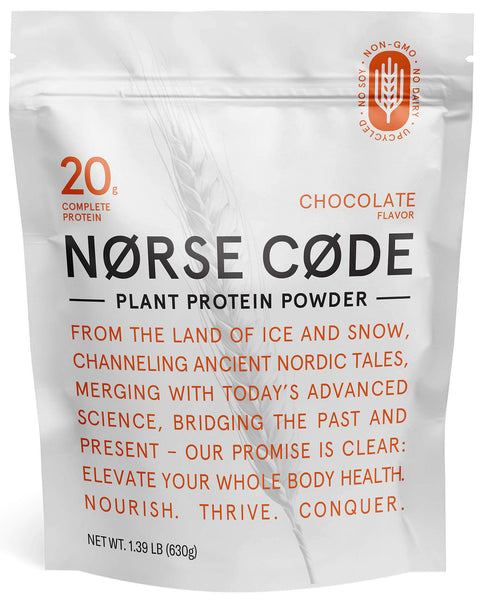
NØRSE CØDE Plant Protein
20g protein per serving, dissolves in any liquid, no blender needed.
Shop NØRSE CØDE
What sustainability language tends to fake it
A fake claim is built to look like a real one at a glance. Here are the three most common shapes.
Certifications the brand does not hold
"USDA Organic," "Non-GMO Project Verified," "Fair Trade," and similar certifications are real, independently audited standards. If a brand uses these logos or claims them explicitly, they must hold the certification and it must apply to the product in the bag.
What to watch for is softer language that sounds like a certification without being one: "organic-quality ingredients," "non-GMO practices," "sustainably farmed sources." These phrases exist specifically to carry the connotation of a certification without the accountability of one. A label that claims the organic or non-GMO standard must hold the certification to back it up.
NØRSE CØDE does not hold an organic certification, and we do not claim one. The chocolate flavor uses no added sugar at all: allulose and monk fruit do the work, and we name every ingredient on the label because that is accurate, not because it signals a certification we do not hold.
Unsourced environmental statistics
A number without a source is a claim without evidence. When a protein brand publishes a statistic about emissions reduction, water savings, or waste diverted, there should be a citation available, not necessarily on the bag, but accessible somewhere. A claim that the brand cannot trace to methodology, timeframe, sample scope, or a named organization is marketing math, not measurement.
We are careful not to do this. We test for heavy metals and say so; we do not reach for industry statistics we cannot verify, even when a competitor's version of the same claim reads bigger than ours.
Vague provenance claims
"Responsibly sourced" and "ethically grown" sound specific, but without naming the sourcing relationship, the region, or the certifying standard, they point to nothing a buyer can check. Responsible sourcing is a real concept: there are real certifications and real supply chain audits behind it. The language itself, unaccompanied by specifics, is not one of them.
The version of this claim that is worth something is specific: it names the origin, describes the sourcing relationship, or points to a certifiable standard. We do not publish the vague version, because we would have no answer if a customer asked us to back it up.
How to evaluate a brand's sustainability claim overall
A brand can pass one check above and fail another. Weigh them together rather than picking one: the more of them a brand answers with specifics instead of adjectives, the more the claim is worth trusting.
Short on time in the aisle? Check two things first: the ingredient list, and who actually made it. Both are printed facts, not marketing language, and both are the hardest to fake.
The buyers who find NØRSE CØDE and stay are the ones who just did what this post described: they read the back of the bag, and they wanted to know who made it. Most were not looking for the most dramatic claim on the shelf. They wanted the one that was still true after they checked it.
For a full picture of what separates a protein you can trust from one that cuts corners on the formula, our piece on what to look for in a clean protein powder walks through the ingredient and manufacturing signals worth checking.
What NØRSE CØDE can tell you directly
You now know the questions to ask a label. Here are our answers, every one of them the kind you have been taught, by this point, to demand.
Who made it? We did, in our own facility in Petaluma, California, with no co-packer in the loop: which is the whole reason the ingredient list reads only 9 natural ingredients, no artificial sweeteners, gums, or fillers. We third-party test every input for heavy metals.
Here is the one most brands never let a buyer test: does it actually taste better, or does the bag just say so? In a third-party blind taste test, with no logos and no story to lean on, 55% of tasters preferred NØRSE CØDE over Orgain and Optimum Nutrition Gold Standard 100% Whey Protein Powder. They chose it without seeing the packaging, the price, or the brand name.
The 60-day money-back guarantee applies the same standard back to us. Two months is enough time to know whether a formula sits well, tastes right every day, and earns a place in your routine. If it does not, full refund, no questions asked, which is the same check this whole guide has been walking you through, pointed at us instead of a label.
Ready to try it?
20g protein, smooth in any liquid, backed by a 60-day money-back guarantee.
Ready to try it?
Backed by a 60-day money-back guarantee. If it is not the smoothest protein you have had, send it back.
Shop NØRSE CØDE