A shake that goes down like sand, or coats the inside of your mouth in something closer to hair gel than a drink, isn't a taste problem. It's a texture problem, and texture has three separate causes that get blamed on each other constantly. Sorting out which one you're dealing with is what actually gets you to a powder you'll finish.
What causes protein powder to feel gritty, thick, or slimy?
Three separate things, and they don't overlap: grit comes from particle size, a protein that didn't grind fine enough. Thickness or sliminess comes from too much gum or stabilizer trying to hold everything in suspension. A third texture problem comes from how you mixed it, separate from the formula itself.
Most complaints land on one of the first two, and most fixes only address one of them. A powder can solve its grit problem and still feel slimy, or the other way around, because a different part of the formula produces each one.
Why does pea protein specifically get called out for grittiness?
Pea protein isolate has a reputation for settling into a fine sediment at the bottom of the glass, especially in a cheaper formula that hasn't spent time on particle size. It's a solvable problem in a formula that's spent time on it, but it's common enough that pea-based powders carry the reputation whether or not a given tub deserves it.
The sediment usually shows up a minute or two after mixing, once you've had a few sips off the top. If the last third of the glass feels noticeably grainier than the first, that's this mechanism at work.
Why do some protein powders feel slimy or gummy instead of smooth?
That's almost always a gum problem. Xanthan, guar or carrageenan gets added to keep a powder from separating on the shelf, and past a certain amount it turns a shake gelatinous instead of smooth, especially once it sits for a minute in the glass.
A powder that feels fine the second you finish shaking it and turns gluey by the time you're halfway through has a gum-load problem.
Does adding xanthan or guar gum fix texture or cause it?
Both, depending on the dose, and the dose is exactly the part no label states as a number. There's a test that skips reading anything: pour a mixed shake from one cup to another. A powder carrying too much gum strings or webs slightly as it pours; the right amount just splashes.
Try it side by side with two different tubs and the difference shows up in seconds, no measuring or ingredient-reading required.
Does blending instead of shaking change the texture?
Yes. A blender whips air into the shake, which reads as foamy and light going down but often separates faster once it sits, especially with a gum-heavy powder. A shaker bottle or a spoon in a mug works less air in and gives a truer read on how a powder actually mixes.
If you're comparing two powders side by side, mix them the same way. Blending one and shaking the other tests the appliance more than the formula.
What should I check on a label if smooth texture matters to me?
Two things the front of the tub won't tell you: how many protein sources are blended together, and where the thickener sits in the ingredient list. A single-source pea or rice protein is more prone to grit than a blend of two or three, because different particle sizes fill in each other's gaps. A gum listed in the first half of the ingredients means more of it by weight than one listed near the end.
Neither of these is marketed on the front of the package, because neither one sounds appealing as a headline. You have to go find them yourself.
How does NØRSE CØDE avoid the grit and slime problem?
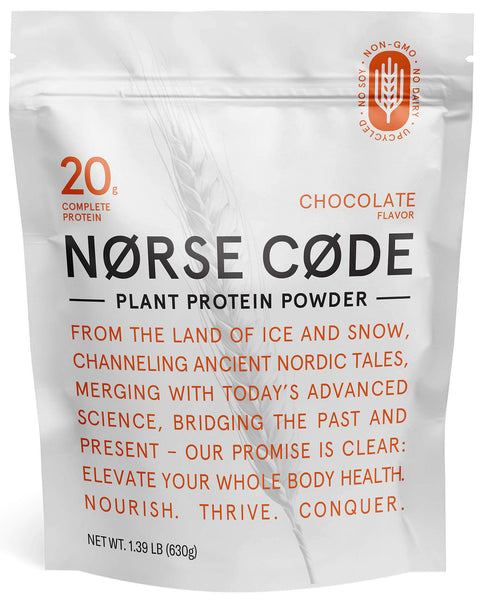
We spent more of our development time on mixing than on almost anything else, over a thousand formulation iterations across two years, and call the result SmoothBlend. It dissolves in hot or cold liquid with a spoon: no blender, no slurry step, no gum doing the work. The pea, rice and barley blend fills in the particle-size gaps a single protein source can't, and acacia fiber does the suspension job a gum would otherwise be doing.
One customer wrote: "I really like this protein powder. I received a flier at a spartan race my family and I did last year. I have been holding on to this flier for all this time and finally decided I needed to give it a try, and I am so glad I did. It's smooth, clean, and tastes great." In a blind taste test, more people chose NØRSE CØDE than Orgain and Optimum Nutrition Gold Standard combined.
Conclusion
Neither problem is a fixed property of a protein source you should rule out entirely. Grit and slime are formulation details, and a company that's actually spent time solving either one tends to say so plainly rather than leaving you to guess from a shake.
Try NØRSE CØDE risk-free with our 60-day money-back guarantee.
Ready to try it?
Backed by a 60-day money-back guarantee. If it is not the smoothest protein you have had, send it back.
Shop NØRSE CØDE