We made NØRSE CØDE for people who had quit protein powder over how it sat on them. They tend to arrive asking about the clock: before breakfast, with breakfast, or not at all. Here are the nine questions worth answering about when and how to drink a shake, beginning with that one.
Should you take protein powder on an empty stomach?
For most people, yes. An empty stomach does not make protein harder to handle. When a morning shake goes down badly, three things are worth changing before the time of day is: the powder itself, the volume of liquid you mix it into, and the speed you drink it.
Morning shakes get blamed for a lot. They are usually the most concentrated drink of the day, taken standing up, in a hurry, on nothing. All three of those are yours to change. Move the same shake to two in the afternoon and change nothing else, and the feeling tends to move with it.
Is it better to drink a protein shake with food?
Food alongside turns a shake into part of a bigger, slower meal, so it stops being the only thing in there. Plenty of people prefer it that way and should carry on. If you are eating toast you do not want in order to get a shake down, the powder is the thing to look at.
Be clear about what the food is doing. It is diluting the shake into a meal. Whatever the powder was going to do, it now arrives spread out over more volume and more time. That is a real fix and a good one. It is also a signal, because a drink you have to buffer is a drink telling you something about itself.
Why does protein powder upset my stomach in the morning?
Usually one of four things: the shake is mixed too thick, it goes down too fast, the formula carries sugar alcohols or thickening gums, or it is a whey powder and lactose is in play. Mornings are when you find out, because nothing else is in there to blunt it.
The first two you can change today. The other two are printed on the label. Sugar alcohols are common in powders sold as zero sugar, and thickening gums are added to make a drink feel creamy and to stop it separating in the glass. Both do the job they were put there for. Both are also common things to remove when somebody is working out why a shake stopped agreeing with them.
Does it matter what you mix protein powder with?
Which liquid you pick matters less than how much of it you use. Water, dairy milk, oat milk and coffee all work fine. The same scoop in eight ounces is a thicker, heavier drink than it is in twelve, and thickness is the part people actually feel.
Lactose is the one real exception. Dairy milk plus a dairy protein is two servings of the same thing, so if whey has been the problem, swap the liquid before you swap anything else.
Ours dissolves in whatever you pour it into, hot coffee included, no blender and no paste step first. That is SmoothBlend, and what it buys you here is a free hand: pick the liquid you want, in the volume that suits you, without the powder having an opinion about it.
How much liquid should you use in a protein shake?
Eight to twelve ounces per scoop is the usual range, and a heavy shake is almost always mixed at the bottom of it. Ten to twelve ounces is a good place to start. This is the cheapest change available and it settles a lot of shakes on its own.
Thinning a shake does not cost you protein. Twenty grams is twenty grams in eight ounces or in fourteen. What changes is how much there is to get through, and how long you keep noticing it afterwards.
If you go thinner and miss the body, put it back with ice or half a banana. Cutting the liquid again gets you the texture and the problem together.
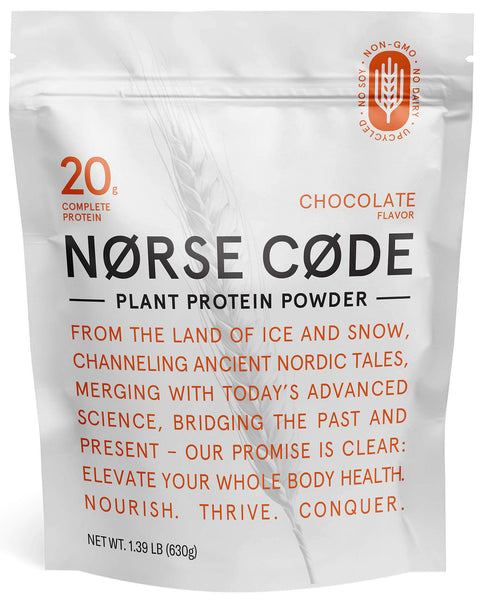
NØRSE CØDE Plant Protein
20g protein per serving, dissolves in any liquid, no blender needed.
Shop NØRSE CØDE
Does drinking a protein shake too fast make it sit badly?
Yes. Twelve ounces of anything in thirty seconds sits badly, and a shake gets treated as a task to finish rather than a drink. A glass you take two minutes over and a glass you take twenty seconds over are two different drinks. This one costs nothing to test tomorrow morning.
Coffee gets sipped over half an hour and nobody blames the coffee. Shakes get finished at the sink with car keys in hand. Sit down with one. Drink it like something you chose.
What makes a protein powder easier to handle on an empty stomach?
The ingredient line, mostly. We built NØRSE CØDE to a rule of nine natural ingredients or less, with prebiotic acacia fiber in the formula, no gums, no fillers and no sugar alcohols. There is less in the glass for a stomach to argue with, which is the whole idea.
The acacia is the piece that belongs to this question. It is a prebiotic fiber, and it gives the drink body: it helps the shake feel like food instead of powder. We chose it as the way to get that texture, which is why there is no xanthan and no guar on our label doing the job in its place. On an empty stomach, when a shake is the only thing you have had, what is in it is the whole story.
Here is a customer on that, in a five-star review: "This is the first plant protein powder I've tried that doesn't make me gassy or bloated. The chocolate tastes great and I drink it almost every day and still love it."
The rest of the formula is short on purpose. Three protein sources, pea, rice and barley, all sitting inside that label of nine natural ingredients or less. Allulose and monk fruit for sweetness. Both flavors are 0g total sugar and 0g added sugar, and no sugar alcohol is doing that work either. We third-party test every input. And in a blind taste test, more people chose NØRSE CØDE than Orgain and Optimum Nutrition Gold Standard 100% Whey Protein Powder combined.
One plain thing to know if you are reading labels for a reason: the barley protein means ours is not a gluten-free powder.
Can you take protein powder on an empty stomach before a workout?
You can, and for most people it is fine. This is one of the times an empty stomach is the point. Give it twenty to thirty minutes if your schedule allows, and mix it thinner than a shake you plan to drink sitting at a desk.
What tends to go wrong before training is volume and pace arriving right as you start moving. A thick shake, finished in a minute, then a run, is a lot to ask of yourself. Same shake, thinner, twenty minutes earlier, is a different morning. No formula change required to find out.
What should you do if every protein powder sits badly?
Read the ingredient panel instead of the directions. The names worth finding are the sugar alcohols, erythritol, maltitol, sorbitol and xylitol, the thickening gums, xanthan and guar, and any dairy protein. Those are the groups people most often end up removing, and a short label has fewer of them in it to begin with.
Then run the swap properly. Give a new powder a full week, in the same liquid, at the same volume, at the same time of day, so the powder is genuinely the only thing that changed. Switching the bag and the routine together is how people end up two months in with four powders under the sink and no idea which one was the problem.
Ours took over a thousand iterations and two years to arrive at a label this short. That is not a boast about effort. It is where the time goes when you decide the answer is going to be fewer things in the glass instead of better ones to cover for them.
The bottom line
Nobody asks this question about a drink that agrees with them. It comes up because a powder made someone think about their own stomach at breakfast, and once that has happened, timing is the first lever within reach. The better outcome is that the question stops being interesting: you drink it when it suits you, in whatever you have, and none of it needs planning.
That is what we were aiming at. Nine natural ingredients or less, prebiotic acacia fiber, no gums and no sugar alcohols, in both flavors.
Ready to try it?
Backed by a 60-day money-back guarantee. If it is not the smoothest protein you have had, send it back.
Shop NØRSE CØDE