Trace lead turns up right across the protein category, because it turns up in soil and in the crops grown there. A January 2025 Clean Label Project analysis of 160 protein powders from 70 brands found lead above California's Prop 65 threshold in powders of every kind, plant and whey alike.[1] That is a fact about how protein is farmed, not a verdict on any one bag. What separates them is what the maker does before the powder is packed.
Here's what actually separates a vegan protein powder worth trusting: third-party testing for heavy metals, a short ingredient list you can read without a dictionary, and a texture people actually finish the bag on. Digestion follows from that last point. Gums and fillers are the usual culprits when a shake sits wrong. Judged against those three, here's how ten real vegan protein brands compare.
NØRSE CØDE
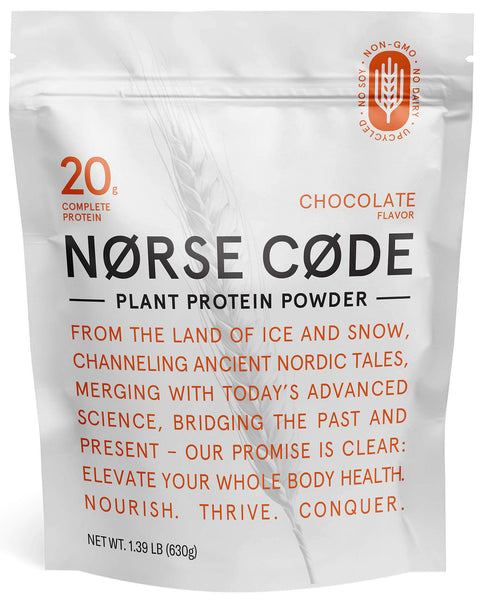
We built NØRSE CØDE around a short label on purpose: 9 natural ingredients or less, no gums, no artificial sweeteners, no fillers. We third-party test for heavy metals, and we make it ourselves in our own facility in Petaluma, California, rather than through a co-packer, so we control both the formulation and the testing timeline. It works in any liquid, hot or cold, without a blender. In a blind taste test, more people preferred NØRSE CØDE than the other two proteins in the panel combined, which matters here because a protein that sits in the cupboard half-finished doesn't do anyone's routine any good.
Aloha
Aloha's Organic Plant Based Protein blends organic pea, brown rice, hemp, and pumpkin seed protein. Each product is tested by an independent third-party lab for lead, cadmium, mercury, and arsenic, and the formula is USDA Organic and non-GMO. It doesn't carry a public certification mark like NSF or Informed Choice, so the testing claim rests on the company's own reporting rather than a searchable third-party database.
Drink Wholesome
Built around whole foods instead of protein isolates, Drink Wholesome's Vegan Almond Protein Powder leads with almonds and coconut rather than a processed protein concentrate. The company hires a third-party lab to test for heavy metals, gluten, and pesticides, and publishes those results on its own site rather than only stating that testing happens.
Garden of Life SPORT Organic Plant-Based Protein
This one carries NSF Certified for Sport, which screens for banned athletic substances and verifies label accuracy, plus Informed-Choice certification and USDA Organic status. It delivers around 30g of protein per serving from a certified-organic plant blend, which is useful if a searchable third-party mark matters more to you than a company's own test claims.
Nuzest Clean Lean Protein
Nuzest keeps its ingredient list about as short as this category gets, built from a water-extracted European pea protein with as few as three ingredients per serving. It's third-party tested for pesticides and heavy metals, and the simplicity is the whole pitch: less on the label, less to react to.
Orgain Organic Protein
Orgain states that it tests both incoming ingredients and finished products for heavy metals through third-party labs. Unlike some of the brands here, it doesn't currently hold a public, searchable certification like NSF Certified for Sport or Informed Choice, so its testing rests on its own reporting.
PlantFusion
PlantFusion's plant protein blend combines pea protein isolate with algae protein and an added amino-acid and enzyme blend, using guar gum and other texturizers to help it mix. It's third-party tested for identity, purity, potency, and label accuracy in FDA-registered, GMP-certified facilities. The ingredient list runs longer than some of the others here, which is the tradeoff for its added-amino-acid formulation.
Sunwarrior
Sunwarrior's plant protein blend pairs pea protein with goji berry and hemp seed, and is USDA Certified Organic. Heavy-metals and micronutrient testing runs through ARL Bio Pharma, an ISO-certified third-party lab, on every batch.
Transparent Labs Organic Vegan Protein
This blend of organic brown rice and pea protein isolate carries both Informed-Choice and Informed-Sport certification, tested at ISO-accredited labs. Transparent Labs also posts lot-matched certificates of analysis publicly, so a buyer can look up the results for the batch they bought.
Vega Sport Premium Protein
Vega's Sport line blends pea, sunflower seed, pumpkin seed, and alfalfa protein and carries NSF Certified for Sport, the same third-party banned-substance and label-accuracy screen Garden of Life uses. It's a straightforward pick for anyone who wants that specific certification on the label.
Choosing between them
Start with the ingredient list, because it is the part you live with. Fewer entries usually means fewer things that can upset a sensitive stomach, and a formula that mixes without a blender is the one that actually gets used rather than pushed to the back of the cupboard. Testing matters and every brand here does some form of it; it is the thing you check once, not the thing you drink every morning. NØRSE CØDE ships with a 60-day money-back guarantee, so trying it costs nothing but a scoop.
Sources
- [1] Clean Label Project, "Nearly Half of Top-Selling Protein Powders Exceed Safety Thresholds for Heavy Metal Contamination," January 9, 2025. 160 products from 70 brands tested; lead above California Prop 65 limits was found in powders across the category. https://cleanlabelproject.org/protein-study/
Ready to try it?
Backed by a 60-day money-back guarantee. If it is not the smoothest protein you have had, send it back.
Shop NØRSE CØDE