Updated: August 12, 2026
A non-chalky protein powder is one whose protein hydrates evenly in liquid on its own, without added gums standing in for a smoother mouthfeel. That's the whole difference. Rough, poorly hydrated protein particles and gum-based thickeners covering for them are the two most common causes of chalky or gritty texture. We built NØRSE CØDE around exactly that problem, using a process we call SmoothBlend.
Texture complaints show up constantly in protein powder reviews and forums, sometimes described as a powder that "makes me gag." Below is every major protein type ranked on texture and mixability, judged against three criteria: how evenly the protein hydrates in liquid, whether it needs added thickeners to feel smooth, and whether it leaves a grainy film at the bottom of the glass.
1. NØRSE CØDE
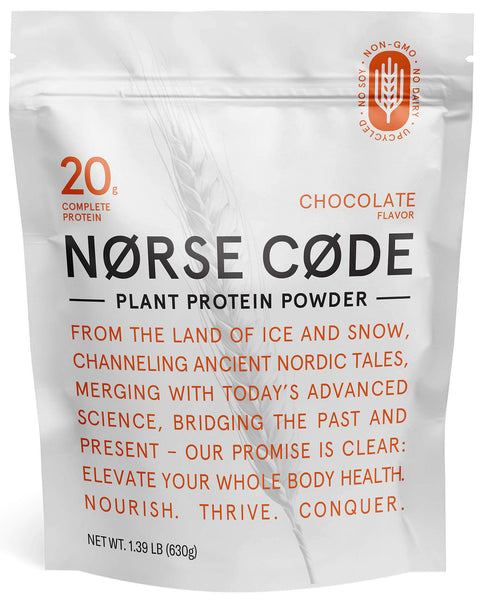
We built NØRSE CØDE around a compact pea, rice, and barley protein blend, formulated through SmoothBlend, 1,000+ formulation iterations over two years to get it to dissolve smooth in any liquid, hot or cold, no blender needed. The ingredient list is short by design, 9 natural ingredients or less or less, no artificial sweeteners, gums, or fillers, a deliberate formulation choice rather than a shortcut: fewer ingredients means less on the label to react to and nothing added just to fake a smoother mouthfeel. It also carries prebiotic acacia fiber and 20g of protein per serving, made in our own facility in Petaluma, California.
2. Whey protein isolate
Whey isolate is more filtered than concentrate, so it generally mixes thinner and dissolves faster with less fat and lactose left behind. It can still turn chalky if you scoop it dry into plain water instead of shaking it, since isolate powders are fine and can clump on contact with liquid rather than hydrating evenly.
3. Whey protein concentrate
Concentrate is the most common budget whey option, but it carries more residual fat and lactose than isolate, which tends to leave a slight film or grit at the bottom of the glass unless it's blended or shaken hard. It usually needs more liquid per scoop to avoid feeling gritty.
4. Micellar casein
Casein has the opposite problem from gritty: it's naturally thick and slow to dissolve, closer to a pudding than a shake. People who want a thin, fast-mixing drink often find casein's thickness its own kind of texture complaint, even though it's not technically chalky.
5. Hydrolyzed whey protein
Hydrolyzed whey is pre-broken-down into smaller peptides, so it dissolves fast and mixes thin with very little settling. The tradeoff is a noticeably bitter aftertaste, which pushes a lot of formulas toward heavy sweeteners or flavoring to cover it, so the texture problem gets traded for a taste problem.
6. Egg white protein powder
Egg white protein tends to mix clear and thin, with low fat and minimal grit. The more common complaint is a distinct eggy smell and aftertaste, which shows up even when the mix itself is smooth.
7. Soy protein isolate
Soy isolate mixes reasonably smooth compared to plant proteins that skip processing, but it has a polarizing flavor profile and has fallen out of favor for daily shakes as more people avoid soy specifically. Texture is rarely the complaint here; taste and ingredient preference usually are.
8. Rice protein (single-source)
Used on its own, rice protein is one of the grittier plant proteins, because its starch particles are larger and harder to fully hydrate in liquid. Most rice-protein-only formulas need a blender rather than a simple shake to cut down the grainy settle.
9. Pea protein isolate (single-source)
Pea protein isolate has a naturally grainy particle structure, so used alone and without a hydration step built into the formula, it commonly settles chalky at the bottom of the glass. This is one of the most frequent sources of the "gritty plant protein" complaint, and it's the exact problem a compact, well-hydrated blend is built to solve.
10. Collagen peptides
Collagen dissolves easily and mixes thin in hot or cold liquid, genuinely one of the smoothest textures on this list. The catch is that collagen doesn't carry the same amino acid profile most people are looking for under "protein powder," so it answers the texture question but not the same nutritional job.
11. Protein powders thickened with added gums
A common industry fix for a grainy plant blend is to add xanthan gum, guar gum, or similar thickeners so the drink feels smoother in the mouth, even when the base protein hasn't actually hydrated any better. That can trade chalky for a different problem: a slightly slimy or gel-like texture, plus a longer ingredient label. Skipping that step, rather than needing it, is the whole point of building a blend that hydrates evenly on its own.
Conclusion
Chalky and gritty texture almost always traces back to one of two things: a protein source that doesn't hydrate evenly on its own, or a thickener added to paper over that problem. Judge any protein powder on those two criteria before you buy another bag you won't finish.
Ready to try it?
Backed by a 60-day money-back guarantee. If it is not the smoothest protein you have had, send it back.
Shop NØRSE CØDE