Protein powder bloating almost always comes down to the formula, not the person drinking it: added gums, sugar alcohols, or an unfamiliar fiber dose account for most cases, according to peer-reviewed digestion research. Below are direct, sourced answers to the questions people ask once they start troubleshooting the ingredient list instead of the shake itself.
Why does protein powder make me bloated?
Bloating from protein powder usually traces to one of three things: added gums fermenting in the gut, sugar alcohols pulling water into the intestine, or a fiber dose your gut isn't used to yet. A 2017 Advances in Nutrition review found polyols like sorbitol and maltitol cause dose-dependent gas, worse when combined with other carbohydrates or in people with IBS.
None of these three causes are exotic, they show up across mainstream protein powders because gums and sugar alcohols are cheap ways to fake a smooth mouthfeel or cut sugar without cutting sweetness. The same review notes malabsorption gets worse specifically when polyols are eaten alongside other fermentable carbohydrates, which is common in a powder that's also carrying added fiber or a sugar-alcohol-heavy sweetener blend, so the ingredient panel, read as a whole formula rather than one flagged additive, is what actually predicts whether a shake causes gas. [1]
What ingredients in protein powder cause gas?
The most common gas triggers are sugar alcohols (sorbitol, mannitol, maltitol, xylitol), gums and thickeners (xanthan, guar, carrageenan), and high doses of certain fibers introduced too fast. A 2017 systematic review in Advances in Nutrition found polyols produce dose-dependent flatulence and discomfort, worse when paired with other fermentable carbohydrates in the same formula.
Sugar alcohols are poorly absorbed in the small intestine, so a large share passes straight to the colon, where gut bacteria ferment it and produce gas. Gums and thickeners follow a similar path: they're fermented rather than digested, which is why a shelf-stable powder can look "clean" on the front label and still list three separate fermentable additives on the back. Our label runs 9 natural ingredients or less, short enough to read at the shelf, with nowhere for a hidden fermentable additive to sit. [1]
Is plant protein always easier on the stomach than whey?
Not automatically. Plant protein skips lactose and dairy proteins, which helps if dairy is your trigger, but a plant powder loaded with gums or sugar alcohols can bloat you just as badly as whey does. The full ingredient list determines that, more than the protein source alone.
"Plant-based" gets read as a synonym for "gentle," when the actual predictor is the additive list sitting underneath the protein source. [1] A plant protein padded with gums to fix a gritty texture can be harder on digestion than a well-formulated whey isolate with nothing added for mouthfeel. Our proprietary plant protein blend uses SmoothBlend to dissolve clean in any liquid, so we skip the gums other formulas lean on to fix texture. Switching from whey solves the lactose problem on its own; the gum problem takes a second look at the label, and treating the two as one fix is how a second "gentle" powder in a row can still disappoint. For the dairy-specific mechanism, see our breakdown of why plant protein can be easier on your stomach.
Are gums and thickeners in protein powder bad for digestion?
Gums like xanthan, guar, and carrageenan are added for texture, and they ferment in the colon the same way excess fiber does, which produces gas and bloating for a lot of people. It's a mouthfeel choice, not a health hazard, but a powder built around it is optimized for shelf feel over comfortable digestion.
Gums are usually there to patch a texture problem created earlier in the formulation or co-packing process, so a brand that doesn't control its own manufacturing has less room to fix that upstream. We formulate and manufacture NØRSE CØDE ourselves, in our own Petaluma, CA facility, which lets us rely on SmoothBlend for smooth dissolving in any liquid, no chalk, no grit, no gum needed. [1]
Does prebiotic fiber help or hurt bloating?
Whether prebiotic fiber helps or hurts depends on the fiber and the dose. A 2021 randomized trial in Nutrients tested acacia gum, the fiber we use, at 0g, 20g, and 40g in a single meal: even the 40g dose produced only mild upticks in bloating, flatulence, and GI rumbling compared to no acacia gum at all, and researchers described overall GI tolerance as low across every dose tested. [2]
We use acacia as our prebiotic fiber for that tolerability profile, though the exact gram dose per serving isn't part of our current published spec sheet, a gap worth knowing about for anyone comparing fiber doses across labels. "Prebiotic" helps with comfortable digestion; it doesn't guarantee zero discomfort, and gradual, real-world intake tends to sit easier than a sudden jump to a full serving.
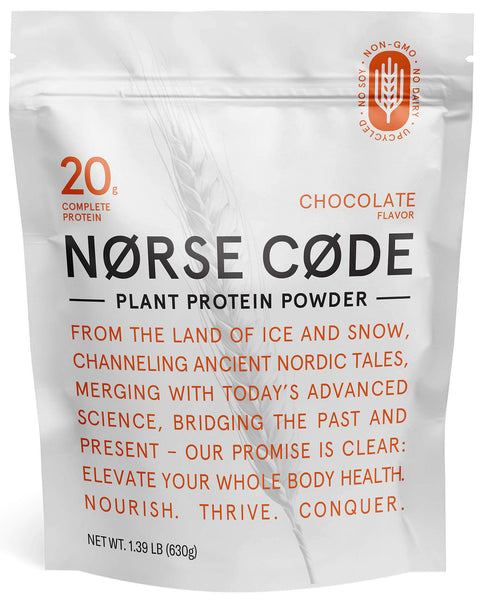
NØRSE CØDE Plant Protein
20g protein per serving, dissolves in any liquid, no blender needed.
Shop NØRSE CØDE
Should I look for a low-FODMAP-friendly protein powder if I bloat easily?
If bloating is a recurring problem regardless of brand, it's worth knowing sugar alcohols are one of the four FODMAP categories research links to IBS-type symptoms. A protein powder with no added polyols removes that entire category before you even look at protein source. [1]
FODMAP stands for fermentable oligosaccharides, disaccharides, monosaccharides, and polyols, a subgroup the same 2017 review discusses as already used in low-FODMAP dietary approaches for IBS. Other ingredients can carry FODMAPs too, so a polyol-free powder isn't automatically low-FODMAP overall, but for the specific complaint of gas and bloating after a shake, checking the label for sorbitol, mannitol, maltitol, and xylitol is a faster diagnostic than assuming based on protein source alone. Our label lists none of those four sugar alcohols; our sweeteners are allulose and monk fruit extract instead.
How do I stop protein powder from bloating me?
Read the label before the price tag: cut anything with more than one sugar alcohol, and treat gums or thickeners as a signal the formula was built for mouthfeel over your gut. [1]
That means checking the three ingredient classes actually responsible for most bloating: sugar alcohols, gums, and an unfamiliar fiber dose. Give a new fiber source about a week at a normal serving before judging it. If bloating persists past two to three weeks on a short, clean-ingredient formula, try a different product or talk to a doctor. For a full label-reading checklist, see our guide to protein powder side effects and what to check before you buy.
When does bloating settle after switching protein powders?
Gut adaptation timelines vary by person; there's no single figure that fits everyone. What's well established for fiber in general: give a new formula a normal serving and a couple of weeks before judging it. Most people report needing that much to adapt.
No study supports a specific day count, so treat any brand that names one as guessing past the research. If discomfort hasn't improved after two to three weeks of consistent, full-serving use, it's worth reconsidering the formula or talking to a doctor rather than continuing on the same product. A 60-day money-back guarantee is one way to test that timeline without the cost falling on you if the formula isn't the right fit.
Sources
- [1] Lenhart A, Chey WD. A Systematic Review of the Effects of Polyols on Gastrointestinal Health and Irritable Bowel Syndrome. Advances in Nutrition. 2017;8(4):587-596. doi:10.3945/an.117.015560
- [2] Larson R, Nelson C, Korczak R, Willis H, Erickson J, Wang Q, Slavin J. Acacia Gum Is Well Tolerated While Increasing Satiety and Lowering Peak Blood Glucose Response in Healthy Human Subjects. Nutrients. 2021;13(2):618. doi:10.3390/nu13020618
Try it without the risk
NØRSE CØDE ships 9 natural ingredients or less, no artificial sweeteners, no gums, no fillers, with acacia prebiotic fiber and 20g protein per serving. It's self-manufactured in our own Petaluma, CA facility and made from inputs we third-party test for heavy metals: the label is the actual formula.
Ready to try it?
Backed by a 60-day money-back guarantee. If it is not the smoothest protein you have had, send it back.
Shop NØRSE CØDE