Updated: August 23, 2026
Adults over 50 should be aiming for about 1.0 to 1.2 grams of protein per kilogram of body weight a day, roughly 73 to 87 grams for a 160lb adult. PROT-AGE set that range for adults over 65 and ESPEN for healthy older people; neither drew a line at 50, so it is the nearest evidence-based target below that age. The per-meal half matters as much and is the part that gets skipped: 25 to 30 grams at each meal, spread across the day.
Breakfast is where the arithmetic usually breaks. Two eggs and toast is about 14 grams, well under the range. Adding 20 grams to it clears 30, which is the job a scoop of NØRSE CØDE does, stirred into the coffee already sitting next to it.
How much protein do adults over 50 actually need?
The figure of record is 1.0 to 1.2 grams of protein per kilogram of body weight per day, above the RDA's deficiency-prevention floor of 0.8 grams. For a 160lb adult, that is the range in the table below.
| Target |
Grams per kg body weight per day |
For a 160lb (73kg) adult |
| General RDA (prevents deficiency only) |
0.8g/kg |
~58g/day |
| Healthy older adults (PROT-AGE, ESPEN) |
1.0-1.2g/kg |
~73-87g/day |
| Managing an acute or chronic illness |
More than 1.2g/kg |
Individual, doctor-guided |
It is worth being precise about who that number was written for. The PROT-AGE study group published the range in 2013 for people over 65, and the ESPEN expert group reached the same figure the following year for healthy older people.[1][2] Neither drew a line at 50. The change they were responding to happens gradually across middle age, so the over-65 figure is the nearest evidence-based target for someone in their fifties, and it is a direction of travel more than a switch that flips on a birthday. Package copy, meanwhile, still quotes the RDA's 0.8g/kg.
Why does the RDA undershoot what people over 50 actually need?
The RDA was built to prevent outright deficiency across a broad population. It was never designed to protect muscle at a life stage when the body responds less to the protein it eats. PROT-AGE names that declining response, along with higher splanchnic extraction, as one of the age-related changes behind its higher target.[1]
That is the mechanism under every "eat more protein as you age" headline: the same intake goes less far than it once did. The RDA was built around deficiency, and holding onto muscle is a second problem with a higher number attached to it.
How much protein should I eat per meal, versus per day?
Roughly 25 to 30g at each meal, spread across the day, and it matters as much as the daily total. That amount maximally stimulates muscle protein synthesis in younger and older adults alike, while a meal under about 20g produces a blunted response in older adults.[3]
That is the useful part, and it is more encouraging than the usual framing: the response itself is still there at any age, and what moves with age is the floor: below roughly 20g in a sitting, an older adult's response is blunted.[3] So the practical target is a floor at each sitting, and a single large dinner will not cover for two light meals ahead of it. Adding leucine to an ordinary mixed meal may lift the response further.[3]
Does spreading protein across the day matter, or just the daily total?
Both. A day built on a light breakfast, a light lunch and a large dinner can hit its daily total while leaving two of three meals under the amount that stimulates muscle protein synthesis, which is why the per-meal figure is worth tracking alongside the daily one.
The highest-value fix is usually the meal carrying the least, and for most people that is breakfast: coffee and toast, or nothing at all, sitting next to a dinner that is already doing its job. Bringing that one meal up tends to bring the daily total up with it.
What is anabolic resistance and why does it matter after 50?
Anabolic resistance is the term researchers use for aging muscle's declining response to ingested protein. The PROT-AGE group names it as one of the age-related changes behind its higher daily target, and it is why the per-meal amount matters as much as the daily one.[1]
Practically, it means the protein arithmetic that held for most of your adult life has moved, the same way other health numbers move with age even when habits haven't.
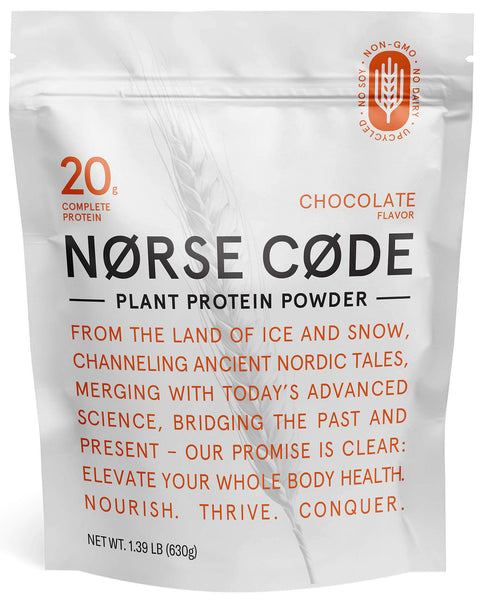
NØRSE CØDE Plant Protein
20g protein per serving, dissolves in any liquid, no blender needed.
Shop NØRSE CØDE
Is this the same as needing protein for sarcopenia?
Sarcopenia is the clinical term for age-related muscle loss, and researchers study protein needs at this life stage closely because of it. The guidance above is general intake advice. No protein powder treats or reverses sarcopenia, and a diagnosed muscle-loss condition belongs in a conversation with a doctor.
The daily target and the per-meal range above are about eating enough protein, distributed well, as a normal part of healthy aging. If you already have a diagnosed condition, treat this page as background for that conversation with your doctor.
Can I get enough protein from food alone, or do I need a supplement?
Food alone can absolutely get you there. Eggs, fish, poultry, dairy, legumes, and tofu all count toward the daily total, and a lot of adults over 50 are already close on paper once the whole day is added up. The obstacle is usually breakfast and lunch, which fall under the per-meal mark even when dinner covers most of the day's requirement on its own.
A protein powder is one straightforward way to cover those two meals without restructuring your food around a new source. Food-first works fine too, especially if your mornings already include eggs or Greek yogurt. A powder is simply the faster route on the mornings a routine leaves light, which for most people is most of them.
What should I look for in a protein powder to hit this target?
Enough protein per serving to carry a light meal up into the 25 to 30g range, and an ingredient list you'd want to drink every day, because the distance gets closed by the daily habit. A short, honest label matters here too: no artificial sweeteners, no gums, nothing added just to extend shelf life.
Then there is whether you actually like drinking it, which decides whether you are still doing this in week four. It also has to survive contact with an actual morning: coffee, water, milk, whatever's already in the fridge. A blender or a recipe is one more thing to manage on exactly the mornings that are already the emptiest.
The protein powder built for this math
Ours is 20g of protein per serving, on a label of nine natural ingredients or less, with 0g of total and added sugar in both flavors, no artificial sweeteners, gums, or fillers, and prebiotic fiber from acacia. It stirs into anything, hot or cold, so a scoop alongside what you were already eating carries the meal up into range.
On the part that decides whether you keep drinking it: in a blind taste test, more people chose NØRSE CØDE than Orgain and Optimum Nutrition Gold Standard 100% Whey combined. We third-party test every input for heavy metals. We also make it ourselves, in our own facility in Petaluma, California, so the label matches what's actually in the bag.
Order by noon PT and it ships same day, backed by a 60-day money-back guarantee, no questions asked.
Sources
- [1] Bauer J, Biolo G, Cederholm T, et al. "Evidence-based recommendations for optimal dietary protein intake in older people: A position paper from the PROT-AGE Study Group," *Journal of the American Medical Directors Association*, 14(8):542-559, August 2013. doi:10.1016/j.jamda.2013.05.021. pubmed.ncbi.nlm.nih.gov/23867520
- [2] Deutz NEP, Bauer JM, Barazzoni R, et al. "Protein intake and exercise for optimal muscle function with aging: Recommendations from the ESPEN Expert Group," *Clinical Nutrition*, 33(6):929-936, December 2014. doi:10.1016/j.clnu.2014.04.007. pubmed.ncbi.nlm.nih.gov/24814383
- [3] Paddon-Jones D, Rasmussen BB. "Dietary protein recommendations and the prevention of sarcopenia," *Current Opinion in Clinical Nutrition and Metabolic Care*, 12(1):86-90, January 2009. doi:10.1097/MCO.0b013e32831cef8b. pubmed.ncbi.nlm.nih.gov/19057193
Ready to try it?
Backed by a 60-day money-back guarantee. If it is not the smoothest protein you have had, send it back.
Shop NØRSE CØDE