What is the highest plant protein source?
Among whole plant foods, hulled hemp seeds come out on top, with dried pumpkin seed kernels close behind, per USDA FoodData Central. Protein per 100 grams for the five highest-ranking foods to know:

Our protein
55% preferred it in a blind taste test. 20g protein per serving, no artificial sweeteners or fillers.
$49.99 for 1 bag, 14 servings. 60-day money-back guarantee, no questions asked.
- Hulled hemp seeds: 31.6 g [1]
- Dried pumpkin seed kernels: 30.2 g [2]
- Raw Spanish peanuts: 26.2 g [3]
- Tempeh: 20.3 g [4]
- Firm tofu: 17.3 g [5]
A few things sit outside this ranking. Isolated protein powders are made by extracting protein from a plant, so their percentage is a product of processing and a different kind of number from a food's. Dried foods also look better than wet ones on a per-100-gram basis, since a dry seed carries no cooking water. Hold both of those in mind when you compare a seed to a block of tofu.
Does the highest protein per 100 grams mean the most protein per serving?
No. A 100 gram figure is a lab comparison, and nobody eats 100 grams of hemp seeds. A 30 gram handful of hulled hemp seeds works out to about 9.5 grams of protein, which is 31.6 grams scaled down to the amount that fits in your palm.[1]
Pick up a handful of seeds and a handful of cooked lentils. The seeds make a small dry pile in the hollow of your palm and run between your fingers like sand. The lentils are soft and wet, slump over your fingers, and weigh more for the same handful. The usual seed serving is a tablespoon or three on a bowl of oatmeal or a salad. To find your own figure, weigh the serving you really eat, multiply it by the per-100-gram figure, and divide by one hundred.
Is tofu or tempeh higher in protein?
Tempeh is higher, and the two also behave differently in the pan. Tofu takes on whatever sauce you give it and goes into a scramble or a stir-fry with no fuss. Tempeh has a nuttier, firmer bite and holds together when you slice it for a sandwich.
USDA lists 20.3 grams of protein per 100 grams of tempeh and 17.3 grams for raw firm tofu set with calcium sulfate.[4][5] Tofu holds more water, and tempeh is whole soybeans fermented into a firm cake. Both start from soy, so if soy is off your list neither is an option. Read the label for the type of tofu too: the USDA entry above is the firm kind prepared with calcium sulfate, and silken tofu will print a lower figure.
How much protein do cooked lentils and edamame really give you?
Cooked lentils carry 9.02 grams of protein per 100 grams and prepared frozen edamame carries 11.9 grams, both per USDA.[6][7] They sit well below the seeds on a per-weight basis because cooking adds water, and they bring fiber and volume to a meal.
Lentils bring fiber along with their protein, and the 222 grams that reach 20 grams of protein fill a bowl. Edamame is the quick one: a bag from the freezer, a few minutes in water, and a salt shaker. Lentils and beans are a common source of digestive discomfort, and the guide to vegetarian protein sources goes into why.
How much food does it take to reach 20 grams of plant protein?
At the USDA figures, 20 grams of plant protein takes about 63 grams of hulled hemp seeds at the light end and about 222 grams of cooked lentils at the heavy end. Tempeh and firm tofu land between them. Food needed for 20 grams of protein:
- Hulled hemp seeds: about 63 g [1]
- Tempeh: about 99 g [4]
- Firm tofu: about 116 g [5]
- Cooked lentils: about 222 g [6]
This is simple division: 20 divided by the protein per gram. Set a kitchen scale on the counter once and weigh the food you eat on an ordinary day, and you will have your own numbers in ten minutes. Most people find that one meal reaches 20 grams without trying when tofu, tempeh or lentils are the main course, and that a breakfast or a mid-afternoon gap is where the total falls short.
Where does a plant protein powder fit?
A powder fits where a plate of lentils or tofu is more than the moment allows, giving you around 20 grams in a glass. When choosing one, compare protein per serving first and then the length of the ingredient list, since a short list leaves less room for fillers.
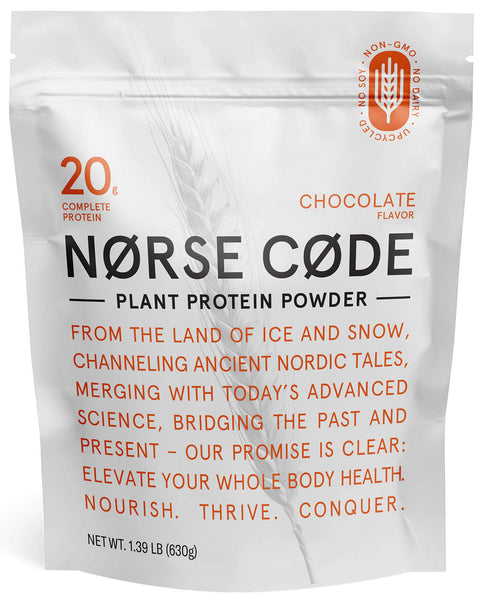
We built NØRSE CØDE to that checklist: 20 grams of pea, rice and barley protein in a label of nine natural ingredients, with no gums and no fillers. Two of those nine carry allergen notes. The MCT oil comes from coconut, so the shake contains coconut, and the barley protein contains gluten, so it is not for celiac disease or a gluten sensitivity.
On a morning with no time for a skillet, stir one scoop into a glass of hot or cold liquid with a spoon, and the 20 grams are done. We use prebiotic acacia fiber in the blend, and we sweeten with allulose and monk fruit, so both flavors read 0g total sugar and 0g added sugar. If you are deciding between two specific brands, we wrote a side-by-side of NØRSE CØDE and Orgain.
Sources
- [1] USDA FoodData Central, "Seeds, hemp seed, hulled" (SR Legacy, FDC ID 170148): 31.6 g protein per 100 g, accessed 2026-10-05. https://fdc.nal.usda.gov/fdc-app.html#/food-details/170148/nutrients
- [2] USDA FoodData Central, "Seeds, pumpkin and squash seed kernels, dried" (SR Legacy, FDC ID 170556): 30.2 g protein per 100 g, accessed 2026-10-05. https://fdc.nal.usda.gov/fdc-app.html#/food-details/170556/nutrients
- [3] USDA FoodData Central, "Peanuts, spanish, raw" (SR Legacy, FDC ID 174263): 26.2 g protein per 100 g, accessed 2026-10-05. https://fdc.nal.usda.gov/fdc-app.html#/food-details/174263/nutrients
- [4] USDA FoodData Central, "Tempeh" (SR Legacy, FDC ID 174272): 20.3 g protein per 100 g, accessed 2026-10-05. https://fdc.nal.usda.gov/fdc-app.html#/food-details/174272/nutrients
- [5] USDA FoodData Central, "Tofu, raw, firm, prepared with calcium sulfate" (SR Legacy, FDC ID 172475): 17.3 g protein per 100 g, accessed 2026-10-05. https://fdc.nal.usda.gov/fdc-app.html#/food-details/172475/nutrients
- [6] USDA FoodData Central, "Lentils, mature seeds, cooked, boiled, with salt" (SR Legacy, FDC ID 175254): 9.02 g protein per 100 g, accessed 2026-10-05. https://fdc.nal.usda.gov/fdc-app.html#/food-details/175254/nutrients
- [7] USDA FoodData Central, "Edamame, frozen, prepared" (SR Legacy, FDC ID 168411): 11.9 g protein per 100 g, accessed 2026-10-05. https://fdc.nal.usda.gov/fdc-app.html#/food-details/168411/nutrients
Ready to try it?
Backed by a 60-day money-back guarantee. If it is not the smoothest protein you have had, send it back.
Shop NØRSE CØDE