What counts as a vegetarian protein source?
Anything that isn't meat, poultry or fish. That still leaves eggs, dairy, legumes (lentils, beans, chickpeas), soy (tofu, tempeh, edamame), whole grains like quinoa, and nuts and seeds. A vegan diet is narrower: it drops eggs and dairy too, leaving legumes, soy, grains, nuts and seeds to do the work alone.
How much protein is actually in vegetarian foods?
Here's the same serving, six different foods, per USDA figures:[1]
| Food |
Serving |
Protein |
| Lentils, cooked |
1 cup |
15 to 18 g |
| Chickpeas, cooked |
1 cup |
about 15 g |
| Tofu |
1/2 cup |
10 to 11 g |
| Greek yogurt, plain |
1 cup |
about 20 g |
| Eggs |
2 large |
about 13 g |
| Quinoa, cooked |
1 cup |
about 8 g |
None of those numbers move much between brands. A food scale and a label are the only real variables worth checking.
Why do vegetarian diets pair rice with beans?
Beans run high in lysine and low in the sulfur-containing amino acids, methionine and cysteine. Rice runs the other way: low in lysine, higher in those sulfur aminos. Eaten together, each covers the other's gap, which is the actual reason rice and beans turns up as a pairing across cuisines that never talked to each other. The same principle is why our own blend uses three protein sources instead of one.
Why do beans and lentils bloat some people and not others?
Legumes carry a type of fiber called oligosaccharides that the small intestine can't break down on its own; it ferments further down, in the gut, and that fermentation is what produces gas.[2] Some guts adjust to it with regular exposure. Others don't, no matter how long they keep eating beans. A protein powder built around a different fiber avoids that specific mechanism. We use prebiotic acacia fiber instead, and skip the gums a lot of plant powders lean on to fix texture. A customer put it plainly:
"This is the first plant protein powder I've tried that doesn't make me gassy or bloated. The chocolate tastes great and I drink it almost every day and still love it."
That's one customer's report. We're not claiming acacia fiber solves bloating for everyone who reacts to beans.
How does NØRSE CØDE fit into a vegetarian protein routine?
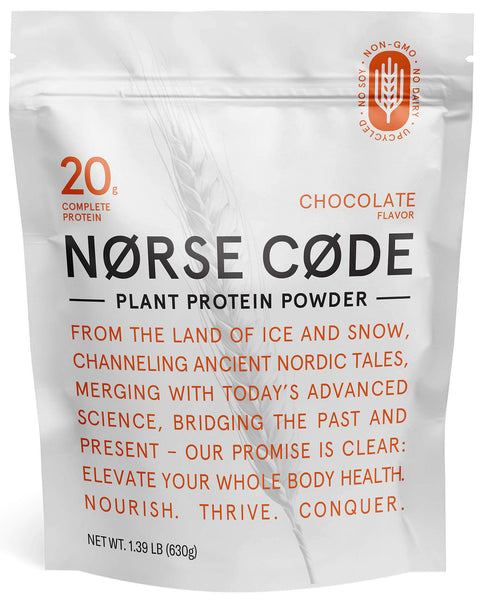
It's a powder that sits alongside lentils and eggs rather than replacing them: 20 grams of protein a serving, from a blend of pea, rice and barley, inside a label of only 9 natural ingredients. No artificial sweeteners, no gums, no fillers. Allulose and monk fruit handle the sweetness, so both flavors land at 0g total sugar and 0g added sugar. It dissolves in whatever you're already drinking, hot or cold, with a spoon, no blender. In a blind taste test, more people preferred it. We back it with a 60-day money-back guarantee: order it, try it for two weeks, and send it back if it sits unfinished. For the full rundown against nine other vegan proteins on testing and ingredients, we compared ten brands here. Two direct side-by-sides, if you're deciding between a specific pair: NØRSE CØDE against Huel Black Edition and against Vega Sport.
Sources
- [1] Center for Science in the Public Interest, "How much protein is in eggs, chicken, beans, or other foods?", USDA FoodData Central figures, accessed 2026-09-25. https://www.cspi.org/article/how-much-protein-eggs-chicken-beans-or-other-foods
- [2] Lumen Learning, "2.14 Oligosaccharides," accessed 2026-09-25: humans lack the alpha-galactosidase enzyme needed to break down the oligosaccharides in beans (raffinose, stachyose, verbascose) in the small intestine, so they pass to the colon and are fermented by bacteria there, producing gas. https://courses.lumenlearning.com/atd-herkimer-nutrition/chapter/2-14-oligosaccharides/
Ready to try it?
Backed by a 60-day money-back guarantee. If it is not the smoothest protein you have had, send it back.
Shop NØRSE CØDE