Protein needs shift during menopause, and a lot of women don't notice until the amount that used to be plenty stops working the way it did. We built NØRSE CØDE around this stretch of life specifically: an easy way to add more protein, one that mixes without a blender and doesn't leave you gassy or bloated. Below are the questions we hear most from women navigating protein and menopause together.
Why Is Protein Important During Menopause?
Protein is important during menopause because declining estrogen makes it harder for your body to build and hold onto muscle, a shift researchers call anabolic resistance. The same intake that maintained your muscle in your 30s can fall short in your 40s and 50s, so getting enough protein becomes one of the few daily habits that pushes back.
Muscle affects more than gym strength. It is also what your body burns through at rest, so losing it changes how your metabolism behaves even before your weight on the scale moves. Protein supplies the raw material your body uses to hold onto that muscle.
How Much Protein Do You Need During Menopause?
The standard RDA is 0.8 grams of protein per kilogram of body weight a day. It was set decades ago as a general adult floor, before anyone had studied what menopause does to muscle specifically. A 2019 clinical trial in postmenopausal women tested a higher intake, about 1.2 grams per kilogram, against that older baseline.[1]
For a woman around 65kg, 1.2 grams per kilogram works out to roughly 78 grams of protein a day. Spread that across meals rather than loading it into one sitting; treat it as a target to aim for.
Does Menopause Cause Muscle Loss, and Can Protein Slow It Down?
Yes, and the loss is real without some form of resistance exercise in the mix. In the 2019 postmenopausal trial, every participant did resistance training throughout, and that consistency did more for their results than which protein amount they were assigned.[1] Protein feeds the rebuilding the training triggers.
Both groups in the study built comparable strength and lean mass overall. The higher-protein group's edge showed up only in longer functional tests, like a 400-meter walk. Skip the training altogether, and a higher protein number on its own has far less to work with.
Can Protein Powder Help With Menopause Weight Changes?
Protein powder does not target menopause weight change directly. A shake is unusually filling for its calories, so swapping one in for a 3pm snack you'd otherwise grab from the pantry is a small change that adds up over weeks. The swap itself does the work; the powder just makes the swap easy to repeat, day after day.
Why Do Many Women Switch to Plant Protein Powder During Menopause?
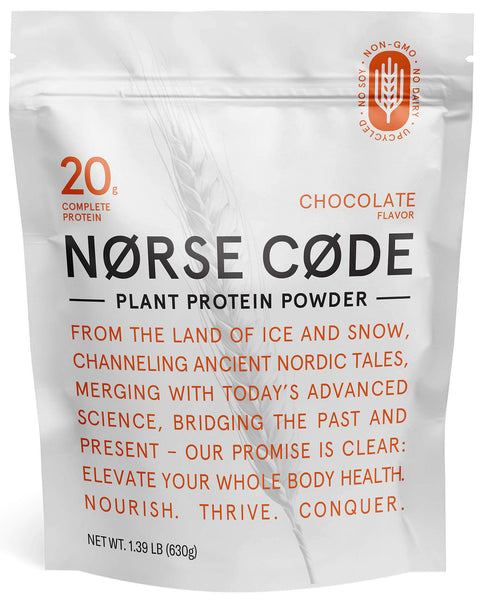
Mostly the ingredient list. A lot of whey and older plant powders lean on gums, fillers and artificial sweeteners that grow harder to tolerate at midlife. NØRSE CØDE is 20 grams of protein from nine natural ingredients, built from a pea, rice and barley protein blend, with no gums or fillers.
Both flavors carry 0g total sugar and 0g added sugar, sweetened with allulose and monk fruit instead. The short ingredient list was the starting point for the formula, decided before anything else got worked out. It is usually the first thing a longtime label-reader notices when she picks up the bag.
Does Protein Powder Cause Bloating During Menopause?
Some does, usually from added gums, a sugar alcohol, or a whey base that does not sit well as digestion changes with age. NØRSE CØDE replaces gums with prebiotic acacia fiber and skips sugar alcohols entirely, which is part of why it tends to sit lighter.
Acacia is a soluble prebiotic fiber, a different ingredient from the thickening gums (xanthan, guar) that show up in other formulas. A customer put it plainly in a review: "This is the first plant protein powder I've tried that doesn't make me gassy or bloated. The chocolate tastes great and I drink it almost every day and still love it."
What Should You Look For in a Menopause Protein Powder?
In this order: whether it sits well digestively, whether it mixes without a blender, whether you actually like drinking it, and only then the ingredient line. We built NØRSE CØDE against exactly those four checks, and it is the reason we spent two years and more than a thousand batches getting there, in our own facility in Petaluma, California.
A protein powder that goes stale in the cupboard usually failed on taste, somewhere around day three or four, long before anyone got around to reading the nutrition panel. In a blind taste test, more people chose NØRSE CØDE than Orgain and Optimum Nutrition Gold Standard 100% Whey Protein Powder combined. It stirs into coffee, water or milk with no blender and no recipe, hot or cold. One customer wrote: "Thanks for making such a great product. I bought another pouch for my friend and she is thrilled with it as well. Chocolatey, satisfying but still light some how. Just right for an afternoon snack!"
When Should You Take Protein During a Menopause Routine?
Spread across the day rather than saved for dinner. Your body can only put so much protein to use in one sitting, so a shake at breakfast or mid-afternoon does more for a daily total than adding it all to one big evening meal.
Sleep and appetite both get unpredictable around this age, so a fixed schedule ("always with breakfast") is often the first thing to fall apart. A powder that mixes into whatever you're already drinking, at whatever hour hunger actually shows up, survives that better than a recipe that assumes a routine you can count on.
If you're weighing which protein powder actually fits this stretch of life against every check above, our menopause protein powder guide runs the comparison in full. If bloating specifically is the reason you're looking, our guide to protein powder for a sensitive digestion goes deeper on that alone. And if whey has never agreed with you, our comparison of plant protein against whey for tolerance covers the switch.
Conclusion
Protein needs go up during menopause because of a hormonal shift. We built NØRSE CØDE to be the shake you actually reach for on a Tuesday, week after week, past the first bag.
- [1] Nahas, P.C., et al. "Moderate Increase in Protein Intake Promotes a Small Additional Improvement in Functional Capacity, But Not in Muscle Strength and Lean Mass Quality, in Postmenopausal Women Following Resistance Exercise: A Randomized Clinical Trial." *Nutrients*, 11(6):1323, 2019.
It's backed by a 60-day money-back guarantee, no questions asked, so there's no risk in finding out.
Ready to try it?
Backed by a 60-day money-back guarantee. If it is not the smoothest protein you have had, send it back.
Shop NØRSE CØDE