Go and pick up whatever is in your cupboard right now. Somewhere on the front it probably says something warm about the planet, and there is no way to tell from the front whether that means anything. There are three things underneath that claim you can actually check, and once you know them you can sort any bag in the aisle in about a minute.
What actually makes one protein powder more sustainable than another?
Three things: what the protein is made from, whether it was grown on purpose or recovered from something already grown, and what it ships in.
The second one does most of the work and almost nobody talks about it. A pea grown to become protein powder brings its whole history with it. The field. The water, the fertilizer, the harvest, the trucks. Protein recovered from a byproduct skips nearly all of that, because the growing already happened for something else and the leftovers were headed for the trash anyway.
Certifications sit outside all three. The badge is the first thing most people reach for and the least useful thing on the bag.
Is plant protein really more sustainable than whey protein?
Usually, and the reason is upstream of the powder.
Whey starts as milk. Milk starts with a cow that has been eating, drinking and emitting for years before anyone isolates a gram of anything. Peer-reviewed comparisons by greenhouse gas put plant proteins below dairy ones fairly consistently.[1]
That is a pattern across categories, not a scoreboard of brands. It gets you into the right aisle. Telling two bags apart once you are standing in it takes the other two questions.
What is upcycled protein, and does NØRSE CØDE use it?
It is protein taken out of something that was already grown for another reason.
Ours is barley, and it comes from brewers' spent grain: the wet mash left in the tank after the sugars have gone into the beer. Every brewery makes it, all the time. It is the biggest solid waste stream a brewery has, about 85% of everything solid it throws out. Worldwide that runs to 36 to 38 million tonnes a year.[2] Sent to landfill it rots, and rotting releases an estimated 513 kg of CO2-equivalent per tonne.[3]
So the barley in your scoop was grown for beer. We are using what the brewer could not, and nobody planted a second field. The footprint of each protein ingredient, side by side, is its own page. When that upcycled barley protein was put through a life-cycle analysis against pea, soy, whey and egg white isolates, it came out with up to 5x less greenhouse gas impact, over 20x less land use, and the lowest water use of the group.[4]
Does a protein powder's packaging affect its environmental footprint?
Yes, and this is the one you can settle yourself tonight.
Empty a tub and pick it up. It still holds its shape. It was built to stand on a shelf with nothing in it, and those walls are material you paid to make and paid to ship. Now pick up an empty bag. It collapses. It was only ever built to hold powder and seal shut.
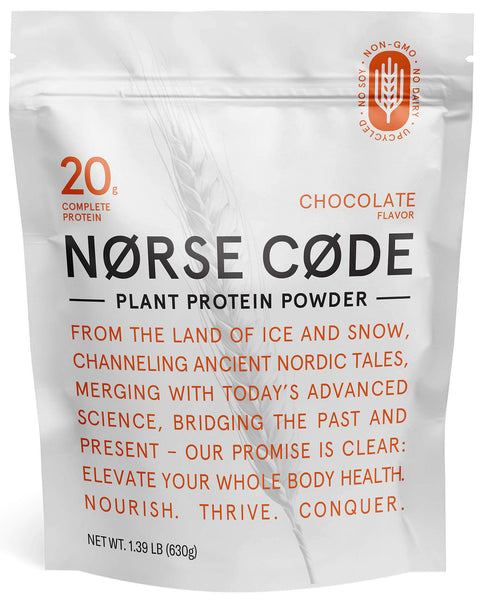
Ours is a bag. It is a smaller decision than where the protein came from, and it is the one you can verify without trusting anybody. If you want the whole field ranked on this, the eco-friendly guide does that.
Do certifications like B Corp or USDA Organic prove a protein powder is sustainable?
No. They answer different questions well.
B Corp looks at how a company treats its people and governs itself. USDA Organic looks at what went on the field. Both are real, and neither one measures carbon, water or land, so a brand can hold both marks and still source a heavy ingredient.
We hold neither. We'd rather hand you the three specifics: where the barley comes from, who makes the powder, and what it ships in. You can check all three without taking our word for any of them.
Does where a protein powder is made matter for sustainability?
It matters for how many times the product moves.
The usual arrangement: a brand buys ingredients, ships them to a co-packer, and has finished bags shipped back. Two extra journeys, and a process the brand watches through someone else's window. We make ours in our own facility in Petaluma, California. Ingredients arrive once. The bag leaves once. When something needs changing we walk over and change it.
Can a more sustainable protein powder still taste good?
Yes, because the two come out of different decisions. Sourcing and packaging are one set. Flavor and texture are another.
Ours took over a thousand iterations across two years to get right, and that work had nothing to do with the barley's origin. In a blind taste test, more people chose NØRSE CØDE than Orgain and Optimum Nutrition Gold Standard 100% Whey Protein Powder combined.
One customer wrote this in a review, unprompted:
"I really like this protein powder. I received a flier at a spartan race my family and I did last year. I have been holding on to this flier for all this time and finally decided I needed to give it a try, and I am so glad I did. It's smooth, clean, and tastes great."
She kept a flier for a year. That is the part that decides whether any of the sourcing above ever gets drunk.
Is NØRSE CØDE the most sustainable protein powder?
Nobody has benchmarked the whole category, so that superlative is not honestly available to anyone selling you protein.
Here is what we can put on the table: barley upcycled from spent grain, a facility in Petaluma we run ourselves, and a bag instead of a tub. Three specifics, all checkable, in place of a badge. How that lands against the powders people usually weigh us against is in the comparison index.
Sources
- [1] Poore, J. & Nemecek, T. "Reducing food's environmental impacts through producers and consumers." Science, 360(6392), 987-992, 2018.
- [2] Zeko-Pivač, A., Tišma, M., Žnidaršič-Plazl, P., et al. "The Potential of Brewer's Spent Grain in the Circular Bioeconomy: State of the Art and Future Perspectives." Frontiers in Bioengineering and Biotechnology, 10:870744, 2022.
- [3] Aradwad, P., Raut, S., Abdelfattah, A., Rauh, C., & Sturm, B. "Brewer's spent grain: Unveiling innovative applications in the food and packaging industry." Comprehensive Reviews in Food Science and Food Safety, 24(3):e70150, 2025.
- [4] Life-cycle analysis of upcycled barley protein isolate, 2021. Full record: references/barley-environmental-footprint.md.
NØRSE CØDE is 20g of protein per serving, 9 natural ingredients or less, made in our own facility in Petaluma. The guarantee runs 60 days, so trying a bag costs you the shipping and nothing else.
Ready to try it?
Backed by a 60-day money-back guarantee. If it is not the smoothest protein you have had, send it back.
Shop NØRSE CØDE