Updated: August 24, 2026
The protein source settles most of a powder's footprint before packaging or offsets enter the picture: peas run about 0.4 kg of CO2-equivalent per 100g of protein, against about 10.8 kg for cheese, the closest dairy comparison the underlying dataset carries.[1]
Nine other powders are below, each with an environmental fact the company itself has published, checked on 2026-08-24. First, the four questions worth asking about any bag you pick up.
Four questions, in order of what they prove
What is the protein made from? This lever is bigger than the other three combined, and it is settled before a brand does anything. Pulses like peas fix their own nitrogen from the air, which removes a large share of the fertilizer behind most crop emissions, and that puts pulses near the bottom of the range, an order of magnitude below cheese.[1] Whey arrives carrying the footprint of the dairy supply chain it came out of.
What is the container made from? A packaging claim earns its place when it names a material and a change: compostable film, recycled resin, a pouch where a rigid tub used to be. A bag that says "eco packaging" and stops there leaves you with nothing to check.
What happens where it is made? Manufacturing is where the water, the offcuts and the freight legs live. A brand running its own line can tell you what happens to all three. Hand the recipe to a co-packer and that visibility usually goes with it.
What has the company published, and when? Offsets, per-meal targets and dated certifications are the loudest signal on any sustainability page. They are also the weakest, because a payment made after the emissions leaves the first three answers where they were. A dated number is worth having, and it belongs behind the other three.
Three further marks are often read as environmental evidence. B Corp certification scores governance and labor practices, USDA Organic certifies farming inputs, and a traceability program discloses who the suppliers are. All three are worth holding. None of them measures carbon, water or plastic.
The ten, at a glance
| Brand |
Protein base |
Container |
Where made |
Published figure |
| NØRSE CØDE |
Pea, rice, barley |
Stand-up bag |
Own facility, Petaluma, California |
Life-cycle analysis of the barley protein[13] |
| ALOHA |
Plant blend |
Not published |
Not published |
5,828 metric tonnes offset, 2022 footprint[2] |
| Form Nutrition |
Plant blend |
Compostable paper and biofilm pouch |
Not published |
None published |
| Vivo Life |
Plant blend |
Home-compostable pouch |
Not published |
Breaks down in 6 to 12 months[4] |
| Sunwarrior |
Rice |
Tub, post-consumer recycled content |
Not published |
None published |
| Nuzest |
Pea |
HDPE tub |
Not published |
None published |
| Garden of Life |
Plant blend |
Bottle, recycled plastic content |
Not published |
Certified carbon neutral, 2021[7] |
| Orgain |
Plant blend |
Container, sugarcane cap |
Not published |
40% less plastic, 30,000 lb a year[8] |
| Huel |
Plant blend |
Not published |
Not published |
Under 0.5 kg CO2e per meal[9] |
| Nutiva |
Hemp |
Rigid container |
Not published |
None published |
Nine of the ten do not say where the powder is blended. That column is the one a brand can only fill by owning the line.
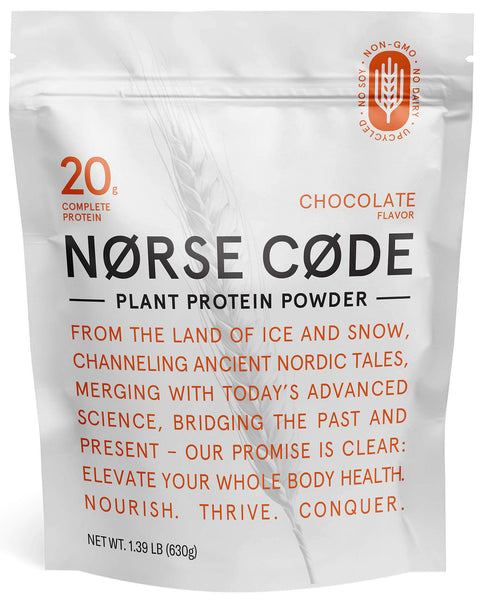
NØRSE CØDE
Nine natural ingredients or less was the rule the formula had to obey, and three protein sources had to fit inside it. Pea is the largest by weight. Rice and barley fill out the rest. Prebiotic acacia fiber gives the shake its body, which is how one ingredient does the job two gum thickeners do elsewhere. Allulose and monk fruit handle sweetness, with no gums and no fillers, and both flavours come out at 0g total sugar and 0g added sugar with no sugar alcohol standing in. In a blind taste test, 55% preferred it.
The barley is the part of the label with a second life behind it. It comes out of brewers' spent grain, the wet grain a brewery is left with once the sugars have been mashed out. That material is about 85% of everything solid a brewery discards.[11] The world produces 36.4 to 38 million tonnes of it a year, and the usual destinations are low-value animal feed and landfill, where it releases roughly 513 kg of CO2-equivalent per tonne.[11][12] Nothing was planted to make ours.
A life-cycle analysis commissioned by the ingredient supplier benchmarks that barley protein against four isolates, and puts it below pea protein isolate, soy protein isolate, whey protein isolate and egg white powder.[13] The study is real and it is not independent of the seller, which is why it is described here as what it is rather than as a headline.
We make it ourselves in our own facility in Petaluma, California, so mixing, testing and bagging happen in one building and nothing moves between a formulator and a co-packer. It ships in a flexible stand-up bag, which uses less plastic than a rigid tub.
A customer who found us at an event put the barley part more briefly than we manage to:
"I have purchased Norse Code when I was at an event. The protein is upcycled from spent barley which reduces environmental footprint. The flavor is like chocolate milk."
For the full breakdown, see what goes into the blend.
ALOHA Organic Plant-Based Protein Powder
In 2023 the offset was bought against the previous year's emissions, with Climate Neutral certification behind it.[2] That order matters and the fourth question is built around it: the payment lands after the footprint has already happened. What it does have is a year attached, which most of this page does not.
Form Nutrition
Paper bonded to a plant-based biofilm, certified compostable to EN standards. Removing the plastic scoop is what finally took the whole pack to plastic-free.[3]
Vivo Life
Most compostable packaging needs an industrial facility. A Vivo Life pouch will break down in a food-waste collection or a backyard pile in 6 to 12 months instead, which is a different promise entirely, because the second one you can actually keep without a municipal contract.[4] Emissions are offset into renewable energy projects.
Sunwarrior
A tub is heavier than a pouch before anything goes into it, so recycled resin is doing real work on that format rather than decorating it.[5] Whether the rigid format is worth defending at all is a question the brand has not put in writing anywhere we could find, and it is the question we would ask first.
NØRSE CØDE Plant Protein
20g protein per serving, dissolves in any liquid, no blender needed.
Shop NØRSE CØDE
Nuzest Clean Lean Protein
What happens to the water after the peas are done with it? Very few brands answer it at all, and this one does. The water used in pea isolation is purified and recycled back into the process, and the material left over goes to biofuel and animal feed rather than to waste.[6] The tub stays HDPE, and the reason given is shelf life: compostable films cannot yet hold an airtight seal for long enough, so choosing one would trade a packaging win for a spoilage problem. We find that trade honest, and slightly frustrating, because it is the same wall every brand on this page eventually hits and nobody has climbed it yet. It is also the sort of detail that only shows up when a company has actually stood in the room where the powder is made.
Garden of Life
Certified carbon neutral in June 2021 and announced that November, brand-wide and across the full product range, through the nonprofit Carbonfund.org, with the Carbonfree seal printed on pack.[7] Recycled plastic goes into the bottles at a share the company says rises each year.
Orgain Organic Protein Plant-Based Protein Powder
Ask what a percentage cut is measured against and the answer is always the brand's own older packaging, never anyone else's, so it tells you how far Orgain has moved rather than where it now sits.[8] The sugarcane caps are the part we would want to see the rest of the category copy.
Huel
Targets are not certificates, and Huel states this one as a target: the figure is per meal rather than per bag, measured from ingredient sourcing through packaging and delivery.[9] Nothing was bought to make it true, which cuts both ways.
Nutiva Organic Hemp Protein
Hemp is the base, and the packaging story dates back further than the rest: a 2020 commitment to begin testing recyclable flexible film the following year, to replace the rigid containers the protein ships in.[10] Six years on it is fair to want an update. The company also funds regenerative-farming training for the growers it buys from, through farmer field schools.[10]
Conclusion
Every powder here answers at least one of the four questions, and none of them answers all four. On the protein itself, all ten start from a plant base, which is the largest single lever on this page and one they have all already pulled. Form Nutrition and Vivo Life both ship packs you can compost at home. Nuzest and NØRSE CØDE are the two that can say what happens on the line the powder is made on. ALOHA and Garden of Life are the two carrying a certified, dated number. Decide which of the four questions you actually care about. Then compare the brands inside that one question.
Sources
- [1] J. Poore and T. Nemecek, "Reducing food's environmental impacts through producers and consumers," Science, 360(6392), 987-992, 2018; data republished as "Greenhouse gas emissions per 100 grams of protein," Our World in Data, ourworldindata.org/grapher/ghg-per-protein-poore. Accessed 2026-08-24.
- [2] ALOHA, "How ALOHA Became Climate Neutral Certified in 2023," aloha.com/blogs/articles/how-aloha-became-climate-neutral-2023. Accessed 2026-08-24.
- [3] Form Nutrition, "Form Nutrition's Commitment to Sustainability," formnutrition.com/inform/sustainability. Accessed 2026-08-24.
- [4] Vivo Life, "Our journey to plastic free," vivolife.com/blogs/news/our-journey-to-plastic-free. Accessed 2026-08-24.
- [5] Sunwarrior, "Our Commitment to Quality, the Planet, and You," sunwarrior.com/pages/our-commitment-to-quality-the-planet-and-you. Accessed 2026-08-24.
- [6] Nuzest, "How Sustainable is Clean Lean Protein?", nuzest.co.uk/blogs/articles/how-sustainable-is-clean-lean-protein. Accessed 2026-08-24.
- [7] "Garden of Life Now Certified Carbon Neutral: The Company, The Products and The Announcement," company press release, November 2021, prnewswire.com. Accessed 2026-08-24.
- [8] Orgain, company news post announcing its Green Initiative packaging figures, orgain.com/blogs/news/orgainbcorpcertification. Accessed 2026-08-24.
- [9] Huel, "What is Huel's carbon footprint per meal?", Huel Help Centre. Accessed 2026-08-24.
- [10] Climate Collaborative, "Spotlight: Nutiva takes on Packaging and Regenerative Agriculture," 2020, climatecollaborative.com/spotlight_nutiva_2020. Accessed 2026-08-24.
- [11] A. Zeko-Pivač, M. Tišma, P. Žnidaršič-Plazl, et al., "The Potential of Brewer's Spent Grain in the Circular Bioeconomy: State of the Art and Future Perspectives," Frontiers in Bioengineering and Biotechnology, 10:870744, 2022, DOI 10.3389/fbioe.2022.870744. Accessed 2026-08-24.
- [12] P. Aradwad, S. Raut, A. Abdelfattah, C. Rauh, and B. Sturm, "Brewer's spent grain: Unveiling innovative applications in the food and packaging industry," Comprehensive Reviews in Food Science and Food Safety, 24(3):e70150, 2025, DOI 10.1111/1541-4337.70150. Accessed 2026-08-24.
- [13] Life-cycle analysis of the upcycled barley protein used in the NØRSE CØDE blend, commissioned by the ingredient supplier and benchmarking it against soy protein isolate, pea protein isolate, whey protein isolate and egg white powder. On file; the supplier is not named here. Full record: `references/barley-environmental-footprint.md`.
Ready to try it?
Backed by a 60-day money-back guarantee. If it is not the smoothest protein you have had, send it back.
Shop NØRSE CØDE