Protein synthesis gets used for two different things: what every cell does with a gene, and what a gym-goer means when they talk about building muscle. The cell version comes from molecular biology and the gym version from sports nutrition research, which is why the sources below come from two different fields.
What is protein synthesis?
Protein synthesis is the process a cell uses to turn the information in a gene into a working protein. It has two major steps, transcription and translation, which together are called gene expression.
Most genes contain the information needed to make proteins, so each protein starts as a gene, a stretch of DNA, and the cell follows that gene's instructions.
The path from gene to protein is complex and tightly controlled within each cell. The flow of information from DNA to RNA to protein is one of the fundamental principles of molecular biology, and it is sometimes called the central dogma. We start with the cell because the protein on our label is made of the same material a cell assembles here: chains of amino acids.
What happens in a cell before a protein gets built?
The cell first copies the gene. In transcription, the information stored in a gene's DNA is passed to a similar molecule called RNA, inside the cell nucleus.
The type of RNA that carries the information for making a protein is called messenger RNA, or mRNA, because it carries the message from the DNA out of the nucleus and into the cytoplasm.
Think of a recipe book that never leaves the library. You photocopy one recipe and take the copy to the kitchen. The DNA is the book and stays in the nucleus, and the mRNA is the photocopy that travels. Both RNA and DNA are chains of building blocks called nucleotides, with slightly different chemical properties.
How does a ribosome build the protein?
Translation takes place in the cytoplasm. The mRNA meets a specialized complex called a ribosome, which reads the sequence of mRNA nucleotides.
Each sequence of three nucleotides is called a codon, and it usually codes for one particular amino acid. Amino acids are the building blocks of proteins. A type of RNA called transfer RNA, or tRNA, assembles the protein one amino acid at a time.
Say the ribosome reads codon after codon, and the chain grows by one amino acid with each. The assembly continues until the ribosome meets a stop codon, a sequence of three nucleotides that does not code for an amino acid. The finished chain is the protein.
A protein is a chain of amino acids put in the order the gene specifies, and a different order makes a different protein. When we read a protein figure off a label, this ordered chain is what the grams are counting.
What is muscle protein synthesis?
Muscle protein synthesis is the same process of building proteins, happening in muscle cells. Sports nutrition researchers measure it to ask how much protein, and what kind, helps muscle build and repair.
One proposal that circulates widely is that muscle protein synthesis is maximized in young adults by a meal of about 20 to 25 grams of high-quality protein, and that anything above that amount is believed to be oxidized for energy or turned into urea and other organic acids.
That figure is a proposal drawn from studies of young adults, so it describes that group first and everyone else second. If you lift or train regularly, the practical use of the number is as a starting point for planning a meal, and your own days and appetite do the rest.
Is there a limit to how much protein your muscles can use at one meal?
Possibly, but the size of any per-meal limit is still debated, and the evidence is inconclusive on a firm number. A 2018 review by Brad Schoenfeld and Alan Aragon, in the Journal of the International Society of Sports Nutrition, describes the controversy over the maximum amount of protein that can be used for lean tissue building in a single meal for people in regimented resistance training.
The authors set out to review the literature and work out an upper anabolic threshold for per-meal intake. We have not put a number from their findings on this page, so the mechanism and the figures they weigh are best read in the paper itself, linked in the sources below.
For planning, treat the per-meal figure as an aid and adjust it by what you eat and how you train. A dietitian can tailor it to your goals if you want a firm number.
Where does a protein powder fit in all this?
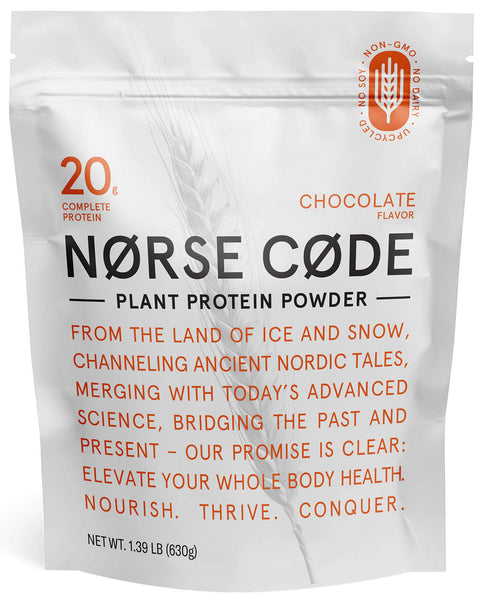
A powder is one way to put protein into a meal. One scoop of NØRSE CØDE is 20 grams of protein, which equals the low end of that proposed range, so a scoop on its own reaches the bottom and a scoop beside food goes further.
We chose pea, rice and barley for the protein: three sources inside a label of only 9 natural ingredients, with no artificial sweeteners, gums or fillers, and it dissolves in hot or cold liquid with a spoon, so a post-workout shake needs no blender. One customer who uses it after rides wrote:
"I have tried a few protein powders specifically for post workout consumption. Really like Norse Code, blends well in smoothie and tastes great - plus the nutrition i need for post workout/ride."
We would rather you heard this here than at the bottom of a bag: it contains coconut, from the MCT oil, and the barley means it is not gluten-free. For how it compares with other powders, see our guide to the best protein powder and NØRSE CØDE against Orgain.
Conclusion
Decide today which meal in your week usually has the least protein, and write the grams in that meal next to its name. That one number is what a scoop would be added to, and it gives you something to compare after two weeks.
A bag of ours is 14 servings, which is two weeks at one scoop a day with that meal, and the 60-day money-back guarantee leaves the remaining weeks to decide whether to reorder or ask for a refund.
Ready to try it?
Backed by a 60-day money-back guarantee. If it is not the smoothest protein you have had, send it back.
Shop NØRSE CØDE
Sources
- National Library of Medicine, MedlinePlus Genetics. "How do genes direct the production of proteins?" Transcription, translation, mRNA, ribosome, codon, tRNA, stop codon and the central dogma. medlineplus.gov
- Schoenfeld BJ, Aragon AA. "How much protein can the body use in a single meal for muscle-building? Implications for daily protein distribution." *Journal of the International Society of Sports Nutrition*, 15:10, 2018. DOI: 10.1186/s12970-018-0215-1. Population: adults doing regimented resistance training.