Open the fridge and the cupboard and look at what is in there. Most kitchens already hold four or five foods that carry a real amount of protein, and the useful skill is knowing which ones, and how much a normal portion of each gives you. We make a protein powder, and this page is mostly about the other ways to get there. All the food numbers below are from the USDA's FoodData Central, per 100 grams of the food as listed.

Our protein
55% preferred it in a blind taste test. 20g protein per serving, no artificial sweeteners or fillers.
$49.99 for 1 bag, 14 servings. 60-day money-back guarantee, no questions asked.
What are the most protein-rich foods?
Roasted chicken breast, dried pumpkin seeds and cooked farmed salmon lead the foods most kitchens stock, at 31.0g, 30.2g and 22.1g of protein per 100 grams in USDA data. The numbers describe each food as it is eaten, so roasted chicken is measured cooked and the seeds are measured dry.
Almonds and tempeh sit just under the salmon, at 21.2g and 20.3g per 100 grams. The list mixes meat, fish, seeds and nuts, so the choice can follow whichever of them you already buy and like to eat.
Which plant foods are rich in protein?
Tempeh and firm tofu carry the most protein of the plant foods you cook with, at 20.3g and 17.3g per 100 grams. Cooked lentils and chickpeas come in at roughly half that, because they are mostly water by the time they reach the plate.
Both tempeh and tofu are soy. Tofu in the USDA entry is raw, firm and set with calcium sulfate, so what you buy in a block is what the number describes. Tempeh is fermented, which gives it a firmer, nuttier bite. If you have never cooked either, slice a block of tofu, press it with a clean towel for ten minutes and pan-fry the slices. That one change makes it a different food. Lentils and chickpeas read low on the chart because of that water.
Which animal foods are rich in protein?
A hard-boiled egg carries 12.6g of protein per 100 grams and plain nonfat Greek yogurt carries 10.3g. Meat and fish sit well above both, so eggs and yogurt are the easy options you can eat cold, standing at the fridge, with no cooking.
Boil six eggs on Sunday and you have breakfast sorted until Friday. Yogurt works the other way: it carries a little less than an egg and takes no preparation at all. Buy it plain and add your own fruit. Chicken and salmon need a pan or an oven, which is the real reason they feature less in a rushed week than their numbers suggest.
Is protein per 100 grams the right number to compare?
Per 100 grams puts foods on the same footing, so it works for comparing them with each other. For planning a meal, use the weight of your portion, since nobody eats exactly 100 grams of anything: a handful of pumpkin seeds is about 28 grams, which works out to roughly 8g of protein.
Take that handful as a worked example. Pumpkin seeds sit near the top of the per-100-gram chart, and the handful still delivers well under a third of what 100 grams would. Weigh the portion you eat once on a kitchen scale and write its weight and protein on a sticky note inside the cupboard door. For the seeds, the note would read about 28g and about 8g.
How do you get more protein into a day without cooking more?
Add it to food you already eat. Yogurt at breakfast, a handful of seeds on a salad and an egg alongside lunch each add protein without a new recipe. The foods that work are the ones that take under a minute, since those are the ones that happen every day.
Start with the meal that has the least protein in it. If breakfast is thin for you, that is the easiest place to add one item, and the same goes for a mid-afternoon gap. One of our customers described how that looks in practice: "I use it right after working out at the gym and with my morning yogurt/berries/granola." The pattern is a food you already eat with a protein added to it, and the same logic works with a spoon of seeds in your oats.
Where does a protein powder fit among protein-rich foods?
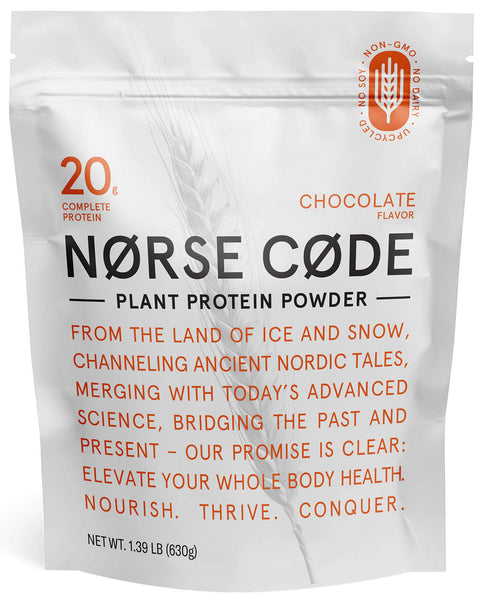
A powder adds a measured amount of protein to a day, on top of the foods above. One scoop of NØRSE CØDE has 20g, in a glass you can stir with a fork.
We built it as a way to add protein on a day when there is no time to cook. The label has nine natural ingredients, and the protein is a blend of pea, rice and barley. It took over a thousand iterations, over two years, to get a powder that dissolves without a blender. In a blind taste test, more people chose NØRSE CØDE than Orgain and a leading whey protein combined. It is a good partner for the egg and yogurt breakfast from the answer above, and our guide to the best protein powder goes through the choices if you are shopping.
Conclusion
Once you have weighed a few portions, add up the sticky notes for one ordinary day. A 28g handful of pumpkin seeds is about 8g, so the total shows which meal is thin before you add anything. If a scoop of NØRSE CØDE would fit in that meal, its 20g goes straight onto the total.
Do the sticky notes today, while the cupboard is open. If the thin meal turns out to be breakfast, order a bag now, so the first scoop goes into the yogurt you already eat and you can read your new total that same morning. The 60-day money-back guarantee covers the bag if it sits unfinished, no questions asked.
Ready to try it?
Backed by a 60-day money-back guarantee. If it is not the smoothest protein you have had, send it back.
Shop NØRSE CØDE
Sources
- USDA FoodData Central, SR Legacy, accessed 2026-10-06. Chicken, broilers or fryers, breast, meat only, cooked, roasted (FDC 171477): 31.0g protein per 100g.
- USDA FoodData Central, SR Legacy, accessed 2026-10-06. Seeds, pumpkin and squash seed kernels, dried (FDC 170556): 30.2g.
- USDA FoodData Central, SR Legacy, accessed 2026-10-06. Fish, salmon, Atlantic, farmed, cooked, dry heat (FDC 175168): 22.1g.
- USDA FoodData Central, SR Legacy, accessed 2026-10-06. Nuts, almonds (FDC 170567): 21.2g. Tempeh (FDC 174272): 20.3g. Tofu, raw, firm, prepared with calcium sulfate (FDC 172475): 17.3g.
- USDA FoodData Central, SR Legacy, accessed 2026-10-06. Egg, whole, cooked, hard-boiled (FDC 173424): 12.6g. Yogurt, Greek, plain, nonfat (FDC 330137): 10.3g.
- USDA FoodData Central, SR Legacy, accessed 2026-10-06. Lentils, mature seeds, cooked, boiled, without salt (FDC 172421): 9.02g. Chickpeas, mature seeds, cooked, boiled, without salt (FDC 173757): 8.86g.