If your protein powder has a Prop 65 warning on the back, that is a disclosure the maker added under a California law, about trace amounts of something like lead. It is not a finding that the powder is unsafe. Ours has one as well.
What does a Prop 65 warning on protein powder mean?
It means the company that makes the powder chose to print California's standard notice for a chemical on the state's list. Proposition 65 sets no limit on what a product may contain. It sets the daily exposure below which no notice is needed, and each company decides whether its product needs one.
California voters passed the law in 1986.[1] A business needs the notice unless it can show the exposure stays under the state's line.[2] Showing that takes more than one test. The line is a daily amount for an average user, so the answer depends on how much of the product people eat as well as on what is in it.[7] Lead in a crop also shifts from field to field and harvest to harvest, so a result from one batch does not settle the next.[10] A notice printed on the bag covers every batch, every flavour and every way people use it. That is why a business can reasonably print it even when its product may sit under the line.
Nobody from the state reviews a label before the notice goes on it. California's guidance says businesses make their own determinations.[3]
So a company can work out that a day's servings stay under the line and leave the notice off. Or it can print the notice. Both are within the law.
What does a Prop 65 warning on protein powder actually say?
The standard food version reads: "Consuming this product can expose you to chemicals including lead, which is known to the State of California to cause cancer and birth defects or other reproductive harm."[4] It then points to P65Warnings.ca.gov/food. It names the chemical. It never says how much is in the product.
Since January 2025 food labels can also use a shorter version, and it has to name the chemical too: "Risk of cancer and reproductive harm from exposure to lead."[5] Packaging printed before 2028 may keep the older short form, so you will see both on shelves for a while.
The line behind the notice is a daily amount. For lead it is half a microgram a day.[6] It is worked out from how much of the product an average user eats in a day.[7] One scoop a day and three scoops a day are different exposures from the same bag, and the label reads the same for both people.
Is a protein powder with a Prop 65 warning safe to drink?
The warning is not a safety ruling, and California says so in plain words: a Prop 65 warning "does not mean that a product or place violates safety or health standards."[8] The line it uses for lead, half a microgram a day, sits well below the reference levels the FDA works from.
The FDA's reference level for women of childbearing age is about 18 times California's line.[9]
Even the FDA's level for children, the strictest it uses, is four times higher than California's.[9]
None of that makes lead harmless. The FDA says there is no known safe level of lead exposure, and it aims to bring lead in food as low as possible over time.[9]
Why is there lead in protein powder at all?
Plants take up lead from the soil they grow in, and animals take it in from the plants they eat.[9] Protein powder is made from one or the other, so trace lead can come along with it. The FDA measures lead in everyday foods through its Total Diet Study.
Its numbers make the state's threshold easier to picture. 0.5 micrograms is about what a third of a cup of cooked spinach holds, going by the Total Diet Study average.[10][11]
The same testing lets the FDA estimate what people already take in from ordinary food. For an average American adult, that comes to somewhere between 1.7 and 5.3 micrograms daily.[12]
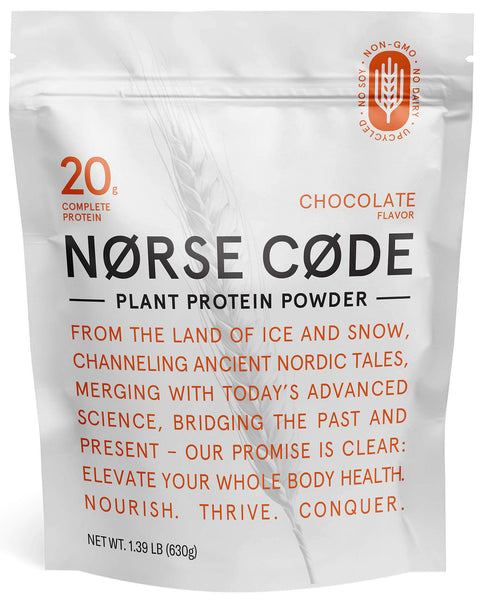
NØRSE CØDE Plant Protein
20g protein per serving, dissolves in any liquid, no blender needed.
Shop NØRSE CØDE
Why does one protein powder carry the warning and another does not?
Each company makes its own call, and several different situations produce the same blank label. A powder can go without the notice because the company showed it stays under the line, because the company is too small for the law to apply, or because it is not sold in California.
The size rule is simple: businesses with fewer than 10 employees are outside the law.[3] A small brand can ship to California and print nothing, however its powder would measure.
On the other side, the maker of a tub with the notice may have measured it over the line, or may print the notice across every batch without measuring each one. California does not require a test before a business decides.[3]
Does NØRSE CØDE carry a Prop 65 warning?
Yes. Our bag carries California's Prop 65 notice, and we print it to comply with California law for food sold in the state. It uses the same standard wording as any other food warning, names a chemical on the state's list, and points to the state's website for more information.
The notice cannot tell you what else is in the bag, so here it is. NØRSE CØDE has only 9 natural ingredients. No artificial sweeteners, gums, or fillers. The protein comes from pea, rice and barley, three sources counted inside those nine, alongside prebiotic acacia fiber. Allulose and monk fruit do the sweetening, with 0g total and 0g added sugar in both flavours and no sugar alcohols.
That short list is what one verified buyer of our chocolate flavour, new to protein powder, picked us on. From the five-star review: "I chose it because of clean ingredients. I love the taste and how it easily mixes with plant based milk or your liquid of choice."
We third-party test every input for heavy metals. We make it ourselves, in our own facility in Petaluma, California, which keeps the choice of every ingredient in our own hands.
Conclusion
A Prop 65 notice on a tub is a disclosure its maker chose to make. It carries no amount and no verdict on safety, so it cannot rank one powder against another. We print it on ours.
Sources
- [1] California Office of Environmental Health Hazard Assessment (OEHHA), "About Proposition 65." https://oehha.ca.gov/proposition-65/about-proposition-65
- [2] California Health and Safety Code § 25249.10. https://leginfo.legislature.ca.gov/faces/codes_displaySection.xhtml?lawCode=HSC§ionNum=25249.10
- [3] OEHHA, "Frequently Asked Questions for Businesses," P65Warnings.ca.gov. https://www.p65warnings.ca.gov/business-resources/frequently-asked-questions-businesses
- [4] California Code of Regulations, Title 27, § 25607.2 (food exposure warnings). https://www.law.cornell.edu/regulations/california/27-CCR-25607.2
- [5] OEHHA, final regulation text, Clear and Reasonable Warnings amendments, effective January 1, 2025. https://oehha.ca.gov/sites/default/files/media/2025-01/finalregtext112624approval_0.pdf
- [6] OEHHA, "Current Proposition 65 No Significant Risk Levels (NSRLs) and Maximum Allowable Dose Levels (MADLs)." https://oehha.ca.gov/proposition-65/general-info/current-proposition-65-no-significant-risk-levels-nsrls-maximum
- [7] California Code of Regulations, Title 27, § 25821 (level of exposure, reproductive toxicants). https://www.law.cornell.edu/regulations/california/27-CCR-25821
- [8] OEHHA, "Frequently Asked Questions," P65Warnings.ca.gov. https://www.p65warnings.ca.gov/faq
- [9] U.S. Food and Drug Administration, "Lead in Food and Foodwares." https://www.fda.gov/food/environmental-contaminants-food/lead-food-and-foodwares
- [10] Seyfferth, A. L., Limmer, M. A., Runkle, B. R. K., Chaney, R. L., "Mitigating Toxic Metal Exposure Through Leafy Greens: A Comprehensive Review Contrasting Cadmium and Lead in Spinach," GeoHealth, 2024 (FDA Total Diet Study boiled spinach 1991 to 2017, mean lead 0.008 mg/kg). https://pmc.ncbi.nlm.nih.gov/articles/PMC11181011/
- [11] USDA FoodData Central, "Spinach, cooked, boiled, drained, without salt" (1 cup = 180 g). https://fdc.nal.usda.gov/food-details/168463/nutrients
- [12] Gavelek, A., Spungen, J., et al., "Lead exposures in older children, women of childbearing age and adults: FDA total diet study 2014-16," Food Additives & Contaminants: Part A, 2020, 37(1):104-109. https://pubmed.ncbi.nlm.nih.gov/31647750/
Ready to try it?
Backed by a 60-day money-back guarantee. If it is not the smoothest protein you have had, send it back.
Shop NØRSE CØDE