Chalky is the word people reach for most when a shake goes wrong. It's a dry, powdery film on the tongue and the back of the throat that outlasts whatever flavor was layered on top of it. It shows up most with whey, and it has a specific, findable cause. Here are the eight questions worth working through, starting with the one everybody actually means.
Is whey protein chalky?
Some of it, yes. Whey isolate and concentrate are dense, low-moisture powders, and when a scoop doesn't fully dissolve, the undissolved bits sit on the tongue as a dry film that reads as chalk. How much liquid you use and how hard you shake it change the outcome as much as the brand does.
Whey concentrate carries more fat and lactose than isolate, and that extra material tends to clump rather than dissolve, which is a common source of the coating people describe. Ten ounces of water against a scoop built for twelve makes the same tub worse before flavor even enters into it. Check the ounces marked on your shaker cup before you switch brands over this.
Why does whey protein taste chalky in the first place?
Processing strips whey isolate of fat and lactose, and that stripped-down powder needs more thickener or flavoring to taste like anything, which is often where the dry, dusty aftertaste comes from. Cocoa is a common contributor too: it's naturally chalky on its own, before the whey even joins it.
Plain unsweetened cocoa powder has that same dry, chalky texture before anything else touches it. A chocolate whey has to work hard to hide that underneath sweetener and flavoring, and on a cheap formula it doesn't fully manage it. The same brand's vanilla tub often tastes cleaner than its chocolate one, simply because there's less dry powder fighting the rest of the mix.
Does plant protein taste chalky too?
It can, for a related reason. Pea and rice protein isolates start out grittier than whey, so a plant blend has to work harder to end up smooth. Gums are the usual fix, and they trade one texture problem for another: a shake that dissolves fine can turn slimy instead.
That's the tradeoff a lot of plant protein is built around. A powder engineered to dodge chalk often lands on slimy instead, and a formula that gets both right is doing something more specific than just picking a protein source.
Can you fix a chalky protein shake?
Often, yes, without changing the tub. More liquid, a longer shake, and a minute of sitting before you drink it clear up a surprising amount of chalk. Past that, the ingredient list is doing the rest of the work, and a dusty formula stays dusty no matter how long you stand at the counter shaking it.
Try twelve ounces instead of eight before you blame the brand. A blender bottle with a wire whisk ball breaks up more than a shaker cup alone, and giving the shake thirty seconds to sit lets the powder finish hydrating instead of drinking it half-dissolved. If none of that changes anything, the formula itself is the ceiling.
Why do some protein powders turn gritty even after they mix smooth?
Fine, insoluble protein particles can look fully dissolved in the shaker and still feel gritty on the tongue, because a cup only shows you the liquid. It doesn't show you what's still suspended in it. This is more common with cheaper isolates and with blends stacking several protein sources that don't hydrate at the same rate.
A pea protein and a rice protein don't absorb water on the same schedule. Blend them without accounting for that, and the cup looks fine while one of the two is still sitting there half-hydrated when you drink it. More shaking at that point just moves the liquid around the slower protein.
Does chocolate or vanilla protein powder taste chalkier?
Chocolate, most of the time. Cocoa solids are dry and slightly gritty on their own, and a chocolate powder leans on more of them to taste like anything. Vanilla usually reads cleaner, because there's no cocoa in the mix working against the rest of the formula.
We hear this from our own customers too. One wrote in after finding us at a race: "I really like this protein powder. I received a flier at a spartan race my family and I did last year. I have been holding on to this flier for all this time and finally decided I needed to give it a try, and I am so glad I did. It's smooth, clean, and tastes great." That's the shape we're building both flavors toward, chocolate included.
How does NØRSE CØDE avoid the chalky problem?
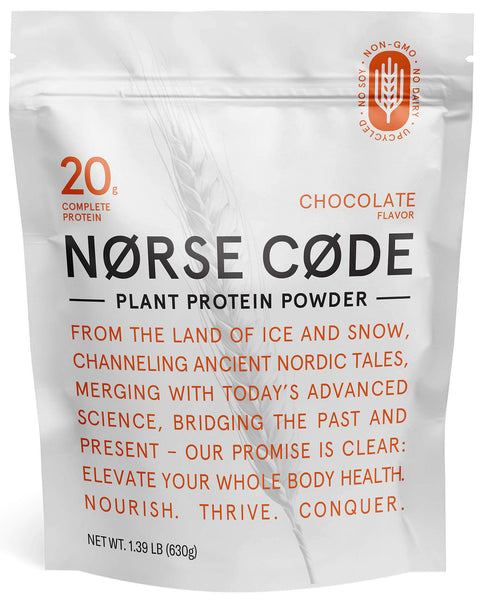
We built it around nine natural ingredients and a pea, rice and barley blend that hydrates evenly, with no gums doing the work of holding it together. In a blind taste test, more people chose NØRSE CØDE than Orgain and a leading whey protein combined.
The blend is the actual mechanism: three protein sources that absorb liquid at closer rates than one isolate alone, so there's less of the half-hydrated grit that makes a shake feel dusty. Prebiotic acacia fiber and allulose with monk fruit round out the label instead of a gum, and both flavors carry 0g total sugar with no sugar alcohol doing the work in its place. The full ingredient breakdown covers what's in and what's deliberately left out, and what we tested every ingredient against is its own page.
Does milk fix a chalky shake instead of water?
Often, yes. Dairy or oat milk carries fat that coats the tongue, and that coating masks the dry, grainy sensation chalk leaves behind. Switch the same scoop from water to milk and it feels like a different drink, even though the undissolved particles sitting in the glass never changed.
Whole milk does more of this than skim, simply because it carries more fat to work with. Oat milk brings some of the same effect from its own fat content. Water does nothing to hide what's still suspended in it, which is why the same scoop tastes chalkier mixed in water than it does mixed in milk, even though the powder itself hasn't changed at all.
Conclusion
Chalk is fixable some of the time and a formula problem the rest of the time. A longer shake, more liquid, or swapping in milk covers the fixable kind. A blend that hydrates unevenly, or a chocolate flavor leaning hard on cocoa, is the formula kind, and it looks the same in the glass every morning until the tub is replaced.
NØRSE CØDE ships with a 60-day money-back guarantee, so finding out which kind yours is costs nothing but a scoop.
Ready to try it?
Backed by a 60-day money-back guarantee. If it is not the smoothest protein you have had, send it back.
Shop NØRSE CØDE