Most people have never actually added up a day of protein. Three meals, maybe a snack, a rough sense that it's probably fine. Body weight, activity level, the type of protein, and how well a given scoop actually sits with you move the real total more than most people assume.
How much protein a day do you actually need?
Most healthy adults land somewhere around 0.8 grams per kilogram of body weight as a baseline, more if you're active or trying to build muscle. For a 150-pound person that's roughly 55 grams a day at the low end, spread across meals rather than eaten in one sitting.
That number sits at the low end. Athletes and anyone training regularly often need close to double it. Body weight, activity and goals move the target from there, and well over 100 grams a day is normal for someone lifting hard several times a week.
Does the type of protein matter as much as the total grams?
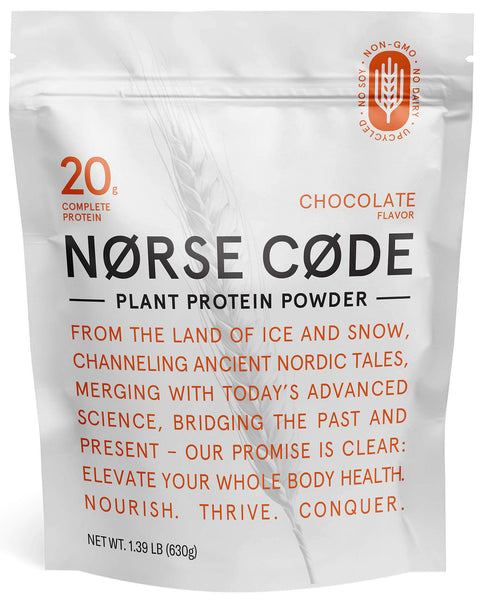
The grams get most of the attention, but the source matters too. Ours comes from three plants, pea, rice and barley, blended specifically because each covers gaps the others leave, inside a label of nine natural ingredients total.
Pea protein alone runs low on certain amino acids that rice and barley happen to supply, and rice runs short on what pea covers. Blending the three was a formulation decision. It took more than a thousand iterations to land on the ratio. A single-source plant protein can still get you to your daily total. A blended one gets there with a broader amino acid spread per scoop.
Is 20 grams of protein in one serving enough for a whole day?
A single scoop covers a fraction of the day. Breakfast might carry 15 grams from eggs, lunch another 20 from chicken or lentils. A shake adds one more piece: 20 grams, sweetened with allulose and monk fruit, with 0g total and 0g added sugar either way.
Twenty grams was not picked at random. It sits close to what one meal already contributes, which is the amount a shake can realistically add without turning into a meal replacement in its own right.
Do you need more protein on days you work out?
Generally, yes, especially if the goal is muscle repair or growth rather than just meeting a minimum. A shake after a workout is a common way people add a serving without planning a whole extra meal around it, especially on a morning with no time to cook eggs before heading out.
The timing matters less than people assume. Getting the total in somewhere across the day does more than trying to hit a narrow window right after training.
Can you get too much protein in a day?
For most healthy adults eating well above the minimum, tolerance is rarely the limiting factor. Extremely high intakes are usually unnecessary for typical fitness goals, and food quality and total calories matter more than pushing protein higher and higher.
In practice, tolerance to a specific source matters more than any theoretical ceiling. That's a separate question from how much you eat in a day.
Does how a protein powder sits with you change how much you actually get?
It does. A skipped scoop is zero grams, and people skip a powder over texture, over a stomach reaction, or just because they stopped liking the taste. Ours carries prebiotic acacia fiber for digestion, and in a blind taste test more people chose it over Orgain and a leading whey protein combined.
One customer got a flier at a Spartan race, held onto it for a year, and finally tried it: "I really like this protein powder. I received a flier at a spartan race my family and I did last year. I have been holding on to this flier for all this time and finally decided I needed to give it a try, and I am so glad I did. It's smooth, clean, and tastes great."
Conclusion
Six questions, one shopping list: a rough target set by your weight and activity, a protein source that covers more ground than one plant alone, a shake that adds a real 20 grams without eating up the rest of the day's budget, timing that matters less than the daily total, a ceiling most people never come close to, and a scoop you actually finish. That last one decides more than any number above it.
Ready to try it?
Backed by a 60-day money-back guarantee. If it is not the smoothest protein you have had, send it back.
Shop NØRSE CØDE