Protein advice reaches you as three kinds of number: a multiple of what you weigh, a figure for each meal, and the flat amount printed on a label. They answer different questions. We make a plant protein powder, so one answer includes ours.
How many grams of protein should you eat a day?
The Dietary Guidelines for Americans, 2025-2030 set a protein goal of 1.2 to 1.6 grams per kilogram of body weight per day.
For a 70 kg adult that works out to 84 to 112 grams.
The Recommended Dietary Allowance, 0.8 grams per kilogram or 56 grams for the same adult, is the lower, older figure.
Do the sum with your own weight. Divide your weight in pounds by 2.2 to get kilograms, then multiply by 1.2 and by 1.6. Two examples:
- 60 kg (132 lb): 72 to 96 grams
- 90 kg (198 lb): 108 to 144 grams
Write your two results on the first line of a notes page.
Is the 0.8 grams per kilogram figure still the right one?
A 2026 Perspective in The Journal of Nutrition argues that the higher range rests on a rapid review of weight-management trials, and that this evidence is too narrow to support one recommendation for every American at every age. The 0.8 figure still stands for the narrow question it was built for, which is how much protein prevents deficiency in a healthy adult.
That is the figure behind most nutrition labels, and the disagreement explains why two reputable sites can hand you two different numbers on the same afternoon. If you are healthy and your intake sits between 0.8 and 1.6 grams per kilogram, you are inside every current published recommendation. Pick a number in that band, keep it for a month, and see how your days feel.
How many grams of protein should go in each meal?
A practical figure from the sports-nutrition literature is 0.4 grams per kilogram per meal.
For a 70 kg adult that is about 28 grams a meal, across at least four meals.
It comes from studies of people doing regular resistance training, so treat it as a target for that group and a reference point for everyone else.
Four even meals is a lot of structure for a weekday. Two meals that hit the number, a lighter third and a snack is closer to how most days go. Look at what you ate this morning and count the grams. If it came to under ten, you have found the meal to work on first, and the other two can stay as they are.
How do you find out how many grams you actually eat?
Write down every food you eat for three days in a row, with the grams of protein per serving from its label. One day misleads, because a Tuesday and a Saturday look different. Divide the three-day total by three and set it beside your range.
Check the serving size before you write anything down. Picture the wrapper in your hand on day two: the front says 10 grams, the back says the bar is two servings, and you ate the whole bar. The log line says 20. Foods with no label need a lookup, and the USDA's FoodData Central lists grams of protein per portion for most of them. We have no tidy way to log a restaurant dinner, so estimate it and put a question mark next to it. At the end of day three you have your average and your range side by side. If your average sits below your range, that gap in grams is what you are short by.
Can a scoop of protein powder cover part of your daily grams?
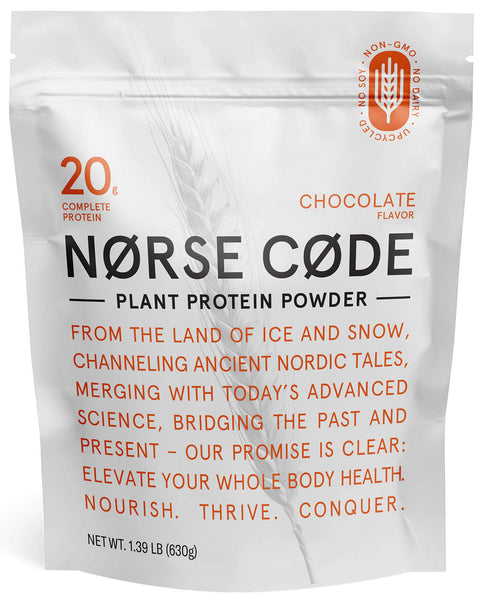
Yes, by the amount on the label. One scoop of NØRSE CØDE is 20 grams of protein.
Against a daily range of 84 to 112 grams, that is roughly a fifth to a quarter of the day. Whatever powder you buy, read the grams per scoop off its label and put that number in your sum.
We chose pea, rice and barley for the protein: three sources inside a label of only 9 natural ingredients, with no artificial sweeteners, gums or fillers. A customer put the whole review in six words:
"Love love love. Only protein I use."
It contains coconut, from the MCT oil, and the barley means it is not gluten-free. Twenty grams a scoop is the floor we hold ourselves to, and some powders carry more per scoop, so the label on whichever tub you pick supplies the number for your sum.
Is there such a thing as too much protein?
The National Academies set an acceptable range for protein of 10% to 35% of daily calories for adults, and set no upper limit because the data were not adequate to do so. If you have kidney disease or any condition that changes how your body handles protein, talk to your doctor before raising your intake.
Take a 2,000-calorie day, with protein at 4 calories a gram:
| Share of calories |
Calories from protein |
Grams of protein |
| 10% |
200 |
50 |
| 35% |
700 |
175 |
The 84 to 112 grams from the first question sits well inside that band. The missing upper limit reflects a gap in the evidence, so intakes far above the band remain an open question.
If your three-day average comes out above 175 grams on a 2,000-calorie day, take it to a doctor or a dietitian before you add a scoop.
Conclusion
Once you have your three-day average, subtract it from the low end of your range. Say your average is 70 grams and the low end is 84: the gap is 14 grams, which one scoop covers with room to spare. A gap of 20 grams or less is one scoop's worth. A larger gap is worth splitting between a scoop and food at the lightest meal you counted. If there is no gap, you do not need a powder at all.
A bag of ours is 14 servings, so one scoop a day lasts two weeks, and the 60-day money-back guarantee lets you finish the bag and decide afterwards. If your gap came out at 20 grams or less, that is a bag you can start this week.
Ready to try it?
Backed by a 60-day money-back guarantee. If it is not the smoothest protein you have had, send it back.
Shop NØRSE CØDE
Sources
- US Departments of Agriculture and Health and Human Services, *Dietary Guidelines for Americans, 2025-2030*, released 7 January 2026. Protein serving goals of 1.2 to 1.6 grams of protein per kilogram of body weight per day, adjusting as needed for individual caloric requirements. cdn.realfood.gov/DGA.pdf
- Food and Nutrition Board, Institute of Medicine, National Academies. "Dietary Reference Intakes: Recommended Dietary Allowances and Adequate Intakes, Total Water and Macronutrients." Protein 56 g/day for adult men and 46 g/day for adult women, with 0.8 g/kg for the reference body weight, and an Acceptable Macronutrient Distribution Range of 10% to 35% of calories with no Tolerable Upper Intake Level stated. ncbi.nlm.nih.gov, summary table 4 and summary table 5
- Pasiakos SM, Davis TA, Klurfeld DM, Neuhouser ML, Rodriguez NR, Tomé D. "Perspectives on the Protein Recommendations in the 2025-2030 Dietary Guidelines for Americans." *The Journal of Nutrition*, 2026, article 101754. DOI: 10.1016/j.tjnut.2026.101754
- Schoenfeld BJ, Aragon AA. "How much protein can the body use in a single meal for muscle-building? Implications for daily protein distribution." *Journal of the International Society of Sports Nutrition*, 15:10, 2018. DOI: 10.1186/s12970-018-0215-1. Population: adults doing regimented resistance training.