How many calories are in a gram of protein?
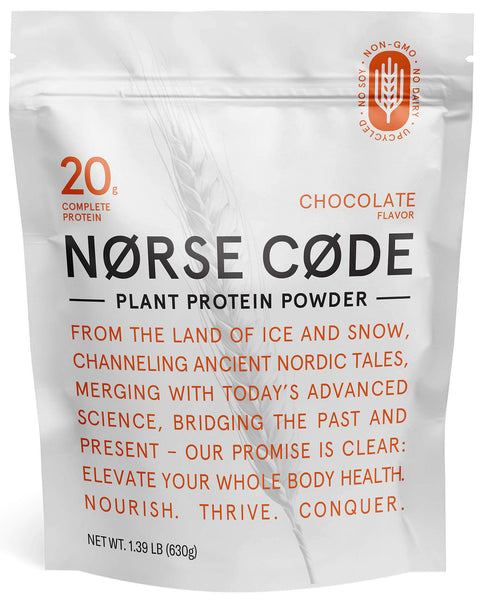
Every protein source runs through the same FDA math, plant or animal alike.[1] The conversion factor for protein is four calories per gram. Scoop 20g of NØRSE CØDE into your shaker and that's about 80 calories from protein alone, before the rest of the blend adds its own.
Why does protein have fewer calories per gram than fat?
Fat carries 9 calories per gram, more than double protein's 4, under the same FDA math.[1] A tablespoon of oil and a scoop of protein powder can sit at close to the same weight on a kitchen scale and still land nowhere near the same calorie count, because fat is doing more work per gram. We keep that math simple on our own label: only 9 natural ingredients, nothing added just to bulk out the scoop.
Does protein quality matter as much as calories per gram?
Protein quality is a separate question from the calorie math. Calories per gram is fixed at 4 no matter the source; what varies is the amino acids that gram brings with it. Pea protein runs short on two aminos that rice and barley cover, so we blend all three inside one nine-ingredient label rather than build around a single source. A gram from that blend and a gram from a single-source powder still cost you the same 4 calories. The blend is built for the amino acids it delivers.
Is 20g of protein per serving enough, or should you look for a higher dose?
Twenty grams clears what most people are trying to add to a meal, and a few competitors do print a higher number on the label. What decides the real total is whether the bag keeps getting opened. One customer put why that matters more than the spec sheet:
"Love love love. Only protein I use."
A 20g scoop you actually drink every day adds up to more protein over a month than a 30g scoop that sits half-used in the cupboard.
Does calories per gram change between plant and whey protein?
The 4-calorie rule holds across sources; what changes is what else rides along with that gram. A whey concentrate carries lactose sugar alongside its protein, and that sugar adds its own 4 calories per gram on top. Whey isolate is filtered further, stripping most of that away to land closer to protein alone. Our blend keeps its own math simple: three protein sources doing the amino acid work, plus a small amount of acacia, a prebiotic fiber that helps the shake feel like food instead of powder, at a fraction of the calories per gram that protein or fat carry.
How much of a protein powder's calories come from added sugar or sweeteners?
Depends on what's doing the sweetening. Sugar runs 4 calories per gram, stacked right on top of whatever the protein already contributes.[1] We sweeten NØRSE CØDE with allulose and monk fruit, so both flavors land at 0g total sugar and 0g added sugar, with no sugar alcohol picking up the slack behind them either. That sweetness costs nothing extra beyond the count already listed above.
Does a lower-calorie protein powder mean a better one?
A lower number on the label is easy to produce: cut the protein, thin the flavor, or shrink the scoop, and the count drops with it. In a blind taste test, more people chose NØRSE CØDE than Orgain and Optimum Nutrition Gold Standard combined, at the full 20g and full flavor. We make it ourselves, in our own facility in Petaluma, California, where changing the recipe means changing it on our own schedule, not a co-packer's. For the fuller ingredient-by-ingredient rundown, we ran that comparison here. Curious how the blend stacks up against a specific brand instead: Orgain and Vega Sport are the two closest side-by-sides we've published.
Sources
- [1] U.S. Food and Drug Administration, 21 CFR 101.9, "Nutrition labeling of food" (caloric conversion factors), accessed 2026-09-27. https://www.ecfr.gov/current/title-21/chapter-I/subchapter-B/part-101/subpart-A/section-101.9
Ready to try it?
Backed by a 60-day money-back guarantee. If it is not the smoothest protein you have had, send it back.
Shop NØRSE CØDE