For someone over 60, the best plant-based protein powder is whichever one you will still be drinking most mornings in five years. Ours is NØRSE CØDE: 20g of protein from a three-source plant blend of pea, rice and barley, inside a label of nine natural ingredients or less. Both flavors are zero sugar, sweetened with allulose and monk fruit. No gums, and it wets evenly in one stir, hot or cold. We third-party test every input for heavy metals. 55% preferred it in a blind taste test.
The daily number after 60, and the per-meal number underneath it
Two expert groups have published a daily protein figure for older adults. PROT-AGE issued its position paper in 2013, ESPEN followed in 2014, and they arrived at the same floor.
- Daily protein, both groups: at least 1.0 to 1.2 grams per kilogram of body weight.[1][2]
- The RDA both papers measure against: 0.8 g/kg.[1] That figure was set to prevent deficiency across a whole population.
- For a 75 kg adult, that puts the daily range at 75 to 90 grams.
- Both papers address people over 65. Your sixties are the runway into that guidance.
A second question sits underneath the daily total. What changes between your fifties and your sixties is how much protein a single meal has to carry. Muscle is built from the protein in a given meal, and the amount required to switch that process on fully rises with age. A 2015 analysis in The Journals of Gerontology pooled dose-response data from healthy older men, average age 71, and healthy younger men, average age 22, and located the point where muscle protein synthesis stopped climbing.[3]
- Older men: 0.40 grams of protein per kilogram of body weight, eaten in one sitting.
- Younger men: 0.24 grams per kilogram.
- For a 75 kg adult, the older figure works out to about 30 grams at a meal.
Older muscle responded weakly to the smaller doses that were sufficient at 22.[3] The practical consequence is where the scoop goes. A scoop stirred into water between meals is a snack. The same scoop taken alongside breakfast brings that meal toward the 30 gram mark. Every powder below reaches at least 18 grams a serving, so each of them carries most of a meal's share. None of them reaches 30 grams alone, which is why the scoop belongs alongside food rather than instead of it. Dose is a floor to check here, and it will not be what separates these ten.
What separates them is whether the powder survives contact with an actual morning, five days a week, for years. That comes down to four things.
The daily arithmetic, and how to spread it across a day, lives on its own page: how much protein adults over 50 actually need.
Four things that decide a daily powder
How it behaves in the glass. A powder that needs a blender gets used on mornings when there is time for a blender. Most smooth-mixing powders reach that texture with xanthan or guar gum. We built ours to wet evenly without them, so a scoop, your liquid and a spoon is the whole procedure.
How it sits afterwards. Gums and sugar alcohols are the two ingredient groups we hear named most often when a shake feels heavy an hour later. A shake that feels heavy gets skipped, and the daily total goes unmet on the days it does. Both groups are declared on the panel, so this is checkable before you buy.
What sweetens it. This is where these ten diverge most. Five name monk fruit or stevia or both, two are unsweetened, one uses thaumatin, and two decline to name what they use. Three carry an added sugar or a sugar alcohol behind the sweetener. Ours uses allulose and monk fruit, and both flavors come out at zero sugar, added or otherwise. On a powder you intend to drink daily, that line deserves as much attention as the protein figure.
Whether you like drinking it. No label answers this, and it determines whether the bag gets finished. The only honest evidence is a taste test somebody else scored. We ran one on three proteins, ours among them. 55% preferred it in a blind taste test.
One more thing worth knowing as you read packaging: USDA Organic certifies how a crop was farmed and handled. A lab test of the finished powder is a separate check. Plenty of labels present the two together, and the table below keeps them apart.
Ten plant-based powders, read off the label
Every figure below was read on 22 August 2026 from each brand's own product page. Ours leads, and the remaining nine are alphabetical.
| Powder |
Protein |
Sweetener |
Gums or sugar alcohols |
Added sugar |
Price per serving |
| NØRSE CØDE |
20g |
Allulose, monk fruit |
None |
None, 0g |
$2.54 on the eight-bag subscription, $3.57 for one bag bought once |
| Aloha Organic Protein Powder |
18g |
Monk fruit extract, coconut sugar |
Xanthan gum |
5g total sugars, added figure not broken out |
About $2.20 |
| Momentous 100% Plant Protein |
20g |
Stevia and monk fruit, Reb M in the vanilla |
None; brand states free from gums and stabilizers |
2g organic cane sugar |
About $2.27 |
| Naked Pea |
27g |
None, unsweetened |
None; one ingredient on the label |
2g total sugars, naturally occurring |
$0.76, published by the brand |
| Nuzest Clean Lean Protein |
18 to 21g by flavor |
Thaumatin |
None; brand states no gums, thickeners or emulsifiers |
None, 0g |
About $2.25 |
| Ora So Lean & So Clean |
23g |
Not named; page states no stevia and no erythritol |
No erythritol per the page; gums not addressed |
None, 0g |
About $2.50 |
| Orgain Organic Protein |
21g |
Organic stevia and erythritol |
Erythritol |
Less than 1g declared |
Servings count not stated |
| Sprout Living Epic Protein Original |
26g |
None, unsweetened |
None; brand states free of gums |
None, 0g |
About $2.91 |
| Transparent Labs Organic Vegan Protein |
24g |
Not named on the page |
Not addressed on the page |
Page states no added sugar |
About $1.67 |
| Truvani Plant Based Protein |
20g |
Organic vanilla powder, organic monk fruit |
None; brand states gum free |
Not stated |
About $3.00 |
Testing, as each brand's own page describes it on the same date:
- NØRSE CØDE: we third-party test every input for heavy metals, and check each one against its spec before a bag is filled.
- Aloha: USDA Organic certified and Non-GMO Project verified, with no lab testing program named.
- Momentous: NSF Certified for Sport, with batch testing for purity, potency and label accuracy.
- Naked: independent third-party testing for heavy metals, stated on the product page.
- Nuzest: ISO 17025 accredited laboratories, covering heavy metals, pesticides and glyphosate among others.
- Ora: outside lab testing, with results shared publicly.
- Orgain: USDA Organic certified, with no lab testing program named.
- Sprout Living: ingredients and finished goods checked by an outside lab.
- Transparent Labs: Informed Choice and Informed Protein certified, with purity results published.
- Truvani: no testing program named.
What we could read is what each brand publishes on its own page.
1. NØRSE CØDE
This formula took more than 1,000 iterations over two years, and most of them were thrown out on texture. A three-source plant blend of pea, rice and barley carries the 20g, and getting that blend smooth without reaching for a gum is what the iterations were spent on. Prebiotic acacia fiber goes in as well, which is part of why the shake feels like food instead of powder. We make it ourselves in our own facility in Petaluma, California, so when something needs fixing we start on it the same week. A bag holds 14 servings, roughly two weeks of daily use, which is why the subscription exists.
2. Aloha Organic Protein Powder
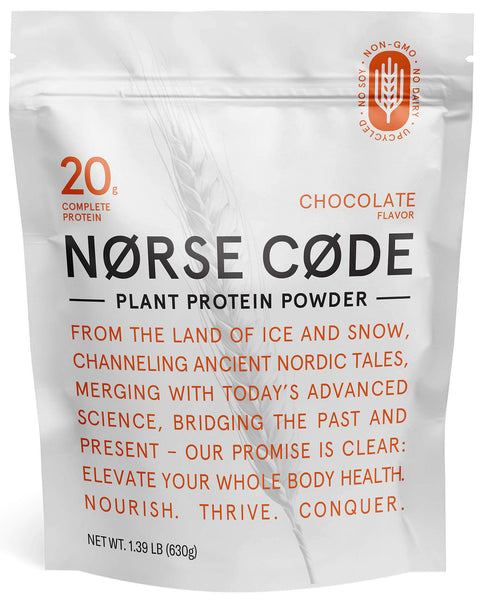
NØRSE CØDE Plant Protein
20g protein per serving, dissolves in any liquid, no blender needed.
Shop NØRSE CØDE
Pea and brown rice lead here, with hemp seed and pumpkin seed behind them, reaching 18g on a fully organic label. Blue agave inulin supplies the fiber, monk fruit extract and coconut sugar do the sweetening, and xanthan gum handles texture. Total sugars land at 5g a serving, with coconut sugar accounting for part of that.
3. Momentous 100% Plant Protein
Pea protein and organic brown rice protein make up 20g a serving on a list with no gums or stabilizers. It holds NSF Certified for Sport, a program that screens finished batches for purity, potency and whether the label matches the contents. Two grams of organic cane sugar are declared on the panel.
4. Naked Pea
One line on the ingredient list: pea protein from yellow split peas grown on US and Canadian farms. It reaches 27g a serving with 2g of naturally occurring sugars and nothing added, and the brand states independent third-party testing for heavy metals. It is unflavored and unsweetened, so it tastes like peas. Blended with fruit that carries its own flavor, that goes unnoticed. Straight into water it is a different experience. Naked sells it in a 5lb tub, so the smallest way in is still a large bag.
5. Nuzest Clean Lean Protein
Three things go into this one: pea protein isolate, natural flavors, and thaumatin, a sweetener drawn from the katemfe fruit. Protein runs 18 to 21g depending on flavor and total sugars are zero. The brand states there are no gums, thickeners or emulsifiers in it, and testing runs through ISO 17025 accredited laboratories.
6. Ora So Lean & So Clean
Organic pea protein and organic rice protein make up 23g a serving. Added sugar is zero, the page states there is no stevia and no erythritol in it, and Ora says its outside testing results are shared publicly. Ora does not say what it sweetens with.
7. Orgain Organic Protein
Widely stocked in supermarkets. Twenty-one grams of organic plant protein a serving, with 7g of prebiotic and fiber alongside, organic stevia and erythritol doing the sweetening, and under 1g of added sugar declared. The full ingredient list appears on the product page only inside a nutrition-panel image, so the additives are legible on the canister in a store and hard to read from a phone.
8. Sprout Living Epic Protein Original
Sprout Living declares 26g a serving on a six-line label. Pea, pumpkin seed and sunflower seed protein do the work, with chia seed, cranberry seed and Jerusalem artichoke root alongside. It is unsweetened, and it tastes distinctly of the seeds it is made from. That reads as an ingredient in a blended drink and as the main event in a glass of water.
9. Transparent Labs Organic Vegan Protein
Twenty-four grams a serving, drawn from organic rice protein concentrate and organic pea protein isolate on the panel. Those two forms are worth knowing apart: a concentrate carries more of the original plant along with the protein, and an isolate carries less. This label uses both. It is Informed Choice and Informed Protein certified, and Transparent Labs publishes its purity results.
10. Truvani Plant Based Protein
Five organic lines on this label and nothing else: pea protein, pumpkin seed protein, chia seed protein, vanilla powder and monk fruit, at 20g a serving. No stevia and no gums. The protein is a concentrate, so more of the plant travels with it, and no added fiber goes into the blend.
What a bag costs
The table above carries a per-serving figure for each powder, the price on the page divided by the servings on the container. Orgain publishes a price without a serving count, so its row carries no figure.
Price is worth checking before you commit to a subscription, and it is not what separates these ten. The spec table above carries our full range, from the eight-bag subscription to a single bag bought once. What ours buys is on the panel: no gums, zero sugar in either flavor, and third-party testing on every input.
Choosing between them
Sorted on what the labels declare:
- Gums and sugar alcohols: two carry one, Aloha with xanthan gum and Orgain with erythritol. Six state they contain none: ours, Momentous, Naked, Nuzest, Sprout Living and Truvani. Ora rules out erythritol without addressing gums, and Transparent Labs addresses neither.
- Sweetener: eight of the ten will tell you what sweetens them. Ora and Transparent Labs will not. Of the eight, Naked and Sprout Living are unsweetened outright and Nuzest uses thaumatin. The other five, ours included, use monk fruit or stevia or both.
- Added sugar: six declare none, ours, Naked, Nuzest, Ora, Sprout Living and Transparent Labs. Naked's 2g of total sugars occur naturally in peas, with nothing added. Momentous declares 2g of organic cane sugar, Orgain under 1g, and Aloha lists coconut sugar behind 5g of total sugars. Truvani leaves the figure unstated.
- Testing: seven of the ten name a lab testing program, ours included. Aloha and Orgain name certifications of practice without one, and Truvani names neither. The programs differ in what they cover, so read what each one actually tests.
Four clear every one of those declarations: ours, Naked, Nuzest and Sprout Living. Two of those four are unflavored or unsweetened, which suits a blender and a handful of fruit. Nuzest runs a single pea isolate and a sweetener drawn from fruit. Ours is sweetened with allulose and monk fruit at zero sugar, and it is built to be drunk plain, in water, at the counter, on a morning with four minutes in it.
Taste is what no label will tell you in advance. We cover it with 60 days, money back, no questions asked, which is long enough to find out across four or five mornings a week.
Ready to try it?
Backed by a 60-day money-back guarantee. If it is not the smoothest protein you have had, send it back.
Shop NØRSE CØDE
Sources
- [1] Bauer J, Biolo G, Cederholm T, et al. "Evidence-Based Recommendations for Optimal Dietary Protein Intake in Older People: A Position Paper From the PROT-AGE Study Group." *Journal of the American Medical Directors Association*, 14(8):542-559, August 2013. DOI: 10.1016/j.jamda.2013.05.021
- [2] Deutz NE, Bauer JM, Barazzoni R, et al. "Protein intake and exercise for optimal muscle function with aging: Recommendations from the ESPEN Expert Group." *Clinical Nutrition*, 33(6):929-936, December 2014. DOI: 10.1016/j.clnu.2014.04.007
- [3] Moore DR, Churchward-Venne TA, Witard O, Breen L, Burd NA, Tipton KD, Phillips SM. "Protein Ingestion to Stimulate Myofibrillar Protein Synthesis Requires Greater Relative Protein Intakes in Healthy Older Versus Younger Men." *The Journals of Gerontology: Series A*, 70(1):57-62, January 2015. DOI: 10.1093/gerona/glu103