Updated: August 24, 2026
The lowest-footprint substitute for whey starts with the protein source. Plant proteins as a category carry a smaller land, water and greenhouse gas footprint per gram of protein than dairy protein.[1]
That much is settled, and it is also where most sustainability copy stops. The question that separates ten plant powders from each other is what the protein was before it was protein: a crop grown for the purpose, or a material recovered from something that already happened. Everything else, the offsets and the packaging and the manufacturing, sits on top of that answer.
Ten plant proteins below, ours first, then nine others in no particular order. A published figure proves only that the claim is checkable. It tells you nothing about whether the footprint is low.
What each brand publishes
| Brand |
Protein base |
Protein per serving |
Sweetener |
Sugar |
The environmental fact it publishes |
Source |
| NØRSE CØDE |
Pea, rice, upcycled barley |
20g |
Allulose, monk fruit |
0g total, 0g added |
Barley protein recovered from brewers' spent grain; a supplier-commissioned life-cycle analysis puts it below pea protein isolate |
[2][3][4] |
| ALOHA |
Pea |
18g |
Coconut sugar, monk fruit |
5g total sugars |
5,828 metric tonnes of CO2 offset in 2023, against its 2022 footprint; Climate Neutral certified |
[5] |
| Drink Wholesome |
Almond, coconut |
15g or more, stated as "15+" |
Monk fruit |
Not stated on the page we read |
No environmental figure on the product page we read |
[10] |
| Huel |
Pea, rice, oat |
20g |
Not stated on the page we read |
Not stated on the page we read |
Develops meals against a published per-meal emissions target; company carbon intensity independently assured |
[9][14] |
| Nuzest |
Pea isolate |
20g |
Thaumatin |
0g |
Water purified and recycled after pea isolation; leftover material to biofuel and animal feed |
[6] |
| Orgain |
Pea |
21g |
Stevia, with erythritol |
Under 1g |
40% of the plastic removed from its containers, which it puts at 30,000 pounds a year; sugarcane-based caps |
[7] |
| Sunwarrior |
Rice |
15g to 19g by flavor |
Organic stevia leaf |
Not stated on the page we read |
Tubs made with post-consumer recycled materials |
[8] |
| Transparent Labs |
Pea, rice |
24g |
Not named on the page we read |
Page states no added sugar |
No environmental figure on the product page we read |
[11] |
| Truvani |
Pea, pumpkin seed, chia |
20g |
Monk fruit |
Not stated on the page we read |
No environmental figure on the product page we read |
[12] |
| Vega |
Pea, pumpkin seed, sunflower seed |
30g |
Stevia leaf extract |
None stated |
No environmental figure on the product page we read |
[13] |
Four of the ten carry no environmental figure on the product pages we read. A bag can look green from across the aisle and still have nothing behind it you can check.
1. NØRSE CØDE
Our protein comes from three sources: pea, rice and upcycled barley. The barley is the part worth explaining, because it is the part most people have never heard of.
Brewing leaves behind an enormous residue stream. Spent grain is roughly 85% of everything solid a brewery discards.[2] The world produces 36.4 to 38 million tonnes of it a year, and most of it becomes low-value animal feed or goes to landfill, where it releases about 513 kg of CO2e per tonne.[2][3]
Our barley protein is pulled out of that stream. A life-cycle analysis commissioned by the ingredient supplier benchmarked the material against soy, pea, whey and egg white powder, and put it at a lower footprint than pea protein isolate.[4] The study was paid for by the company that sells the ingredient, which is worth knowing while you read it. Nothing was planted to make it.
We held the formula to nine natural ingredients or less, and the three protein sources all sit inside that count, alongside prebiotic acacia fiber, allulose and monk fruit. No gums, no fillers, no artificial sweeteners, and both flavors come out at 0g total sugar and 0g added sugar with no sugar alcohol standing in. We make it ourselves in our own facility in Petaluma, California, in small batches, which is the part of a supply chain we could get our hands on directly.
It ships in a stand-up bag. That is a smaller thing than the barley and we mention it anyway, because the zip on it is still not as good as we want and a customer told us so before we noticed.
In a blind taste test, 55% preferred it. Here is a customer review, left by someone who came to us off whey:
"Outstanding! I have been looking for an alternative to whey protein, the last remaining animal product in my diet. Dissolves beautifully and tastes great even in cold water. Better yet in coffee. The use of upcycled barley is brilliant. Also, cool name."
2. ALOHA
An offset is a payment made once the emissions have already happened, which puts it downstream of every sourcing decision the powder was built on. ALOHA's version of it is dated and specific, and a year attached to a number is what lets anyone check it later.[5]
3. Nuzest
Because compostable film still cannot hold an airtight seal for a full shelf life, the tub stays HDPE, and Nuzest says so on the same page where it describes what happens to its water and its leftover plant material.[6] Naming the trade-off is rarer than making it.
4. Orgain
Orgain went after the container rather than the contents.[7] The powder inside is the pea protein it always was, and the claim on the page is about resin and caps, which is a real change and a narrow one.
5. Sunwarrior
Recycled content does more work on a tub than on a pouch, because a rigid container starts out heavier.[8]
6. Drink Wholesome
Almonds and coconut carry the protein here, and neither is an annual row crop. Almond farming is irrigated year round in a way an annual pea crop is not, so the water question changes shape. That reading is ours, incidentally. The product page publishes no environmental figure for us to check it against.[10]
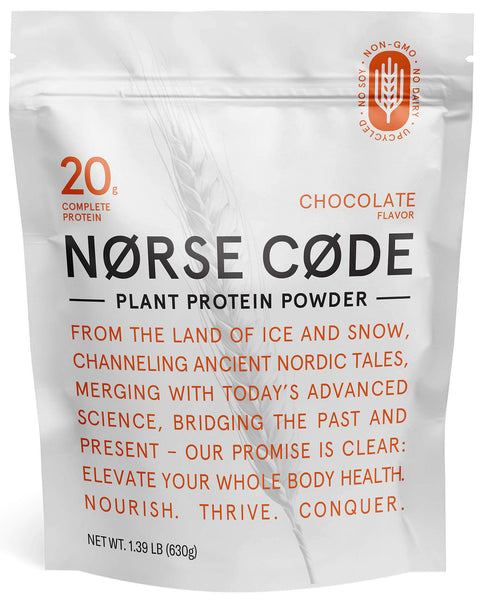
NØRSE CØDE Plant Protein
20g protein per serving, dissolves in any liquid, no blender needed.
Shop NØRSE CØDE
7. Huel
Sold as a meal replacement before it is sold as a protein powder, Huel measures what a whole meal costs the atmosphere and holds itself to a target drawn from WWF's One Planet Plate work, with company-level carbon intensity assured under ISO 14064-3.[9] Its unit of account is the meal, so a scoop of it sits inside a bigger number than the rest of this list reports.
8. Truvani
Every ingredient is tested for glyphosate, with The Detox Project's thresholds used as the floor, and Truvani sources organic wherever it can get it.[15] Those are claims about what goes on a field. Carbon and packaging go unmentioned on the same page.
9. Vega
Type myvega.com/pages/climate-action into a browser and you land on the homepage. The same happens with the eliminate-waste and sustainability addresses, all three checked on 2026-08-24.[16] Each address still answers, and what it answers with is the storefront. The product page itself carries no environmental figure.[13]
10. Transparent Labs
Whey built the name. The brand also sells a vegan line on organic pea and rice protein, and organic certification is the only sustainability-adjacent claim on that page: it governs the farming inputs behind the crop and stops there.[11]
Why taste decides whether "sustainable" survives a full bag
A lower-footprint protein lowers nobody's footprint if the bag goes stale at the back of a cupboard after two scoops. That is the part a spec sheet cannot measure, and taste is still the first reason people quit a protein powder.
We set the guarantee at 60 days for that reason. Drink it four or five mornings a week and you will know inside three weeks whether it is the one you finish.
Does a grass-fed or organic whey badge count as a substitute?
No. Grass-fed describes what the cows ate, and organic certification governs farming inputs. Both describe how the milk was produced, and the protein is still milk protein. A substitute changes the source.
The same test applies to everything on this page. A B Corp mark scores governance and labor practices, USDA Organic certifies farming inputs, and a traceability program discloses who the suppliers are. Carbon, water and plastic sit outside all three.
Conclusion
Ten brands, one shared move: dairy protein swapped for plant protein, which is the largest single lever any of them pulls.[1] ALOHA, Nuzest, Orgain and Sunwarrior each publish something specific on top of that, an offset figure, a manufacturing process, a plastic reduction, a packaging material. Huel publishes a per-meal target. Four carry no figure we could find.
Ours starts with a protein recovered from a waste stream that already exists. Read the ingredient list and find out where the powder is actually made before taking the word "sustainable" at face value.
Sources
- [1] Poore, J. & Nemecek, T. (2018). "Reducing food's environmental impacts through producers and consumers." *Science*, 360(6392), 987-992. DOI: 10.1126/science.aaq0216. Comparative land, water and greenhouse gas figures per unit of protein summarized in "Environmental Impacts of Food Production," Our World in Data, accessed 2026-08-24.
- [2] Zeko-Pivač, A., Tišma, M., Žnidaršič-Plazl, P., et al. (2022). "The Potential of Brewer's Spent Grain in the Circular Bioeconomy: State of the Art and Future Perspectives." *Frontiers in Bioengineering and Biotechnology*, 10:870744. DOI: 10.3389/fbioe.2022.870744.
- [3] Aradwad, P., Raut, S., Abdelfattah, A., Rauh, C., & Sturm, B. (2025). "Brewer's spent grain: Unveiling innovative applications in the food and packaging industry." *Comprehensive Reviews in Food Science and Food Safety*, 24(3):e70150. DOI: 10.1111/1541-4337.70150.
- [4] Life-cycle analysis of the upcycled barley protein used in the NØRSE CØDE blend, commissioned by the ingredient supplier and benchmarking the material against soy protein isolate, pea protein isolate, whey protein isolate and egg white powder. Study on file; the supplier is not named here. Full record: `references/barley-environmental-footprint.md`.
- [5] ALOHA, "How ALOHA Became Climate Neutral Certified in 2023," accessed 2026-08-24.
- [6] Nuzest, "How Sustainable is Clean Lean Protein?" accessed 2026-08-24.
- [7] Orgain, "B Corp certification and packaging," accessed 2026-08-24.
- [8] Sunwarrior, "Our Commitment to Quality, the Planet, and You," accessed 2026-08-24.
- [9] Huel, "Sustainability," huel.com. Accessed 2026-08-23.
- [10] Drink Wholesome, vegan protein powder product page, drinkwholesome.com. Accessed 2026-08-23.
- [11] Transparent Labs Organic Vegan Protein, transparentlabs.com. Accessed 2026-08-24.
- [12] Truvani Plant Based Protein, shop.truvani.com. Accessed 2026-08-23.
- [13] Vega Protein + Recovery, myvega.com. Accessed 2026-08-24.
- [14] Huel, protein powder product page, huel.com. Accessed 2026-08-24.
- [15] Truvani, "Test Results" ingredient standards page, truvani.com/testresults. Accessed 2026-08-24.
- [16] Vega, sustainability page addresses `myvega.com/pages/climate-action`, `myvega.com/pages/eliminate-waste` and `myvega.com/pages/sustainability`, each returning an HTTP 301 redirect to the myvega.com homepage when requested on 2026-08-24.
Ready to try it?
Backed by a 60-day money-back guarantee. If it is not the smoothest protein you have had, send it back.
Shop NØRSE CØDE