Updated: August 24, 2026
A sustainable protein source is one you can trace to a checkable fact: how much land and water it took to grow, whether it was farmed for the purpose or pulled out of something else, and whether the brand will name its own process plainly.
We built NØRSE CØDE on pea, rice and upcycled barley protein because that combination answers all three. Here is the whole field on those measures, and then what is true about each one that a table cannot hold.
| Source |
Land |
Water |
Crop or byproduct |
Protein per serving |
| Pea |
Low |
Low |
Crop |
High |
| Rice |
High |
High, paddy irrigation |
Crop |
High |
| Barley (upcycled) |
None grown for it |
None grown for it |
Byproduct of brewing |
High |
| Soy |
Moderate, swings on origin |
Moderate |
Crop |
High |
| Whey |
High, upstream dairy herd |
High, upstream dairy herd |
Byproduct of cheesemaking |
High |
| Hemp |
Low |
Low |
Crop |
Low |
| Algae and spirulina |
Almost none, ponds and tanks |
Low, recirculated |
Cultivated in water |
Moderate |
| Cricket |
Low |
Low |
Farmed insect |
High |
| Collagen |
High, upstream cattle herd |
High, upstream cattle herd |
Byproduct of meat processing |
High |
| Pumpkin and other seeds |
Low |
Low |
Byproduct of oil pressing |
Low |
| Mycoprotein |
Low direct, moves to the feedstock crop |
Moderate |
Fermented on sugar |
High |
| Potato |
None grown for it |
Low |
Byproduct of starch making |
Moderate |
| Fava and chickpea |
Low |
Low to moderate |
Crop |
High |
Land and water here are directional ratings, not one dataset's numbers. Nobody publishes a single table that covers all thirteen on the same boundary and the same functional unit, and pretending otherwise is how footprint pages go wrong. The hard figures that do exist are cited in the sections below, with the study each came from.
Pea, rice and barley: the blend behind NØRSE CØDE
We picked three sources for three different reasons, and only one of them is a story.
Peas fix their own nitrogen out of the air, which removes a large share of the fertilizer behind most crop emissions. Poore and Nemecek's 2018 assessment of roughly 38,700 farms puts peas at 0.44 kg of CO2e per 100 g of protein, against 10.82 for cheese.[1]
Rice is where we have to be straight with you. It draws on a crop already grown at enormous scale for food, so the marginal cost of pulling protein out of it stays low, and it does work in the blend that pea alone does not do. In that same dataset, though, rice sits at 6.27 kg of CO2e per 100 g of protein, the highest figure of any plant entity Poore and Nemecek measured.[1] Flooded paddy is why. We use rice anyway, we think the blend is better for it, and anyone checking our citation was going to find that line eventually.
Barley is the third source, and it works differently from the other two. Ours is upcycled from brewers' spent grain, the wet grain a brewery is left with once the sugars have been mashed out.
Spent grain is roughly 85% of everything solid a brewery discards, and the world produces 36.4 to 38 million tonnes of it a year.[2][3]
Two things make it useful. It runs 18.5% to 24.7% protein by dry matter, which is what makes it a protein input at all.[2] And landfilled, it releases about 513 kg of CO2e per tonne, so keeping it out of the ground counts for something on its own.[3]
A life-cycle analysis commissioned by the ingredient supplier benchmarked it against soy, pea, whey and egg white powder, and put it at a lower footprint than pea protein isolate.[4] That study was paid for by the company selling the ingredient and it is not peer reviewed, which is worth knowing while you read the number. Nothing was planted to grow it.
Then we controlled the rest ourselves. We make NØRSE CØDE in our own facility in Petaluma, California, in small batches, inside a label of 9 natural ingredients or less. All three protein sources sit inside that count. It ships in a stand-up bag.
In a blind taste test, more people chose NØRSE CØDE than Orgain and Optimum Nutrition Gold Standard 100% Whey Protein Powder combined. A bag that goes stale in a cupboard saved nobody anything. One customer, in a review of the chocolate:[6]
"The upcycled barley is a cool sustainability bonus, and it's dairy-free, which works great for me and especially my lactose intolerant wife."
Soy
Where it grew decides more about a soy protein than anything else you can find out about it. Soy off established US or Canadian farmland and soy tied to recent clearing in the Amazon or the Cerrado carry very different numbers, and both arrive in a bag labeled "soy protein." Sourced well, it delivers a lot of protein off a given area of farmland, which is the argument its defenders make for it.
Whey and dairy protein
Before there is whey, there is cheese. The milk was headed for the vat either way, and what drains off afterwards was for a long time poured away or spread on fields, so recovering it is a genuine efficiency. What that efficiency does not do is erase the herd. Cows, their feed, their land and their methane all sit upstream of every gram of whey protein, and the powder carries that cost forward with it. How much of the cost belongs to the cheese and how much to the whey is a live argument among the people who do this accounting for a living, and the split moves the final number a long way. Whey saves something real, and it starts from a high baseline.
Hemp
Fast-growing, low on irrigation and pesticide, easy to rotate into a field. Growers put it in rotation for reasons that have nothing to do with protein powder.
Algae and spirulina
Ponds and bioreactors, so no farmland at all, and after fifteen years of being the answer that is ten years away, still a rounding error on the shelf.
Cricket and insect protein
Feed conversion is the whole argument. Crickets turn feed into edible protein far more efficiently than pigs or cattle, and somewhat more efficiently than chickens, on a small fraction of the land.[5] Texture and price have kept the category niche in the US, and neither looks close to being solved.
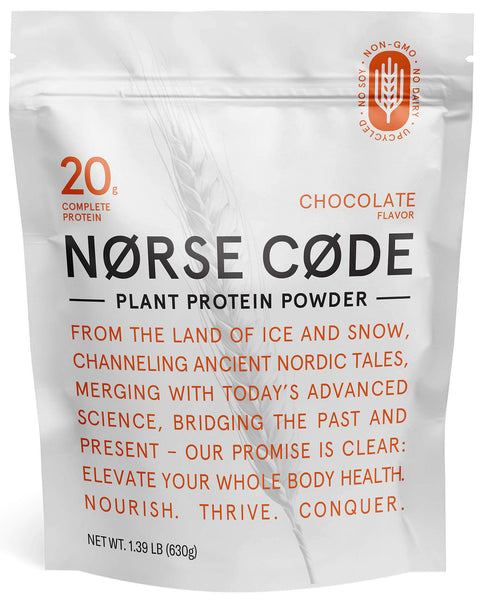
NØRSE CØDE Plant Protein
20g protein per serving, dissolves in any liquid, no blender needed.
Shop NØRSE CØDE
Collagen and bone broth protein
Ask what collagen is recovered from and the answer is animal processing: hides, bones and connective tissue. That makes it a byproduct in the same sense whey is, and it carries the same upstream livestock footprint. It is also low in tryptophan, so it works alongside other protein in a day's eating.
Pumpkin seed and other seed proteins
Pumpkin and sunflower seeds go to the oil press first, and the protein is made from the cake left behind, which makes most seed protein a byproduct of an oil business. Sunflower protein in particular turns up in more powders than most people would guess.
Mycoprotein and fungal protein
Grown in steel tanks by fermenting a fungus on sugar, mycoprotein needs very little farmland of its own and produces protein on a timescale measured in hours. The catch sits upstream: the sugar feedstock is a crop, usually glucose from wheat or corn, so the land does not disappear, it moves. It also comes out as a textured food, so most people meet it as a burger and almost never as a scoop in a shaker.
Potato protein
The potato starch industry throws off a protein-rich liquid it used to treat as wastewater, and potato protein is that liquid, recovered. Nothing is planted for it. Volumes are small next to pea, and it shows up mostly in European formulations, which is why most American shoppers have never seen it on a panel.
Fava bean and chickpea protein
Like peas, both fix their own nitrogen and both earn a place in a rotation on that alone. Fava gives a strong protein yield off an acre. Neither has pea's supply chain behind it yet, so price and availability move around more than a formulator would like.
How to check a sustainability claim yourself
Three questions to ask of any brand's language:
- What specific plant, animal or insect is this protein made from?
- Where was it grown or raised, and was it grown for this, or recovered from something else?
- Can the brand name its ingredients, its manufacturing and its packaging directly, without pointing at a certification badge?
Most brands answer the first two and go quiet on the third. B Corp certification scores governance and labor practices, USDA Organic certifies farming inputs, and a traceability program discloses who the suppliers are. All three are worth holding. None of them measures carbon, water or plastic.
Conclusion
On land and water, plant sources carry the strongest case, and the gap is wide. Recovered sources are the interesting edge inside that: upcycled barley starts from a material a brewery was going to throw away, which saves something no amount of careful farming can save. Algae, mycoprotein and insect protein are smaller-scale options worth watching. Whey and collagen make a real but narrower byproduct argument from a high baseline.
Whichever source you land on, the two things worth finding out are where it was grown or raised, and how the brand actually makes the powder.
Ready to try it?
Backed by a 60-day money-back guarantee. If it is not the smoothest protein you have had, send it back.
Shop NØRSE CØDE
Sources
- [1] Poore, J., & Nemecek, T. (2018). "Reducing food's environmental impacts through producers and consumers." *Science*, 360(6392), 987-992. DOI: 10.1126/science.aaq0216.
- [2] Zeko-Pivač, A., Tišma, M., Žnidaršič-Plazl, P., et al. (2022). "The Potential of Brewer's Spent Grain in the Circular Bioeconomy: State of the Art and Future Perspectives." *Frontiers in Bioengineering and Biotechnology*, 10:870744. DOI: 10.3389/fbioe.2022.870744.
- [3] Aradwad, P., Raut, S., Abdelfattah, A., Rauh, C., & Sturm, B. (2025). "Brewer's spent grain: Unveiling innovative applications in the food and packaging industry." *Comprehensive Reviews in Food Science and Food Safety*, 24(3):e70150. DOI: 10.1111/1541-4337.70150.
- [4] Life-cycle analysis of the upcycled barley protein used in the NØRSE CØDE blend, commissioned by the ingredient supplier and benchmarking it against soy protein isolate, pea protein isolate, whey protein isolate and egg white powder. Commissioned study, on file; the supplier is not named here. Full record: `references/barley-environmental-footprint.md`.
- [5] van Huis, A., & Oonincx, D. G. A. B. (2017). "The environmental sustainability of insects as food and feed: A review." *Agronomy for Sustainable Development*, 37(5), 43. DOI: 10.1007/s13593-017-0452-8.
- [6] Verbatim customer review, NØRSE CØDE Amazon review record dated 18 July 2025, pulled 2026-08-24.