By nature, no. Plant protein takes less land, water, and generates fewer greenhouse gas emissions per gram than whey, which comes from milk. A specific whey brand can still narrow the gap with a grass-fed program or a shorter supply chain. None of that moves whey ahead of a crop grown directly for protein.
Is whey protein sustainable?
That depends on what's being compared. Set against plant protein, whey sits on the higher side of the resource ledger, a fact that comes from the production system itself, so it holds across brands. Set one whey brand against another, real differences show up: a grass-fed program or a shorter supply chain can put one meaningfully ahead of a competitor using the same base ingredient.
Animal agriculture uses more land, water, and energy per gram of protein than a plant crop grown directly for food, regardless of which whey brand does the producing. A brand can improve its own number relative to other whey brands through feed sourcing, transport distance, or farm practices, but that competition happens entirely above the line a plant crop starts under.
Why does whey protein have a bigger environmental footprint than plant protein?
Whey adds a conversion step plant protein skips entirely: grow the feed, raise the cow, process the milk into cheese, then whey. Each stage uses more land, water, and energy than growing a crop for direct human consumption, which is why dairy protein consistently outpaces plant protein in published life-cycle studies.
The clearest public data on this comes from a 2018 analysis in the journal *Science*, built from life-cycle records across roughly 38,000 farms in 119 countries.[1] The table below puts the gap in real terms.
| Food source |
Greenhouse gas emissions |
Basis |
| Cheese |
more than 20 kg CO2-equivalent |
per kilogram of food produced |
| Peas |
about 1 kg CO2-equivalent |
per kilogram of food produced |
Cheese and whey come from the same dairy system, so this twenty-times gap runs through whey's own footprint before the milk ever reaches a protein tub.
Does whey being a byproduct of cheesemaking make it more sustainable?
It makes whey more efficient than raising cattle purely for protein powder, since the milk becomes cheese either way and whey shares that existing footprint. The cattle and feed behind the milk were already required for the cheese, the most resource-intensive stage in the chain, so the underlying number stays close to cheese's own.
That's a genuine efficiency in how the dairy industry uses its raw material, and worth crediting: turning a leftover into a usable protein source is better than wasting it. What it doesn't do is give whey a footprint independent of cheese's, since the cows and feed that made the cheese possible are the same cows and feed the footprint gets measured against.
Does a grass-fed or organic label mean whey protein is sustainable?
No. Grass-fed describes what the cows eat, and organic certification governs farming inputs like synthetic pesticides. Both describe how an animal was raised or fed, a real but separate question from how much land, water, and greenhouse gas the protein cost to produce. A whey powder can carry both labels and still sit high on that scale.
Some grass-fed programs are independently inspected for pasture practices, which is a real audit of how the animal was raised. It isn't an audit of carbon or water, because grass-fed certification was never built to measure either one. A brand that wants to back up an actual environmental claim has to publish a separate, dedicated figure for it.
Does whey protein use more water than plant protein?
Yes. Producing milk requires water for the cows directly and for growing their feed, a layer of use a plant crop skips entirely. Life-cycle studies on dairy consistently show a higher water footprint per gram of protein than pea, rice, or most other plant sources, for the same reason the emissions gap exists.
Every gallon that goes into growing a cow's feed is water a plant protein crop skips entirely, because the plant crop is the finished ingredient and the cow's feed is a stage the milk hasn't even been produced from yet.
Is plant protein actually more sustainable than whey?
As a category, yes. Plant crops grown for protein need less land and water per gram than dairy, and produce far less greenhouse gas, because growing the crop is the entire process. Dairy protein runs through several extra stages first: feed, cow, milk, cheese, whey. That's the finding behind our own decision to build NØRSE CØDE as a plant protein.
The category-level gap comes from the same 38,000-farm analysis behind the table above, so it reflects the production system across many farms and brands rather than one company's marketing.
What's a lower-footprint alternative to whey protein?
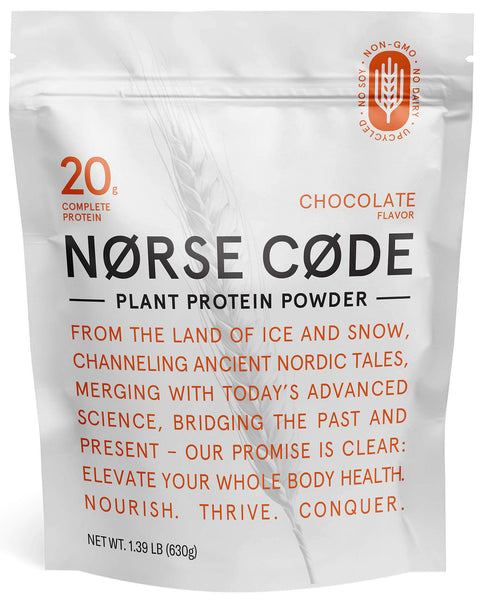
Any protein grown directly from plants: pea, rice, soy, or a blend. We built NØRSE CØDE from pea, rice, and barley protein, made in our own facility in Petaluma, California, 9 natural ingredients or less, with prebiotic fiber from acacia. In a blind taste test, 55% of tasters preferred it, so the lower footprint comes with a formula people actually want to drink.
Making it ourselves means we run the whole process, from formulation through the batch that ships, in our own facility.
Conclusion
Set against a plant protein, whey sits higher on land, water, and greenhouse gas per gram, a gap that traces to the extra stages between growing feed and shipping a finished powder. Being a byproduct of cheese lowers whey's number somewhat, since the cows already existed for the cheese, but it doesn't erase the gap. A grass-fed or organic label answers a real question about how the animal was raised. It doesn't answer the carbon or water question, which takes its own separate figure to actually measure. We built NØRSE CØDE from pea, rice, and barley protein to start from the lower end of that ledger.
Ready to try it?
Backed by a 60-day money-back guarantee. If it is not the smoothest protein you have had, send it back.
Ready to try it?
Backed by a 60-day money-back guarantee. If it is not the smoothest protein you have had, send it back.
Shop NØRSE CØDE
Sources
- [1] Poore, J. & Nemecek, T. (2018). "Reducing food's environmental impacts through producers and consumers." *Science*, 360(6392), 987-992. Per-kilogram emissions figures (cheese, peas) per Our World in Data, "You want to reduce the carbon footprint of your food? Focus on what you eat, not whether your food is local," ourworldindata.org, accessed 2026-08-16.