Most women asking this already know there's a textbook number out there. What they actually want to know is whether a normal day gets them anywhere close to it, and what changes if it doesn't. Here's the honest range, what changes with age, and what actually separates a protein powder that's doing its job from one that's just doing math on a label.
How much protein does a woman need in a day?
The government's baseline is 0.8 grams of protein per kilogram of body weight per day. That's the amount that keeps a sedentary adult from slowly losing muscle, and it was built to find a floor. An active woman, or a woman past 40 trying to hold onto her strength, needs a separate number.
| Reference point |
Grams per kilogram |
A 150-pound woman |
| Government floor, prevents deficiency [1] |
0.8 g/kg |
about 55g a day |
| Active range, Harvard nutrition researchers [2] |
1.2 to 2.0 g/kg |
80 to 135g a day |
Weigh herself, multiply once, and she has the row that actually applies to her, not the one printed on a cereal box.
Does that number change as a woman gets older?
Yes, and the research is more specific about how than most articles let on. Two expert groups, PROT-AGE and ESPEN, each set a protein floor of at least 1.0 to 1.2 grams per kilogram for adults over 65, stated as a minimum with no upper limit given, and both wrote it specifically for that age band.[3][4]
Against the 0.8 g/kg baseline covered above, that floor for adults over 65 runs roughly 30 to 50 percent higher, at the same body weight. Neither group says the shift waits for a birthday: how efficiently the body uses the protein it gets declines gradually, through the 40s and 50s, rather than flipping the day she turns 65. What changes earlier is how the protein she does eat gets distributed through her three meals, which is worth more than the headline number by itself.
How much protein actually needs to land in one meal or shake for it to count?
About 25 to 30 grams in one sitting maximally triggers muscle repair, in young and older adults alike, while a meal under roughly 20 grams produces a smaller response in both groups.[3] Below that per-meal number, the body still absorbs the amino acids, but more of them get burned for fuel and fewer go toward rebuilding tissue.
This is why spreading protein evenly across three meals beats stacking most of it into dinner, the way a typical day tends to run: eggs at breakfast, a sandwich at lunch, a full plate of protein at night. A morning that starts at 8 or 10 grams and adds a 20-gram shake closes most of the gap to that 25-to-30 threshold before lunch even happens. It's mostly a timing fix, and it changes how much of the protein a body actually gets to use.
Is there a point where extra protein stops helping?
A body doesn't stockpile extra protein for later. Eating well past her target on Tuesday won't cover a lighter Wednesday: each day's protein gets used or burned on its own, which is why a steady number most days works better than a big push followed by a lean one.
The same logic holds inside a single sitting. A 20-gram shake does its job once. A second shake back to back, taken as insurance against a day she expects to fall short, mostly adds calories, because the body can only put so much toward repair at a time. A woman chasing a bigger number for the day is better off adding a second serving at a different meal.
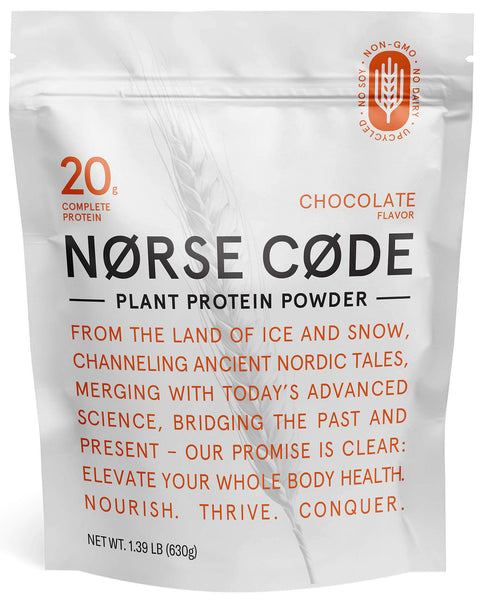
NØRSE CØDE Plant Protein
20g protein per serving, dissolves in any liquid, no blender needed.
Shop NØRSE CØDE
Does where the protein comes from actually matter?
It matters for digestibility and for which amino acids actually show up, more than it matters for the raw gram count on the label. A single plant protein source, taken alone, tends to run short on one or two amino acids a body needs alongside the rest.
Pea protein is well studied and digests well, but it runs naturally lower in the sulfur-containing amino acids methionine and cysteine. Rice protein runs the opposite way: strong on those, lighter on lysine. Neither gap shows up on a nutrition label. The label reports total protein grams; it says nothing about which amino acids came up short. Blending two or three plant sources is one straightforward way to cover for what any single one leaves out. It's the same reasoning behind why a bowl of lentils and rice has fed people for generations without anyone needing a label to explain why it works.
How can a woman tell if a protein powder's protein-quality claim is actually real?
Turn the bag around and read the ingredient list, then count how many protein sources are actually in it. We build NØRSE CØDE on three plant proteins, pea, rice and barley, inside a label of 9 natural ingredients total, specifically so the sources cover for each other the way a single one can't.
Pea carries most of the blend, rice fills in what pea runs light on, and barley rounds out the rest: three sources, inside a nine-ingredient label that skips the gums and fillers longer formulas lean on. The rest of the label is short by design too: prebiotic acacia fiber, which also gives the shake its body without a thickener, allulose and monk fruit for sweetness, and 0 grams of total and added sugar in both flavors. It took over a thousand formulation iterations, over two years, to land that blend, made in our own facility in Petaluma, California. Read the label itself.
What's the easiest way to actually hit the number, every day, without turning it into a project?
Pick one meal where protein is easiest to add, and turn it into a repeatable shake instead of a decision made from scratch every morning. Taste is usually what breaks that repetition: in a blind taste test, more people chose NØRSE CØDE than Orgain and Optimum Nutrition Gold Standard 100% Whey Protein Powder combined.
Most people who buy a second bag come back for a third. The ones that stick are the shakes a woman doesn't have to think about each morning. Skip a week, and every number above stops applying the moment the bag goes quiet in the pantry. One customer described it this way, in her own words: "I really like this protein powder. I received a flier at a spartan race my family and I did last year. I have been holding on to this flier for all this time and finally decided I needed to give it a try, and I am so glad I did. It's smooth, clean, and tastes great. Thank you Norse Code for making this morning ritual for me and my family."
Sources
- [1] National Institutes of Health, Office of Dietary Supplements, "Dietary Supplements for Exercise and Athletic Performance: Health Professional Fact Sheet." https://ods.od.nih.gov/factsheets/ExerciseAndAthleticPerformance-HealthProfessional/
- [2] Harvard Health Publishing, "Are you eating enough protein?" https://www.health.harvard.edu/nutrition/are-you-eating-enough-protein
- [3] Paddon-Jones, D. and Rasmussen, B.B., "Dietary protein recommendations and the prevention of sarcopenia," Current Opinion in Clinical Nutrition and Metabolic Care, 2009. https://pubmed.ncbi.nlm.nih.gov/19057193/
- [4] Bauer, J. et al. for the PROT-AGE Study Group, "Evidence-based recommendations for optimal dietary protein intake in older people," Journal of the American Medical Directors Association, 2013. https://pubmed.ncbi.nlm.nih.gov/23867520/
- [5] Deutz, N.E.P. et al. for the ESPEN Expert Group, "Protein intake and exercise for optimal muscle function with aging," Clinical Nutrition, 2014. https://www.sciencedirect.com/science/article/abs/pii/S0261561414001113
Conclusion
Start with the table above for her own number, then use the ingredient list to judge any bag she's holding. If you're comparing us against a specific brand by name, we've written that up for Huel Black Edition, and our full guide to picking a protein powder covers the rest of the decision.
Ready to try it?
Backed by a 60-day money-back guarantee. If it is not the smoothest protein you have had, send it back.
Shop NØRSE CØDE