The best plant-based protein powder for someone over 40 is whichever one you are still drinking in six months. What changes in your forties is how often the thing gets used, and frequency is what breaks a powder. So it comes down to four questions, in this order: how does it sit an hour later, does it mix without a blender, do you like drinking it, and only then, what is on the ingredient line.
NØRSE CØDE is our answer to all four, and we built it against the frequency problem specifically.
A powder that comes out twice a week only has to be tolerable. A powder that comes out most mornings has to survive boredom, a stomach with opinions, and the small daily friction of getting it into a glass. Almost nothing on an ingredient panel predicts how a powder performs on that test.
What the research actually says, and who it was written for
Two expert groups, PROT-AGE and ESPEN, put the daily protein target for older adults at 1.0 to 1.2 g per kg of body weight. Most packaging still works from the older 0.8 g/kg RDA.[1][2]
Worth knowing before you carry that number around: PROT-AGE scoped its range to adults over 65, and ESPEN wrote for "healthy older people" with no age threshold at all. Neither paper drew a line at 40. So nothing published was written for a forty-five-year-old, and anyone who tells you otherwise is rounding. What both describe is a change that arrives gradually across years, which is the honest reason your forties are when a figure written for later starts being worth watching.
One thing that target does settle: it is a daily total, not a per-scoop bar. For a 70kg reader it comes to roughly 70 to 84g a day, so a 20g scoop covers a quarter to under a third of it and meals carry the rest. Every powder below carries 20g or more, so no scoop here is the weak link, and dose is not what separates them.
The nine, read off the label
Figures come from each brand's own product page, linked in each entry. Momentous, Nuzest, Ora and Transparent Labs were read on 24 August. The NOW Sports, Ritual and Sprout Living rows, and part of the Orgain row, stand on a read from 21 August: NOW Foods blocks automated readers outright, and Orgain serves its ingredient panel as an image we could not read as text. A tenth product, Truvani, is gone entirely, because its product page now returns a 404 and we could not re-confirm a single figure.
| Powder |
Protein |
Sweetener |
Xanthan or guar gum |
Acacia |
Other additions |
Added sugar |
| NØRSE CØDE |
20g |
Allulose, monk fruit |
None on the panel |
Acacia fiber |
MCT oil (contains coconut) |
0g |
| Momentous 100% Plant Protein |
20g |
Organic cane sugar, stevia, monk fruit |
None on the panel |
None |
None |
2g |
| NOW Sports Pea Protein |
24g |
None, unflavored |
None on the panel |
None |
None |
0g |
| Nuzest Clean Lean Protein |
20g |
Thaumatin |
None on the panel |
None |
None |
0g |
| Ora Organic So Lean & So Clean |
23g |
Not named on the page |
None on the panel |
None |
Digestive enzymes |
0g |
| Orgain Organic Protein |
21g |
Organic erythritol, organic stevia |
Guar gum, xanthan gum |
Acacia, in the creamer base |
None |
0g |
| Ritual Essential Protein Daily Shake |
20g |
Rebaudioside-M, monk fruit |
Xanthan gum |
None |
Sunflower lecithin, coconut MCT oil |
Not stated on the page |
| Sprout Living Epic Protein Original |
26g |
None, unsweetened |
None on the panel |
None |
Jerusalem artichoke root |
Not stated on the page |
| Transparent Labs Organic Vegan Protein |
24g |
Not named on the page |
None named on the page |
None |
None |
Not stated on the page |
Acacia gets its own column because it prints as "acacia gum" on some panels and "acacia fiber" on others, and it is one soluble fiber from the acacia tree under both names. Filing it as a gum would mark a competitor down for an ingredient we put in our own bag. Xanthan and guar have a column of their own because thickening is the entire reason a formula carries them.
Where a cell reads "Not stated on the page", the brand's website does not print that figure. Added sugars are a required declaration on a US Nutrition Facts panel, so the number exists on the physical bag even when the site omits it.
The table cannot tell you what any of these taste like, and it is nine label reads. We have not drunk the other eight for a month each, so a texture note below is an inference from the ingredient list and nothing more.
We are first because this is our site and NØRSE CØDE is what we would hand you. The eight after us are in no order at all. The numbering is not a ranking.
1. NØRSE CØDE
The frequency problem is the one we built against. A powder used most mornings gets attacked from three directions at once: it has to keep sitting well, it has to keep being easy, and it has to keep being something you want. Losing any one of those empties the cupboard just as effectively.
Easy came first. Mixing got more of our two years than anything else, because it is what decides whether a powder gets used on a Tuesday. We call the result SmoothBlend. It dissolves in hot liquid or cold, in a glass, with a spoon. No slurry step, no frother, no blender unless you want one. The workarounds this category teaches are all things ours does not need.
Sitting well came out of a decision we made on day one, which was to use no xanthan and no guar. That closed the ordinary route to a smooth mouthfeel and made the next two years hard. Prebiotic acacia fiber is what got us there. It is a soluble fiber, and it helps the shake feel like food instead of powder, which is most of what we were chasing.
Over a thousand iterations, over two years. Texture is what killed most of them.
The label came out at nine natural ingredients or less, which is the rule the product was built around, and acacia doing two jobs at once is part of how that rule survived. The proteins are pea, rice and barley. Allulose and monk fruit do the sweetening, and both flavors land at 0g total sugar and 0g added sugar, with no sugar alcohol standing in. No gums, no fillers.
Two things worth knowing before you spend anything. It contains coconut, from the MCT oil. And barley protein is in the blend, so NØRSE CØDE is not gluten-free: if you have celiac disease or a gluten sensitivity, this is not the protein for you, and we would rather you heard it here.
We make it ourselves in our own facility in Petaluma, California. That is why a problem gets worked on the week we hear about it. We third-party test every input for heavy metals. On the eight-bag subscription a serving is $2.54. A single bag bought once works out at $3.57.
A customer who has been at this longer than we have:
"There are lots of protein powder products on the market. I've used several over the years as a body builder when I was younger and now as a backpacker to add a lightweight meal to my pack. NORSE CODE tops them all. Whey is great but if you want a break from dairy this plant based formula checks all the boxes for nutrients. And both flavors great taste!"
And a four-star review, which covers the daily-use test in one line:
"Pretty good. Not chalky, no horrible after taste. Good protein and didn't cause upset stomach."
In a blind taste test, more people chose NØRSE CØDE than Orgain and Optimum Nutrition Gold Standard 100% Whey Protein Powder combined.
Pea protein isolate, natural flavors, thaumatin. That is the whole list. Thaumatin is a sweet-tasting protein drawn from the katemfe fruit. Sweetness from a protein is a different experience from sweetness from sugar, and reviewers of this one commonly describe a slower onset, though that is their account and not a measurement we have run.
This is the one row carrying anything in the gum column, so it gets a caveat. The guar line, the xanthan line and the acacia-in-the-creamer-base line all come from a read on 21 August, and when we went back on the 24th the ingredient panel was served as an image we could not read as text. Treat all three of those cells as three days old. What we did re-confirm on the 24th: 21g, organic erythritol and organic stevia, no sugar added, USDA Organic. Gums are how this one arrives at its texture.
Nothing sweetens this one, which is the point of it and also the thing to plan around. Unsweetened is easy to admire in August and harder to face on a dark morning in February, so give it a smoothie with its own fruit in it.
Built for people who get drug-tested for a living, which is a narrow customer and it shapes everything. PURIS pea protein and organic brown rice do the work, it holds NSF Certified for Sport, and the page describes independent testing for purity, potency and label accuracy. Momentous also declares 2g of organic cane sugar on its own product page, the only added sugar declared anywhere in the table above.
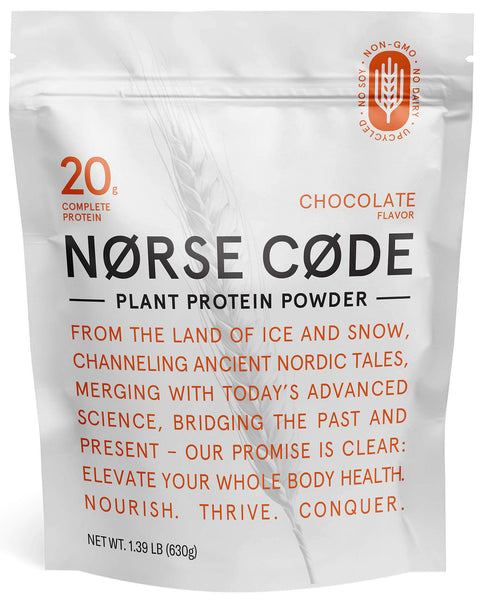
NØRSE CØDE Plant Protein
20g protein per serving, dissolves in any liquid, no blender needed.
Shop NØRSE CØDE
Unflavored pea isolate, and the ingredient list stops there. Whatever this tastes like, you will be deciding it yourself, every morning, which is a small recurring job the other eight have already done for you.
Ritual sells this in age-banded versions, which is at least a real position on whether a body at fifty wants something different from a body at twenty-five. You can argue with the position. Organic pea protein carries the 20g, xanthan gum handles the texture, and there is coconut MCT oil and sunflower lecithin in the mix.
Organic pea protein, which Ora states is 80% isolate, plus organic rice protein, inside a formula the brand builds out to eighteen organic sources with plant-based digestive enzymes. Ora states no gums, fillers or thickeners, and no stevia, erythritol or added sugar. It does not say what does the sweetening.
Organic rice protein concentrate is listed ahead of the pea isolate here, which is unusual in this category, and rice-forward blends tend to land drier on the finish. It holds Informed Choice and Informed Protein certification. The sweetener is not named on the page we read, so settle that with one serving before you commit to a tub.
The part no label covers
Everything in that table you can check before you spend anything. Taste you cannot, and taste is what decides whether a bag is finished or abandoned at the back of a cupboard.
That gap widens with frequency. A flavor you merely tolerate gets far more chances to defeat you at five mornings a week than at two.
Because a label could not settle it for us either, we put ours in front of tasters who did not know whose it was, and the result is in our entry above. One customer got there in two sentences:
"Seriously this is the best daily powder because of how drinkable it is. Never grainy, always tasty."
How to choose
Start with how shakes have sat on you before, which is information you already have and nobody else can give you. If one has left you heavy, look at the xanthan-and-guar column, and at the sweetener column, where Orgain's erythritol is the only sugar alcohol among the sweeteners these brands actually name.
Then look at how it mixes. A powder that needs a blender on a weekday morning is a powder that gets skipped by Thursday, and skipping is how a daily protein target becomes a weekly one.
Then taste, which no column can answer.
The ingredient line comes last. It matters, and it is the evidence underneath the other three, but it cannot stand in for them.
Two or three weeks of drinking the thing most mornings is the only test that settles any of this. Our guarantee runs 60 days, money back, no questions asked, which is enough room to run that test properly.
Sources
- [1] Bauer J, Biolo G, Cederholm T, et al. "Evidence-based recommendations for optimal dietary protein intake in older people: a position paper from the PROT-AGE Study Group." *Journal of the American Medical Directors Association*, 14(8):542-559, August 2013. DOI: 10.1016/j.jamda.2013.05.021
- [2] Deutz NE, Bauer JM, Barazzoni R, et al. "Protein intake and exercise for optimal muscle function with aging: recommendations from the ESPEN Expert Group." *Clinical Nutrition*, 33(6):929-936, December 2014. DOI: 10.1016/j.clnu.2014.04.007
Ready to try it?
Backed by a 60-day money-back guarantee. If it is not the smoothest protein you have had, send it back.
Shop NØRSE CØDE