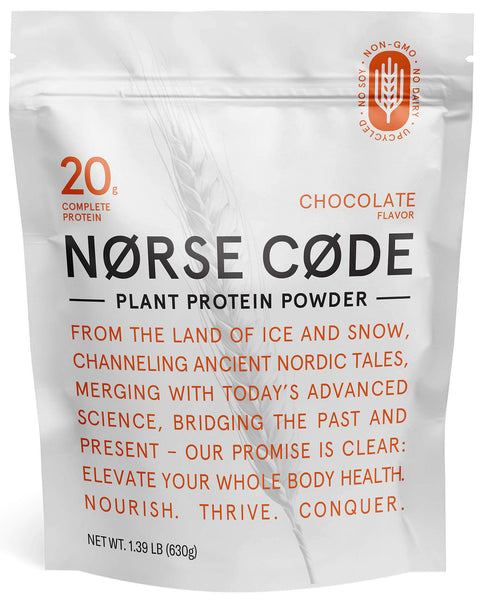
Whey protein's environmental impact comes from the dairy system behind it: producing it takes more land, more water, and generates more greenhouse gas emissions per gram of protein than plant sources like pea or rice. Animal agriculture adds a conversion step that plant protein skips entirely: grow the feed, raise the animal, then process what it produces. We built NØRSE CØDE as a plant protein, from pea, rice, and barley, in part because of that math.
This is the honest version: what the category comparison actually shows, so you can decide for yourself.
Does whey protein have a larger environmental footprint than plant protein?
Yes. As a category, dairy-based proteins carry a larger environmental footprint than plant-based proteins. That comes from the same arithmetic that applies to all animal agriculture: you grow crops, feed them to animals, then process what the animals produce, and each step multiplies the resource use compared to growing crops for direct human consumption.
A widely cited 2018 study published in Science (Poore and Nemecek) found that dairy production uses significantly more land and water, and produces more greenhouse gas emissions per gram of protein, than pea or rice cultivation. The same result shows up consistently across other life-cycle assessments, because the underlying resource math stays similar from study to study.
Whey is a byproduct of cheese production, so it is somewhat more efficient than raising dairy cattle purely to make protein powder. That nuance is real, and the gap still stands: the land, water, and emissions burden of the dairy system whey comes from is meaningfully higher than plant protein production.
How much lower is plant protein's footprint than whey?
Plant proteins are grown directly in soil, with no conversion step through an animal. Plant crops grown for protein need less water and land per gram of protein than dairy-based sources, and produce far less methane. That is the consistent finding across the Poore and Nemecek dataset and the life-cycle assessments that followed it.
We built NØRSE CØDE on a plant base for this reason, and for taste and digestion. A scoop of protein powder is a small piece of a much bigger picture, one choice among many, and a lower-footprint one is available here, with the taste and texture to back it up.
For a full look at what is in that bag, and why we chose each ingredient, The Ingredients That Set Us Apart goes through the formulation in detail. For the head-to-head on digestion, absorption, and taste, The Truth About Whey vs. Plant Protein covers that comparison.
Is the environmental case for plant protein about guilt?
No. Guilt-based arguments tend to fall flat, because they ask people to feel bad rather than give them useful information. Someone who has already been through a few protein powders that did not work out wants a product that solves the problem in front of them: taste, texture, and whether it sits right. The environmental picture is simply one more honest thing to know, alongside those.
The simpler version: if two products are close on quality, taste, and tolerance, and one has a lower environmental footprint, that is worth weighing. All it takes is accurate information and noticing the difference.
What does it actually mean to buy protein that matches how you already live?
The choice has to clear two bars at once: the protein has to work, and it has to line up with what matters to you. The taste has to hold up. The formula has to sit right in your stomach every day. A powder nobody finishes never delivers its environmental advantage either: an unfinished bag in the cabinet does nothing for anyone.
That functional bar gets tested directly. In a third-party, three-way blind taste test, 55% of tasters preferred NØRSE CØDE over Orgain and Optimum Nutrition Gold Standard 100% Whey Protein Powder. It went up against a whey protein and won in a blind setting, proving taste doesn't depend on a dairy source. For the digestion question, Why Vegan Protein Powders Are Easier to Digest explains what drives the difference in how a formula sits over daily use.
NØRSE CØDE comes with a 60-day money-back guarantee. If it does not earn its place in your routine, we refund it, no questions asked. The best way to find out if a plant protein works for you is to try it yourself.
Ready to try it?
Backed by a 60-day money-back guarantee. If it is not the smoothest protein you have had, send it back.
Shop NØRSE CØDE