A protein powder you drink every day gets a level of scrutiny nothing else in the cupboard gets. Since the lead headlines landed, that scrutiny has gone straight to the ingredient line, which is the right place for it. We built NØRSE CØDE around a short one: three protein sources inside a label of nine natural ingredients or less, no gums and no fillers, and we third-party test every input for heavy metals before any of it reaches a batch.
Below is where nine vegan brands stand, ours first, along with what the metals are, where they come from, and what the testing words on the front of a bag do and do not tell you.
Where trace metals in plant protein come from
Not from anything a brand adds. Plants draw minerals out of soil and water as they grow, and lead, cadmium, arsenic and mercury come up through the roots alongside the magnesium and the iron. Vega's own explainer on the subject puts it the same way, and it is true of peas, rice, barley, hemp and cocoa alike. The amount is never fixed. It moves with the field, the water and the season, which is why a single result describes one crop at one moment rather than a brand forever.
What the testing words on a bag actually mean
A lab measures down to a detection limit. The best result any method can return is none detected at that limit, so nobody can truthfully print zero, and the brands worth your attention do not try to. Consumer Reports set its own line at 0.5 micrograms of lead per daily serving, borrowed from California's Proposition 65 maximum allowable dose level, which is the strictest lead standard in wide use.[1] There are no federal limits at all specifying how much lead a protein powder may contain.[1]
Certification programmes measure what a finished batch contains. That is worth something and it is not the same job as controlling what goes in. Testing catches a problem after the ingredient is already in the building; a short, named input list is what keeps the problem out of the building.
What actually separates one bag from the next
You are going to drink this every day for months, so the deciding facts are the daily ones. Whether it sits well. Whether it mixes with a spoon in whatever you are already drinking, hot or cold, without a blender. Whether you like it enough to finish the bag. Then, underneath all three, what is on the ingredient line: how many things are in there, and how many separate places anything unwanted could have come from.
That last one is where the heavy-metals question and the everyday question turn out to be the same question. Fewer inputs, each one named and each one tested, is a smaller surface for contamination and a shorter list to read.
NØRSE CØDE
Nine natural ingredients or less, which is the rule the product was built around. Three protein sources inside that label, pea, rice and barley, with prebiotic acacia fiber, sweetened with allulose and monk fruit. No gums, no fillers. Both flavours carry 0g total sugar and 0g added sugar, so no sugar alcohol is doing the work either. We third-party test every input for heavy metals. Our own quality control then runs at our facility in Petaluma, California, which is what lets us decide what goes in and fix anything that needs fixing on our own timeline rather than a co-packer's.
It dissolves in any liquid, hot or cold, with a spoon. In a blind taste test, more people chose NØRSE CØDE than chose Orgain and Optimum Nutrition Gold Standard 100% Whey Protein Powder combined. One customer, on why she picked it: "My first try of a protein powder. I chose it because of clean ingredients. I love the taste and how it easily mixes with plant based milk or your liquid of choice. An easy and delicious way to up my protein after a workout."
Momentous
Momentous 100% Plant Protein is a pea and rice blend that carries the NSF Certified for Sport mark, meaning each batch goes through independent testing for purity, potency and label accuracy. It reads as a sports-nutrition product first, and the certification is the part buyers in this category usually come to it for. We put the two side by side on our NØRSE CØDE and Momentous comparison.
Naked Nutrition
Naked Pea is a single-ingredient pea protein isolate, which is about as short as an ingredient line gets. The brand states it is independently third-party tested for heavy metals and NSF Contents Certified. Single-ingredient means no sweetener and no flavour, so what it costs you is on the taste side rather than the label side. The full side by side is on our NØRSE CØDE and Naked Nutrition comparison.
Vega
Vega is one of the few brands in the category that has written the soil explanation down in public, on its own heavy-metals page, and it tests raw ingredients and finished product against Proposition 65 and NSF thresholds. The formulas are longer than ours, built around blends rather than a short list. We compare the two on our NØRSE CØDE and Vega comparison.
Transparent Labs
Transparent Labs Organic Vegan Protein is third-party tested for both ingredient verification and product purity, and the brand has built its name on saying so. It is an organic pea and brown rice blend with stevia, which is the sweetener people either get on with or notice immediately. Our head to head is on our NØRSE CØDE and Transparent Labs comparison.
Truvani
Truvani tests every lot of its plant protein for heavy metals and other contaminants and rejects ingredients that miss its internal standards, and told Consumer Reports it had run 162 tests on its chocolate powder over twelve months.[1] That is a lot of testing by category standards. It is an organic pea protein with a short label, and the taste is the usual organic-pea tradeoff.
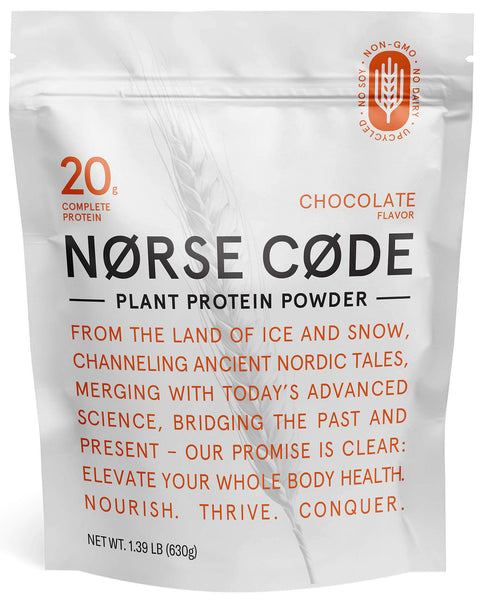
NØRSE CØDE Plant Protein
20g protein per serving, dissolves in any liquid, no blender needed.
Shop NØRSE CØDE
Complement
Complement Protein is an organic blend of pea, pumpkin seed, almond, sunflower seed and chia proteins, and the brand states every batch is third-party tested. Five plant sources is a wider input list than three, which is a different bet on the same problem: more variety in the amino profile, more separate crops behind the bag.
Garden of Life
Garden of Life RAW Organic Protein is built around pea protein plus a blend of thirteen sprouted grains, legumes and seeds, with a separate probiotic and enzyme blend on top, and it carries an NSF Certified mark per the brand's own label. It is the longest ingredient list here by a distance. We take it apart on our NØRSE CØDE and Garden of Life comparison.
Sunwarrior
Sunwarrior Warrior Blend is an organic protein blend of pea, hemp seed and goji berry, grouped on the panel as a proprietary blend with the three components named inside it. Three crops rather than one means three separate growing situations behind the bag, and hemp and goji are less common in this category than pea and rice, which is the reason to look at it.
Are there heavy metals in plant protein powder?
In trace amounts, yes, and in the crops themselves rather than as anything a brand adds. Roots pull minerals out of soil and water, and lead, cadmium, arsenic and mercury travel in alongside the useful ones. The amount shifts by crop, by field and by season, which is why what goes into a bag matters as much as what comes out of it.
Is there plant protein powder that is free of lead?
Not in the absolute sense, and no honest lab report claims otherwise. A test measures down to a detection limit and reports either an amount or none detected at that limit, so free of lead is a marketing phrase rather than a lab one. The useful question is what a brand does about it before anything reaches a batch.
Which protein powder has the least heavy metals?
It varies batch to batch and crop to crop, so no brand holds that title permanently, and any brand claiming it permanently is telling you something a test cannot support. What is durable is the practice: fewer inputs, named plant sources, and independent testing of every one of them. That is how we build NØRSE CØDE.
What is the cleanest vegan protein powder?
Clean has no legal meaning on a supplement label, so the word settles nothing. Read it as a question about the ingredient line instead: how many things are in there, whether you recognise them, and whether gums and fillers are propping up the texture. NØRSE CØDE runs on nine natural ingredients or less, with no gums and no fillers.
What is the safest pea protein powder?
Pea protein carries the same trace amounts every crop-based ingredient carries, so the pea is not the deciding factor. What decides it is how many other things share the bag with it and whether every one of them was tested before it went in. NØRSE CØDE blends pea with rice and barley protein and we third-party test every input for heavy metals.
Where this leaves you
Every brand on this list does something about heavy metals, and the ones that say the least about it are not on the list. What none of them can do is change what a plant took out of the ground, which is why the input list is the part worth reading. NØRSE CØDE is nine natural ingredients or less, three named protein sources, no gums, no fillers, no added sugar, every input third-party tested for heavy metals, and made by us in our own facility. It comes with a 60-day money-back guarantee, so if it is not the smoothest protein you have had, the bag goes back.
Sources
- [1] Consumer Reports, "CR Tested These Protein Powders. All Had Low Levels of Lead," 2025. consumerreports.org. Verified 2026-08-26.
- NØRSE CØDE ingredient, sweetener and sugar figures: our own Chocolate and Vanilla labels of record, verified 2026-08-24.
Ready to try it?
Backed by a 60-day money-back guarantee. If it is not the smoothest protein you have had, send it back.
Shop NØRSE CØDE